• HOME
  • NEWS
  • EXPLORE
    • CAREER
      • Companies
      • Jobs
    • EVENTS
    • iGEM
      • News
      • Team
    • PHOTOS
    • VIDEO
    • WIKI
  • BLOG
  • COMMUNITY
    • FACEBOOK
    • INSTAGRAM
    • TWITTER
Thursday, June 18, 2026
BIOENGINEER.ORG
No Result
View All Result
  • Login
  • HOME
  • NEWS
  • EXPLORE
    • CAREER
      • Companies
      • Jobs
        • Lecturer
        • PhD Studentship
        • Postdoc
        • Research Assistant
    • EVENTS
    • iGEM
      • News
      • Team
    • PHOTOS
    • VIDEO
    • WIKI
  • BLOG
  • COMMUNITY
    • FACEBOOK
    • INSTAGRAM
    • TWITTER
  • HOME
  • NEWS
  • EXPLORE
    • CAREER
      • Companies
      • Jobs
        • Lecturer
        • PhD Studentship
        • Postdoc
        • Research Assistant
    • EVENTS
    • iGEM
      • News
      • Team
    • PHOTOS
    • VIDEO
    • WIKI
  • BLOG
  • COMMUNITY
    • FACEBOOK
    • INSTAGRAM
    • TWITTER
No Result
View All Result
Bioengineer.org
No Result
View All Result
Home NEWS Science News

Astronomers observe a dying red giant star’s final act

Bioengineer by Bioengineer
March 17, 2017
in Science News
Reading Time: 2 mins read
0
Share on FacebookShare on TwitterShare on LinkedinShare on RedditShare on Telegram
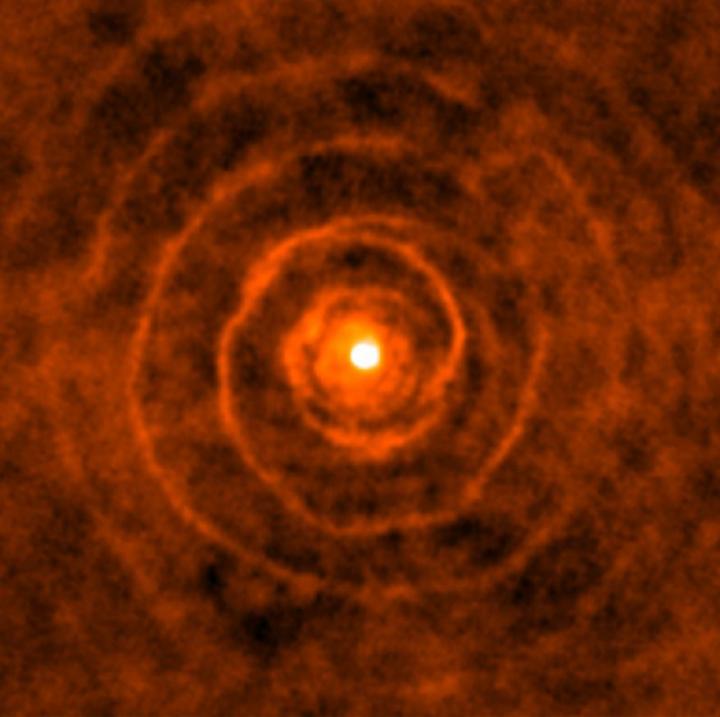
IMAGE

Credit: ALMA, Hyosun Kim

An international team of astronomers has observed a striking spiral pattern in the gas surrounding a red giant star named LL Pegasi and its companion star 3,400 light-years from Earth, using a powerful telescope in northern Chile called Atacama Large Millimeter/submillimeter Array, or ALMA.

"What we are seeing in splendid detail with these observations is the final act of a dying red giant star, as it sheds most of its gaseous bulk in a strong, outflowing wind," said study co-author Mark Morris, UCLA professor of physics and astronomy.

After comparing their telescopic observations with computer simulations, the astronomers concluded that a highly elliptical orbit is responsible for the shape of the gaseous emissions surrounding this system.

The research appears in the journal Nature Astronomy and is the cover story of the March issue.

"Because of the orbital motion of the mass-losing red giant, the cold molecular gas constituting the wind from that star is being spun out like the sprays of water from a rotating garden sprinkler, forming the outflowing pattern of spiral shells," Morris said.

ALMA, a powerful international facility operated cooperatively by many countries around the world including the United States, measures extremely short wavelength radio emission. Using this unique instrument, the scientists were able to create a three-dimensional image of the emission from molecules ejected from LL Pegasi and which then form a spiral pattern caused by the presence of the orbiting companion star.

The images, which show many complete revolutions of the spiral pattern, offer clues about the dynamics of the binary system over a period of 5,000 years.

"This unusually ordered system opens the door to understanding how the orbits of such systems evolve with time as one of the stars loses most of its mass," Morris said.

###

Hyosun Kim of Taiwan's Academia Sinica Institute of Astronomy and Astrophysics led the research team.

View video animations illustrating this research:

  • 3-D visualization of LL Pegasi, starting from a Hubble Space Telescope image
  • Molecular gas emission from LL Pegasi

Media Contact

Stuart Wolpert
[email protected]
310-206-0511
@uclanewsroom

http://www.newsroom.ucla.edu

############

Story Source: Materials provided by Scienmag

Share12Tweet8Share2ShareShareShare2

Related Posts

Confined Migration Causes DNA Damage in Neurons

June 18, 2026

Multimodal Multitask AI Transforms Lung Cancer Grading

June 18, 2026

New Study Seeks to Prolong Immune System Longevity

June 18, 2026

KAIST Creates Next-Generation Self-Powered Wearable Sensor withstanding 668% Stretch

June 18, 2026
Please login to join discussion

POPULAR NEWS

  • ESMO 2025: mRNA COVID Vaccines Enhance Efficacy of Cancer Immunotherapy

    326 shares
    Share 130 Tweet 82
  • Saying Goodbye to PGY-6: Pediatric Fellowship Realities

    102 shares
    Share 41 Tweet 26
  • Multi-Hospital Study Reveals Long Covid Burden Is Twice as High as Current Estimates

    92 shares
    Share 36 Tweet 23
  • Detection of EDCs in Breast Milk and Infant Urine Up to Six Months Highlights Early Exposure Risks

    76 shares
    Share 30 Tweet 19

About

We bring you the latest biotechnology news from best research centers and universities around the world. Check our website.

Follow us

Recent News

Confined Migration Causes DNA Damage in Neurons

Multimodal Multitask AI Transforms Lung Cancer Grading

New Study Seeks to Prolong Immune System Longevity

Subscribe to Blog via Email

Enter your email address to subscribe to this blog and receive notifications of new posts by email.

Join 82 other subscribers
  • Contact Us

Bioengineer.org © Copyright 2023 All Rights Reserved.

Welcome Back!

Login to your account below

Forgotten Password?

Retrieve your password

Please enter your username or email address to reset your password.

Log In
No Result
View All Result
  • Homepages
    • Home Page 1
    • Home Page 2
  • News
  • National
  • Business
  • Health
  • Lifestyle
  • Science

Bioengineer.org © Copyright 2023 All Rights Reserved.