“[…] our study brings attention to the potential influence of adolescent crystalized intelligence on age-related DNAm at older age.”
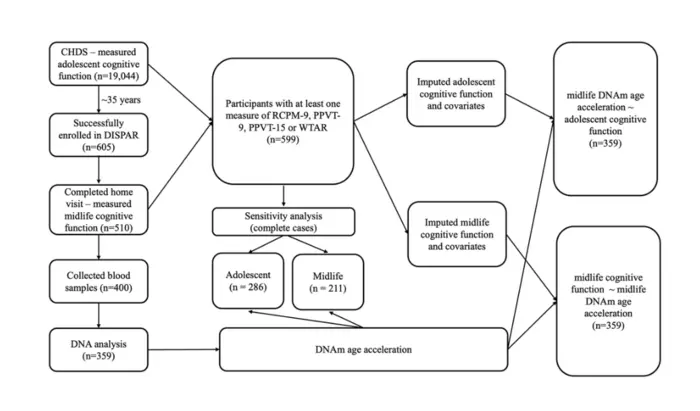
Credit: 2024 Chen et al.
“[…] our study brings attention to the potential influence of adolescent crystalized intelligence on age-related DNAm at older age.”
BUFFALO, NY- June 25, 2024 – A new research paper was published in Aging (listed by MEDLINE/PubMed as “Aging (Albany NY)” and “Aging-US” by Web of Science) Volume 16, Issue 11, entitled, “Associations of childhood, adolescence, and midlife cognitive function with DNA methylation age acceleration in midlife.”
Prior studies showed increased age acceleration (AgeAccel) is associated with worse cognitive function among old adults. In this new study, researchers Junyu Chen, Leah Moubadder, Elizabeth S. Clausing, Katrina L. Kezios, Karen N. Conneely, Anke Hüls, Andrea Baccarelli, Pam Factor-Litvak, Piera Cirrillo, Rachel C. Shelton, Bruce G. Link, and Shakira F. Suglia from Emory University, University of Nebraska, Columbia University, Public Health Institute, Washington, DC, and the University of California Riverside examined the associations of childhood, adolescence and midlife cognition with AgeAccel based on DNA methylation (DNAm) in midlife.
“To the best of our knowledge, this is the first study to show the association of cognition at younger age with midlife age acceleration, and associations between midlife age acceleration measures and cognitive function that are independent of childhood and adolescent cognition.”
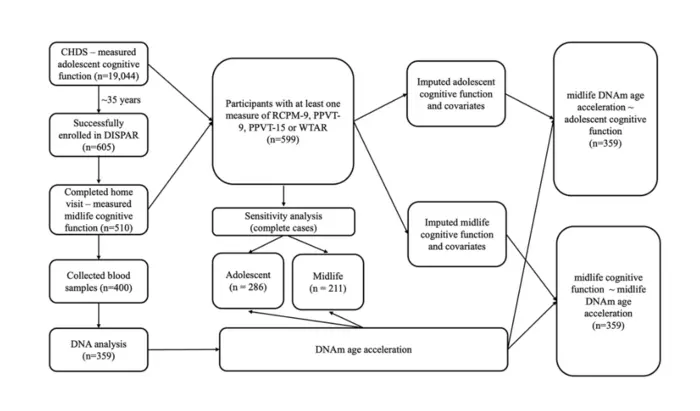
Data are from 359 participants who had cognition measured in childhood and adolescence in the Child Health and Development study, and had cognition, blood based DNAm measured during midlife in the Disparities study. Childhood cognition was measured by Raven’s Progressive Matrices and Peabody Picture Vocabulary Test (PPVT). Adolescent cognition was measured only by PPVT. Midlife cognition included Wechsler Test of Adult Reading (WTAR), Verbal Fluency (VF), Digit Symbol (DS). AgeAccel measures including Horvath, Hannum, PhenoAge, GrimAge and DunedinPACE were calculated from DNAm. Linear regressions adjusted for potential confounders were utilized to examine the association between each cognitive measure in relation to each AgeAccel.
There are no significant associations between childhood cognition and midlife AgeAccel. A 1-unit increase in adolescent PPVT, which measures crystalized intelligence, is associated with 0.048-year decrease of aging measured by GrimAge and this association is attenuated after adjustment for adult socioeconomic status. Midlife crystalized intelligence measure WTAR is negatively associated with PhenoAge and DunedinPACE, and midlife fluid intelligence measure (DS) is negatively associated with GrimAge, PhenoAge and DunedinPACE. AgeAccel is not associated with VF in midlife.
“In conclusion, our study showed the potential role of cognitive functions at younger ages in the process of biological aging. We also showed a potential relationship of both crystalized and fluid intelligence with aging acceleration.”
Read the full paper: DOI: https://doi.org/10.18632/aging.205943
Corresponding Author: Junyu Chen
Corresponding Email: [email protected]
Keywords: age acceleration, adolescent cognition, adult cognition, biological aging, epigenetics
Click here to sign up for free Altmetric alerts about this article.
About Aging:
The journal Aging aims to promote 1) treatment of age-related diseases by slowing down aging, 2) validation of anti-aging drugs by treating age-related diseases, and 3) prevention of cancer by inhibiting aging. (Cancer and COVID-19 are age-related diseases.)
Aging is indexed by PubMed/Medline (abbreviated as “Aging (Albany NY)”), PubMed Central, Web of Science: Science Citation Index Expanded (abbreviated as “Aging‐US” and listed in the Cell Biology and Geriatrics & Gerontology categories), Scopus (abbreviated as “Aging” and listed in the Cell Biology and Aging categories), Biological Abstracts, BIOSIS Previews, EMBASE, META (Chan Zuckerberg Initiative) (2018-2022), and Dimensions (Digital Science).
Please visit our website at www.Aging-US.com and connect with us:
- X, formerly Twitter
- YouTube
- Spotify, and available wherever you listen to podcasts
Click here to subscribe to Aging publication updates.
For media inquiries, please contact [email protected].
Aging (Aging-US) Journal Office
6666 E. Quaker Str., Suite 1B
Orchard Park, NY 14127
Phone: 1-800-922-0957, option 1
###
Journal
Aging-US
DOI
10.18632/aging.205943
Method of Research
Observational study
Subject of Research
People
Article Title
Associations of childhood, adolescence, and midlife cognitive function with DNA methylation age acceleration in midlife
Article Publication Date
13-Jun-2024