• HOME
  • NEWS
  • EXPLORE
    • CAREER
      • Companies
      • Jobs
    • EVENTS
    • iGEM
      • News
      • Team
    • PHOTOS
    • VIDEO
    • WIKI
  • BLOG
  • COMMUNITY
    • FACEBOOK
    • INSTAGRAM
    • TWITTER
Wednesday, May 27, 2026
BIOENGINEER.ORG
No Result
View All Result
  • Login
  • HOME
  • NEWS
  • EXPLORE
    • CAREER
      • Companies
      • Jobs
        • Lecturer
        • PhD Studentship
        • Postdoc
        • Research Assistant
    • EVENTS
    • iGEM
      • News
      • Team
    • PHOTOS
    • VIDEO
    • WIKI
  • BLOG
  • COMMUNITY
    • FACEBOOK
    • INSTAGRAM
    • TWITTER
  • HOME
  • NEWS
  • EXPLORE
    • CAREER
      • Companies
      • Jobs
        • Lecturer
        • PhD Studentship
        • Postdoc
        • Research Assistant
    • EVENTS
    • iGEM
      • News
      • Team
    • PHOTOS
    • VIDEO
    • WIKI
  • BLOG
  • COMMUNITY
    • FACEBOOK
    • INSTAGRAM
    • TWITTER
No Result
View All Result
Bioengineer.org
No Result
View All Result
Home NEWS Science News

Assassins on the rise: A new species and a new tribe of endemic South African robber flies

Bioengineer by Bioengineer
December 6, 2016
in Science News
Reading Time: 2 mins read
0
Share on FacebookShare on TwitterShare on LinkedinShare on RedditShare on Telegram
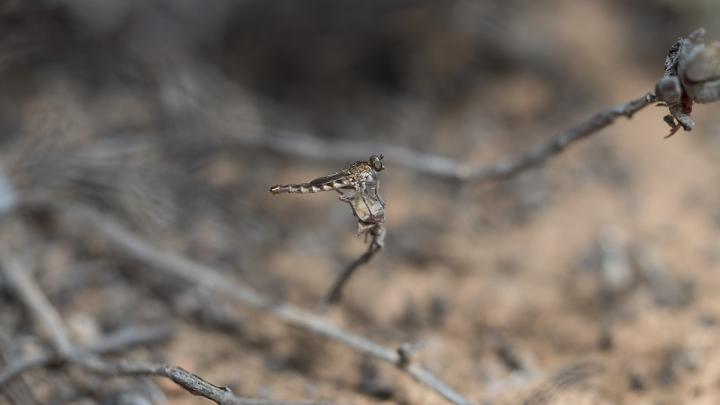
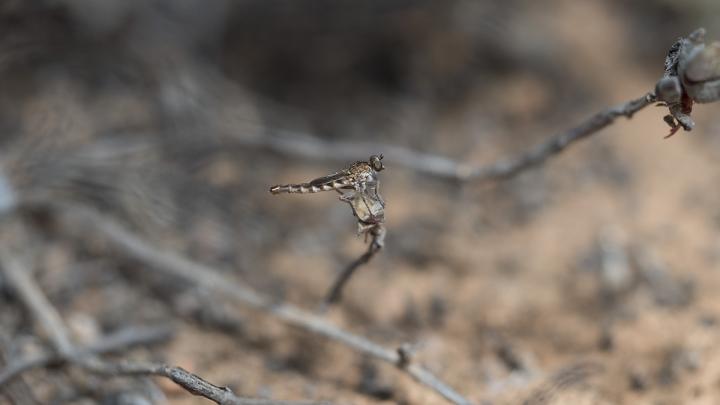
IMAGE

Credit: Torsten Dikow

Discovery of a new species of assassin flies led to the redescription of its genus. This group of curious predatory flies live exclusively in South Africa, preferring relatively dry habitats. Following the revisit, authors Drs Jason Londt, KwaZulu-Natal Museum, South Africa, and Torsten Dikow, Smithsonian Institution National Museum of Natural History, USA, publish updated information about all species within the genus, now counting a total of seven species, and also establish a new tribe. Their study is published in the open access journal African Invertebrates.

The family of assassin flies (Asilidae), also known as robber flies, are curious insects, which have received their common name due to their extremely predatory behavior. The assassin flies prey on a great variety of insects, including beetles, moths, butterflies, wasps, other flies, as well as some spiders, as early as their juvenile stage of development. When hunting, they would ambush their prey and catch it in flight. Then, they would pierce the victim with a short and strong proboscis, while injecting venom. Once in the body of the prey, it quickly dissolves the insides, so that the assassin fly can suck them out.

The published study was spawned by the collection of new specimens of previously described assassin flies of the species Trichoura tankwa by the junior author in December 2015. These specimens could not be easily identified and so the authors started to look at all available specimens in natural history museums.

The new species, called Trichoura pardeos, was discovered in Tierberg Nature Reserve by the authors in 2004, a small conservation area located on the north banks of the Gariep River in the Northern Cape province of South Africa. The habitat comprises almost entirely a large rocky hill, where the vegetation is scarce and dominated by drought-resistant plants, such as aloes. The fly is predominantly red-brown in colour, with silvery, white and yellowish markings.

Having noted morphological variation between the species inhabiting areas with differently timed yearly rainfalls, the entomologists suggest that two groups within the studied genus have adapted to these different patterns in western and eastern South Africa. They also expect that species representing Trichoura could be also dwelling in Namibia, Botswana, Mozambique and possibly Zimbabwe.

###

Original source:

Londt J, Dikow T (2016) A review of the genus Trichoura Londt, 1994 with the description of a new species from the Northern Cape Province of South Africa and a key to world Willistonininae (Diptera, Asilidae). African Invertebrates 57(2): 119-135. https://doi.org/10.3897/AfrInvertebr.57.10772

Media Contact

Dr. Torsten Dikow
[email protected]
@Pensoft

http://www.pensoft.net

############

Story Source: Materials provided by Scienmag

Share12Tweet8Share2ShareShareShare2

Related Posts

Personalized Brain Circuit Dysfunction Drives Parkinson’s Motor Symptoms

May 27, 2026

Hypertension’s Hidden Impact on Obesity-Linked Atherosclerosis

May 27, 2026

Ultraviolet to Mid-Infrared Supercontinuum in Lithium Tantalate

May 27, 2026

ICU Pneumonia Mortality Rates: 37%-60% in Middle-Income vs. 16%-26% in High-Income Countries

May 27, 2026
Please login to join discussion

POPULAR NEWS

  • ESMO 2025: mRNA COVID Vaccines Enhance Efficacy of Cancer Immunotherapy

    317 shares
    Share 127 Tweet 79
  • New Study Reveals Plants Can Detect the Sound of Rain

    735 shares
    Share 293 Tweet 183
  • Common Food Preservatives Associated with Elevated Blood Pressure and Increased Heart Disease Risk

    56 shares
    Share 22 Tweet 14
  • AI-Powered Atlas Uncovers Extensive Whole-Body Damage Linked to Obesity

    53 shares
    Share 21 Tweet 13

About

We bring you the latest biotechnology news from best research centers and universities around the world. Check our website.

Follow us

Recent News

Personalized Brain Circuit Dysfunction Drives Parkinson’s Motor Symptoms

Hypertension’s Hidden Impact on Obesity-Linked Atherosclerosis

Ultraviolet to Mid-Infrared Supercontinuum in Lithium Tantalate

Subscribe to Blog via Email

Success! An email was just sent to confirm your subscription. Please find the email now and click 'Confirm' to start subscribing.

Join 82 other subscribers
  • Contact Us

Bioengineer.org © Copyright 2023 All Rights Reserved.

Welcome Back!

Login to your account below

Forgotten Password?

Retrieve your password

Please enter your username or email address to reset your password.

Log In
No Result
View All Result
  • Homepages
    • Home Page 1
    • Home Page 2
  • News
  • National
  • Business
  • Health
  • Lifestyle
  • Science

Bioengineer.org © Copyright 2023 All Rights Reserved.