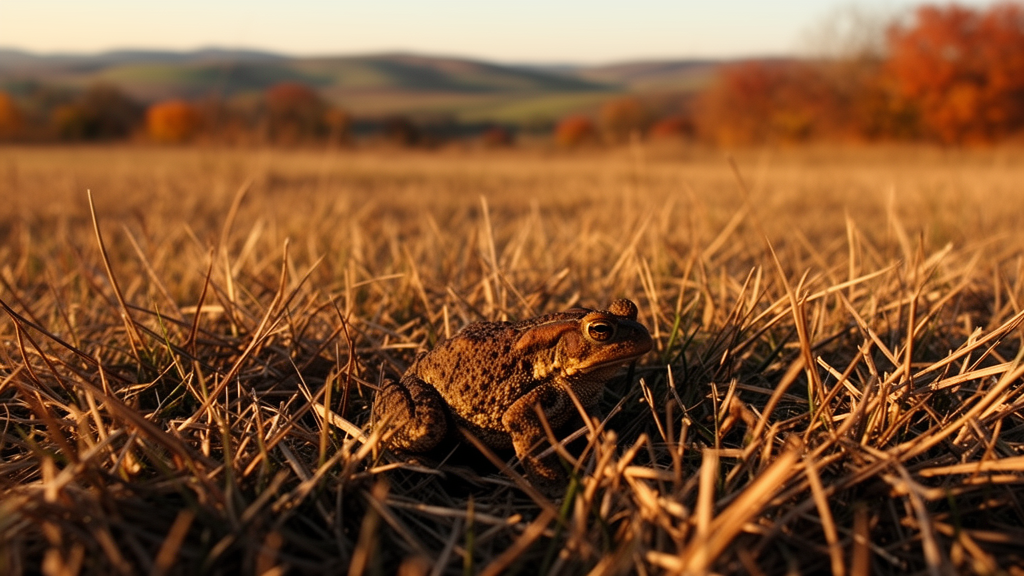
Understanding the spatial behavior of amphibians is a critical component of effective conservation strategy, yet data on the Asiatic toad, Bufo gargarizans, in South Korea has remained surprisingly sparse. While this species is widely distributed across northeast Asia and classified as Least Concern by the International Union for Conservation of Nature, its ecological dynamics outside of the breeding season are poorly documented. Recent research published in the journal Herpetozoa addresses this gap by examining the movement patterns and habitat use of these toads during the pre-hibernation period. By utilizing radiotelemetry, researchers have provided a detailed baseline of how these animals navigate their environment as they prepare for the winter dormancy that is essential for their survival.
The study was conducted at a pond in Jinsang-myeon, Gwangyang-si, Jeollanam-do, South Korea, which serves as an annual breeding site for the species. Field surveys took place between August and November, targeting the non-breeding season prior to hibernation. Researchers tracked 28 individuals, comprising 16 males and 12 females, using lightweight radio transmitters that weighed less than 5% of the animals’ body mass to minimize behavioral impact. The tracked toads exhibited significant sexual dimorphism, with females being substantially larger than males in both body mass and snout-vent length. This size difference is typical for the species and may influence their energy requirements and movement capabilities during the critical pre-hibernation phase.
One of the most striking findings from the radiotelemetry data was the high frequency of immobility observed among the toads. Out of 415 calculated distances between consecutive locations, 284 instances recorded zero movement, meaning that nearly 68% of the time, the toads remained in the exact same spot. When movement did occur, the average distance between locations was approximately 32.1 meters, with a range extending up to 360.9 meters. This pattern suggests that Bufo gargarizans adopts a strategy of minimal displacement, prioritizing the selection of optimal microhabitats over extensive roaming. This behavior is likely an adaptive mechanism to conserve energy while preparing for the physiological demands of hibernation.
Environmental factors played a significant role in determining when the toads moved. Correlation analysis revealed that movement distances increased with higher minimum temperatures, precipitation, and humidity, while decreasing with a larger daily temperature range. On dry days, the toads tended to remain sheltered under structures such as dry leaves, rocks, or artificial objects. In contrast, rainy days prompted them to remain outside or move around more frequently. This sensitivity to moisture is consistent with the physiological characteristics of the Bufonidae family, which possesses thick skin that provides resistance to dry environments but can still suffer from accelerated water loss under extreme conditions. The toads appear to capitalize on favorable weather conditions to move, while remaining stationary during drier periods to minimize water loss.
Home range estimation was performed using two distinct methods: the minimum convex polygon (MCP) and kernel density estimation (KDE). The MCP method, which defines the general area inhabited by the toads, yielded an average home range size of 2,484.0 square meters for all individuals. In contrast, the KDE method, which estimates a potential buffer zone within which the toads may move, produced a much larger average of 55,004.9 square meters. These estimates highlight the difference between the core area where the toads are consistently found and the broader potential area they could access. The use of both methods allows for a more comprehensive understanding of the species’ spatial requirements, distinguishing between actual habitat use and potential habitat availability.
Land use analysis within these home ranges revealed a strong preference for specific habitat types. Regardless of the analysis method or the sex of the toad, over 50% of the habitat consisted of grassland. Approximately 20% of the habitat was classified as used areas, which include zones of human activity such as residential and industrial zones. This preference for grassy habitats aligns with previous studies on other bufonid species, which often favor open, sparsely vegetated areas. The toads’ thick skin likely allows them to tolerate the drier conditions found in grasslands compared to more aquatic habitats. This finding is crucial for conservation planning, as it indicates that maintaining grassland areas is vital for the long-term survival of Bufo gargarizans populations.
Sexual differences in habitat distribution were also observed, although no significant differences were found in movement patterns or home range size. Males were primarily distributed at lower altitudes near the breeding sites, while females were concentrated at higher altitudes around valley areas. This spatial segregation suggests that males and females may have different microhabitat preferences or energy strategies during the pre-hibernation period. Males, being smaller, may require less energy to maintain their position near the breeding pond, whereas females, with their larger body size and higher energy reserves, may be able to disperse to higher elevations. This pattern is consistent with other amphibian species where females often occupy habitats at greater distances from water bodies.
The findings of this study have significant implications for the conservation and management of Bufo gargarizans in South Korea. By identifying the specific habitat types and movement patterns of the toads during the pre-hibernation period, researchers can develop more targeted conservation strategies. The MCP home range can serve as a foundation for establishing protected areas, while the KDE home range can be considered a potential habitat buffer zone. This approach facilitates effective habitat evaluation and management, ensuring that both the core habitats and the surrounding buffer zones are preserved. Furthermore, the study highlights the importance of monitoring common species, as they can serve as valuable models for developing universal conservation measures.
In conclusion, this research provides essential baseline data on the pre-hibernation ecology of the Asiatic toad. The species exhibits a strategy of minimal movement, with activity levels closely tied to environmental conditions such as humidity and temperature. Their home ranges are predominantly composed of grassland and used areas, with males and females showing distinct spatial distributions. These insights enhance our understanding of the species’ life cycle and provide a scientific basis for future conservation efforts. As climate change and habitat fragmentation continue to threaten amphibian populations, detailed studies like this one are crucial for ensuring the long-term preservation of Bufo gargarizans and other common species that play vital roles in ecological dynamics.
Subject of Research: Pre-hibernation movement patterns and habitat use of the Asiatic toad (Bufo gargarizans) in South Korea
Article Title: Movement patterns and habitat use within the home range of the Asiatic toad ( Bufo gargarizans ) prior to hibernation
Article References: Park, S.-M., Rahman, M. M., Ham, C.-H., Park, S.-W., Kang, H.-J., & Sung, H.-C. (2025). Movement patterns and habitat use within the home range of the Asiatic toad (Bufo gargarizans) prior to hibernation. Herpetozoa, 38, 77-85. https://doi.org/10.3897/herpetozoa.38.e141683
Image Credits: AI Generated
DOI: 10.3897/herpetozoa.38.e141683
Keywords: Asiatic toad, Bufo gargarizans, radiotelemetry, home range, amphibian ecology, habitat use, pre-hibernation, South Korea, conservation biology, movement patterns, Movement, patterns
News Source: Drew Townsend. (October 18, 2026). Asiatic Toads Prioritize Stillness and Grasslands Before Hibernation. Scienmag.