• HOME
  • NEWS
  • EXPLORE
    • CAREER
      • Companies
      • Jobs
    • EVENTS
    • iGEM
      • News
      • Team
    • PHOTOS
    • VIDEO
    • WIKI
  • BLOG
  • COMMUNITY
    • FACEBOOK
    • INSTAGRAM
    • TWITTER
Wednesday, October 28, 2026
BIOENGINEER.ORG
No Result
View All Result
  • Login
  • HOME
  • NEWS
  • EXPLORE
    • CAREER
      • Companies
      • Jobs
        • Lecturer
        • PhD Studentship
        • Postdoc
        • Research Assistant
    • EVENTS
    • iGEM
      • News
      • Team
    • PHOTOS
    • VIDEO
    • WIKI
  • BLOG
  • COMMUNITY
    • FACEBOOK
    • INSTAGRAM
    • TWITTER
No Result
View All Result
Bioengineer.org
No Result
View All Result
Home NEWS Science News Health

Artificial synapses that release neurotransmitters aim to go beyond electrical stimulation

by
October 28, 2026
in Health, Technology
Reading Time: 2 mins read
0
Artificial synapses that release neurotransmitters aim to go beyond electrical stimulation

Artificial synapses that release neurotransmitters aim to go beyond electrical stimulation

Share on FacebookShare on TwitterShare on LinkedinShare on RedditShare on Telegram

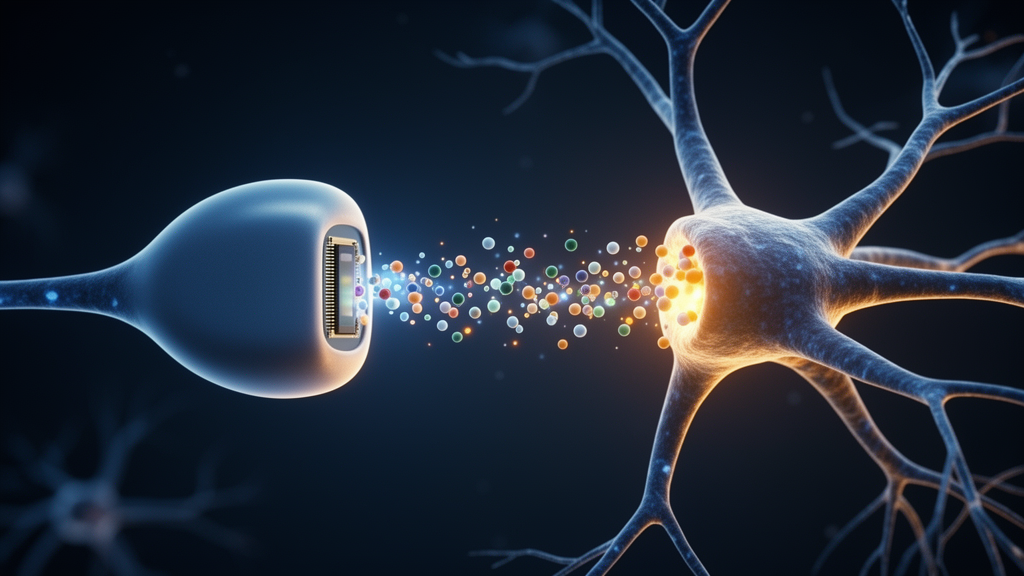
Neurological disorders often involve synaptic dysfunction and imbalances in neurotransmitter signalling, but the two main ways of intervening—systemic drugs and implanted electrodes—both fall short in important ways.

Conventional pharmacological treatment lacks spatiotemporal precision, meaning drugs act everywhere in the body and at all times rather than at a chosen synapse at a chosen moment. Traditional electrical stimulation, meanwhile, is limited by chronic gliosis—the scarring response that progressively insulates implanted electrodes—and by its reliance on intact synaptic machinery, which is exactly what many diseases damage. An artificial synapse is designed to sidestep both limits by delivering the actual chemical messenger, mimicking what a healthy neuron would release.

The review surveys the engineering landscape behind this idea. Current designs range from stimulus-responsive nanocarriers that release cargo on demand, through microfluidic platforms that channel fluids at small scales, to advanced organic electronic ion pumps that translate electronic signals into ion flow, and closed-loop neuromorphic architectures that sense and respond in real time. These are described as significant engineering milestones, and the perspective presents them as a conceptual framework for the field rather than as devices already in clinical use.

That distinction matters, because the authors are blunt about what still stands between the laboratory and the operating theatre. Mechanical implantation trauma remains a challenge, since inserting any device into dense neural tissue damages it. Off-target diffusion is another: a neurotransmitter released at a target site can spread to neighbouring circuits in dense tissue, blurring the very precision the device is meant to provide. And every design so far carries a finite neurotransmitter reservoir, which raises the practical question of refilling; the authors discuss subcutaneous refill ports as a pragmatic transitional solution.

Looking further ahead, the perspective examines the feasibility and what it calls the profound immunological risks of future in situ neurotransmitter synthesis—having the implant manufacture its own chemical supply inside the body. The central message is that bridging the gap between materials science and neurosurgical reality is essential if next-generation adaptive biohybrid interfaces are ever to reach patients.

Subject of Research: Neurotransmitter-mediated artificial synapses as an alternative to electrical neural stimulation

Article Title: Beyond electrical stimulation: toward neurotransmitter-mediated synaptic prostheses

Article References: Faber, P., & Krukiewicz, K. (2026). Beyond electrical stimulation: toward neurotransmitter-mediated synaptic prostheses. Biomedical Materials Science, 1(1), Article 10. https://doi.org/10.1186/s44495-026-00010-5

Image Credits: AI Generated

DOI: 10.1186/s44495-026-00010-5

Keywords: artificial synapses, neurotransmitters, synaptic prostheses, bioelectronics, electrical stimulation, neural interfaces, organic electronic ion pumps, microfluidics, neuromorphic devices, gliosis, drug delivery, neurosurgery

News Source: Denise Maddox. (October 28, 2026). Artificial synapses that release neurotransmitters aim to go beyond electrical stimulation. Scienmag.


Tags: artificial synapsesBioelectronicsDrug deliveryelectrical stimulationgliosismicrofluidicsneural interfacesneuromorphic devicesneurosurgeryneurotransmittersorganic electronic ion pumpssynaptic prostheses
Share12Tweet7Share2ShareShareShare1

Related Posts

Transgenic rice lines show stable vaccine antigen production over three generations

Transgenic rice lines show stable vaccine antigen production over three generations

October 28, 2026
Four Chemical Markers Reveal How Desert Medicinal Plant Adapts to Saline-Alkali Soil

Four Chemical Markers Reveal How Desert Medicinal Plant Adapts to Saline-Alkali Soil

October 28, 2026

New framework makes brain age gap explanations more stable and calibrated

October 28, 2026

Danicopan added to ravulizumab eased anemia in a PNH case report

October 28, 2026

POPULAR NEWS

  • Screen Time and Sleep: Pakistani Students Show Heavy Device Use, Poor Rest

    Screen Time and Sleep: Pakistani Students Show Heavy Device Use, Poor Rest

    29 shares
    Share 12 Tweet 7
  • National learning forums in Lao PDR show rising participation in healthcare quality improvement

    29 shares
    Share 12 Tweet 7
  • Most German parents say they understand and use food labels, survey finds

    29 shares
    Share 12 Tweet 7
  • Chinese Medicine Workforce in Australia Shrinks as Pay and Job Security Drive Exits

    29 shares
    Share 12 Tweet 7

About

We bring you the latest biotechnology news from best research centers and universities around the world. Check our website.

Follow us

Recent News

Transgenic rice lines show stable vaccine antigen production over three generations

Four Chemical Markers Reveal How Desert Medicinal Plant Adapts to Saline-Alkali Soil

Mouse lung lobes already differ molecularly before birth, study finds

Subscribe to Blog via Email

Enter your email address to subscribe to this blog and receive notifications of new posts by email.

Join 85 other subscribers
  • Contact Us

Bioengineer.org © Copyright 2023 All Rights Reserved.

Welcome Back!

Login to your account below

Forgotten Password?

Retrieve your password

Please enter your username or email address to reset your password.

Log In
No Result
View All Result
  • Homepages
    • Home Page 1
    • Home Page 2
  • News
  • National
  • Business
  • Health
  • Lifestyle
  • Science

Bioengineer.org © Copyright 2023 All Rights Reserved.