• HOME
  • NEWS
  • EXPLORE
    • CAREER
      • Companies
      • Jobs
    • EVENTS
    • iGEM
      • News
      • Team
    • PHOTOS
    • VIDEO
    • WIKI
  • BLOG
  • COMMUNITY
    • FACEBOOK
    • INSTAGRAM
    • TWITTER
Saturday, May 16, 2026
BIOENGINEER.ORG
No Result
View All Result
  • Login
  • HOME
  • NEWS
  • EXPLORE
    • CAREER
      • Companies
      • Jobs
        • Lecturer
        • PhD Studentship
        • Postdoc
        • Research Assistant
    • EVENTS
    • iGEM
      • News
      • Team
    • PHOTOS
    • VIDEO
    • WIKI
  • BLOG
  • COMMUNITY
    • FACEBOOK
    • INSTAGRAM
    • TWITTER
  • HOME
  • NEWS
  • EXPLORE
    • CAREER
      • Companies
      • Jobs
        • Lecturer
        • PhD Studentship
        • Postdoc
        • Research Assistant
    • EVENTS
    • iGEM
      • News
      • Team
    • PHOTOS
    • VIDEO
    • WIKI
  • BLOG
  • COMMUNITY
    • FACEBOOK
    • INSTAGRAM
    • TWITTER
No Result
View All Result
Bioengineer.org
No Result
View All Result
Home NEWS Science News Biology

Artificial ‘skin’ gives robotic hand a sense of touch

Bioengineer by Bioengineer
February 11, 2018
in Biology
Reading Time: 2 mins read
0
Share on FacebookShare on TwitterShare on LinkedinShare on RedditShare on Telegram
IMAGE

Credit: University of Houston

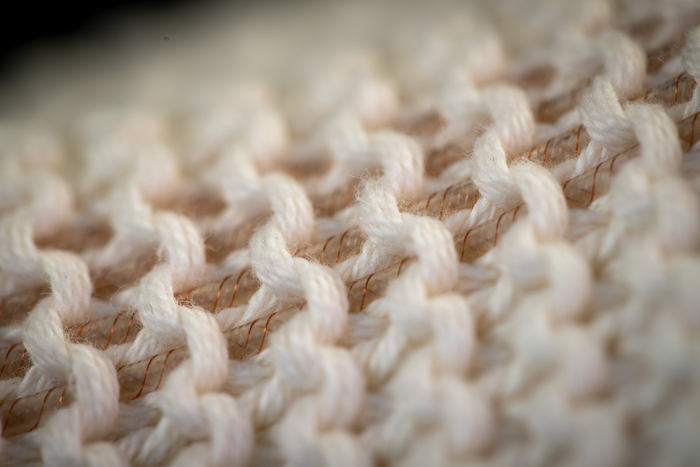
A team of researchers from the University of Houston has reported a breakthrough in stretchable electronics that can serve as an artificial skin, allowing a robotic hand to sense the difference between hot and cold, while also offering advantages for a wide range of biomedical devices.

The work, reported in the journal Science Advances, describes a new mechanism for producing stretchable electronics, a process that relies upon readily available materials and could be scaled up for commercial production.

Cunjiang Yu, Bill D. Cook Assistant Professor of mechanical engineering and lead author for the paper, said the work is the first to create a semiconductor in a rubber composite format, designed to allow the electronic components to retain functionality even after the material is stretched by 50 percent.

The work is the first semiconductor in rubber composite format that enables stretchability without any special mechanical structure, Yu said.

He noted that traditional semiconductors are brittle and using them in otherwise stretchable materials has required a complicated system of mechanical accommodations. That's both more complex and less stable than the new discovery, as well as more expensive, he said.

"Our strategy has advantages for simple fabrication, scalable manufacturing, high-density integration, large strain tolerance and low cost," he said.

Yu and the rest of the team – co-authors include first author Hae-Jin Kim, Kyoseung Sim and Anish Thukral, all with the UH Cullen College of Engineering – created the electronic skin and used it to demonstrate that a robotic hand could sense the temperature of hot and iced water in a cup. The skin also was able to interpret computer signals sent to the hand and reproduce the signals as American Sign Language.

"The robotic skin can translate the gesture to readable letters that a person like me can understand and read," Yu said.

The artificial skin is just one application. Researchers said the discovery of a material that is soft, bendable, stretchable and twistable will impact future development in soft wearable electronics, including health monitors, medical implants and human-machine interfaces.

The stretchable composite semiconductor was prepared by using a silicon-based polymer known as polydimethylsiloxane, or PDMS, and tiny nanowires to create a solution that hardened into a material which used the nanowires to transport electric current.

"We foresee that this strategy of enabling elastomeric semiconductors by percolating semiconductor nanofibrils into a rubber will advance the development of stretchable semiconductors, and … will move forward the advancement of stretchable electronics for a wide range of applications, such as artificial skins, biomedical implants and surgical gloves," they wrote.

###

Media Contact

Jeannie Kever
[email protected]
713-743-0778
@UH_News

http://www.uh.edu/news-events

Original Source

http://www.uh.edu/news-events/stories/2017/SEPTEMBER%2017/09132017Yu-Stretchy-Electronics.php

Share12Tweet8Share2ShareShareShare2

Related Posts

Uncovering C. elegans Immunity via Genetic Screens — Biology

Uncovering C. elegans Immunity via Genetic Screens

May 16, 2026
Single mother must adapt swiftly — the survival of her colony depends on it — Biology

Single mother must adapt swiftly — the survival of her colony depends on it

May 15, 2026

Why Are Nearly Everyone Right-Handed? It Might Be Linked to How We Learned to Walk

May 15, 2026

Excessive Neuronal Activity Initiates Severe Autoimmune Brain Disorder

May 15, 2026
Please login to join discussion

POPULAR NEWS

  • Research Indicates Potential Connection Between Prenatal Medication Exposure and Elevated Autism Risk

    844 shares
    Share 338 Tweet 211
  • New Study Reveals Plants Can Detect the Sound of Rain

    730 shares
    Share 291 Tweet 182
  • Salmonella Haem Blocks Macrophages, Boosts Infection

    62 shares
    Share 25 Tweet 16
  • Breastmilk Balances E. coli and Beneficial Bacteria in Infant Gut Microbiomes

    58 shares
    Share 23 Tweet 15

About

We bring you the latest biotechnology news from best research centers and universities around the world. Check our website.

Follow us

Recent News

Short-Term Home Cognitive & Physical Training Tested in Seniors

Stress Evolution and Time Control in Retreat Roadways

New Kineococcus Species Discovered on Anabasis Seeds

Subscribe to Blog via Email

Enter your email address to subscribe to this blog and receive notifications of new posts by email.

Join 82 other subscribers
  • Contact Us

Bioengineer.org © Copyright 2023 All Rights Reserved.

Welcome Back!

Login to your account below

Forgotten Password?

Retrieve your password

Please enter your username or email address to reset your password.

Log In
No Result
View All Result
  • Homepages
    • Home Page 1
    • Home Page 2
  • News
  • National
  • Business
  • Health
  • Lifestyle
  • Science

Bioengineer.org © Copyright 2023 All Rights Reserved.