• HOME
  • NEWS
  • EXPLORE
    • CAREER
      • Companies
      • Jobs
    • EVENTS
    • iGEM
      • News
      • Team
    • PHOTOS
    • VIDEO
    • WIKI
  • BLOG
  • COMMUNITY
    • FACEBOOK
    • INSTAGRAM
    • TWITTER
Thursday, June 25, 2026
BIOENGINEER.ORG
No Result
View All Result
  • Login
  • HOME
  • NEWS
  • EXPLORE
    • CAREER
      • Companies
      • Jobs
        • Lecturer
        • PhD Studentship
        • Postdoc
        • Research Assistant
    • EVENTS
    • iGEM
      • News
      • Team
    • PHOTOS
    • VIDEO
    • WIKI
  • BLOG
  • COMMUNITY
    • FACEBOOK
    • INSTAGRAM
    • TWITTER
  • HOME
  • NEWS
  • EXPLORE
    • CAREER
      • Companies
      • Jobs
        • Lecturer
        • PhD Studentship
        • Postdoc
        • Research Assistant
    • EVENTS
    • iGEM
      • News
      • Team
    • PHOTOS
    • VIDEO
    • WIKI
  • BLOG
  • COMMUNITY
    • FACEBOOK
    • INSTAGRAM
    • TWITTER
No Result
View All Result
Bioengineer.org
No Result
View All Result
Home NEWS Science News Chemistry

Artificial intelligence is becoming sustainable!

Bioengineer by Bioengineer
February 13, 2020
in Chemistry
Reading Time: 2 mins read
0
IMAGE
Share on FacebookShare on TwitterShare on LinkedinShare on RedditShare on Telegram

The Politecnico di Milano develops a new generation of computing accelerators
IMAGE

Credit: Politecnico di Milano


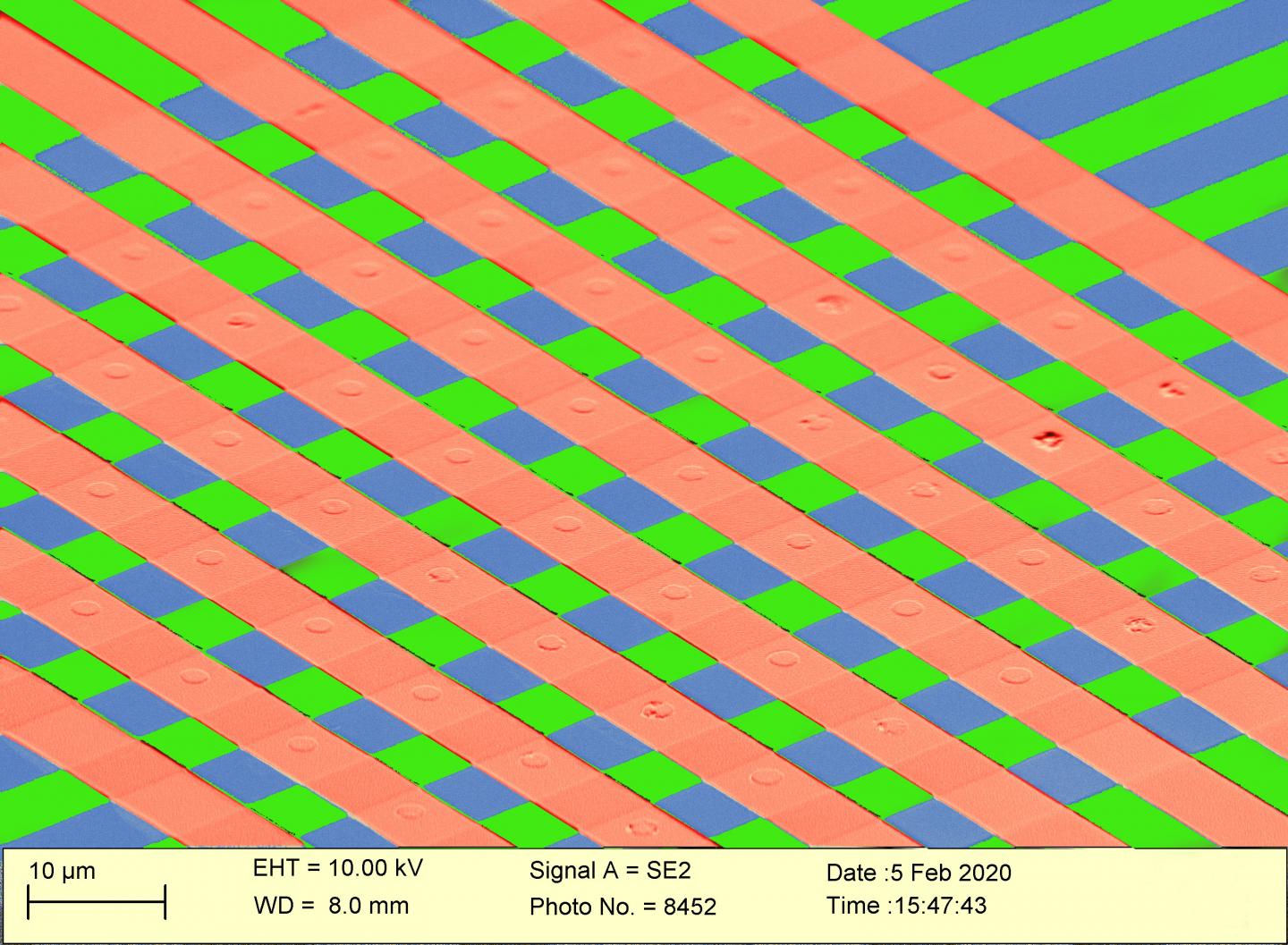
A research group from Politecnico di Milano has developed a new computing circuit that can execute advanced operations, typical of neural networks for artificial intelligence, in one single operation.

The circuit performance in terms of speed and energy consumption paves the way for a new generation of artificial intelligence computing accelerators that are more energy efficient and more sustainable on a global scale. The study has been recently published in the prestigious Science Advances.

Recognizing a face or an object, or correctly interpreting a word or a musical tune are operations that are today possible on the most common electronic gadgets, such as smartphones and tablets, thanks to artificial intelligence. For this to happen, complicated neural networks needs to be appropriately trained, which is so energetically demanding that, according to some studies, the carbon footprint that derives from the training of a complex neural network can equal the emission of 5 cars throughout their whole life cycle.

To reduce the time and energy consumption of the training, one should develop circuits that are radically different from the conventional approach and that are able to mimic more accurately the structure of the neural networks and the characteristics of the biological synapses. A typical example is the concept of in-memory computing, where data are processed directly within the memory, exactly like in the human brain.

Based on this analogy, the research group at Politecnico di Milano have developed a novel circuit that can execute a mathematical function known as regression in just one operation. For this purpose they use a resistive memory, also known as memristor, a device that can memorize any datum (for example the value of a share at a certain time) in the value of its resistance. By arranging these memory elements within an array with the size of a few micrometer (a few millionths of a meter), the group at Politecnico di Milano has been able to execute a linear regression on a group of data. This operation is capable of determining the straight line that best describes a sequence of data, allowing, for instance, to predict the trend in the stock market based on a simple linear model. Logistical regression, that allows to classify data within a database, has also been demonstrated. This function is essential for the so-called recommendation systems, that are a crucial marketing tools for online purchases.

###

Media Contact
Cristina Perini
[email protected]
39-022-399-2508

Original Source

https://www.polimi.it/?id=3936&tx_wfqbe_pi1[id]=1143

Related Journal Article

http://dx.doi.org/10.1126/sciadv.aay2378

Tags: Calculations/Problem-SolvingComputer ScienceNanotechnology/MicromachinesTechnology/Engineering/Computer Science
Share12Tweet8Share2ShareShareShare2

Related Posts

International Team Including Dresden Scientists Develops Novel Designer Proteins for Advanced Study of Living Tissue

June 25, 2026

New Study Uncovers Key Factors Driving Water Chemistry in Nanoscale Environments

June 25, 2026

Plasma Technology Extends Catalyst Lifespan in Hydrogen Production

June 24, 2026

Electric Field and Oxygen Spillover Collaborate to Control Electrode Migration in SOECs

June 24, 2026
Please login to join discussion

POPULAR NEWS

  • Saying Goodbye to PGY-6: Pediatric Fellowship Realities

    103 shares
    Share 41 Tweet 26
  • Multi-Hospital Study Reveals Long Covid Burden Is Twice as High as Current Estimates

    92 shares
    Share 36 Tweet 23
  • Detection of EDCs in Breast Milk and Infant Urine Up to Six Months Highlights Early Exposure Risks

    77 shares
    Share 31 Tweet 19
  • New Drug Candidate Developed at McMaster Shows Potential for Treating Brain Cancer

    58 shares
    Share 23 Tweet 15

About

We bring you the latest biotechnology news from best research centers and universities around the world. Check our website.

Follow us

Recent News

Energy-Saving Membrane Technology Developed by KAIST and Georgia Tech Enables Crude Oil Separation Without Boiling

Cracking the Code: How Cancer Evades Antibody-Drug Conjugates and New Strategies to Overcome Resistance

Chiral Laser Gyroscopes Surpass Lock-In Limit

Subscribe to Blog via Email

Enter your email address to subscribe to this blog and receive notifications of new posts by email.

Join 82 other subscribers
  • Contact Us

Bioengineer.org © Copyright 2023 All Rights Reserved.

Welcome Back!

Login to your account below

Forgotten Password?

Retrieve your password

Please enter your username or email address to reset your password.

Log In
No Result
View All Result
  • Homepages
    • Home Page 1
    • Home Page 2
  • News
  • National
  • Business
  • Health
  • Lifestyle
  • Science

Bioengineer.org © Copyright 2023 All Rights Reserved.