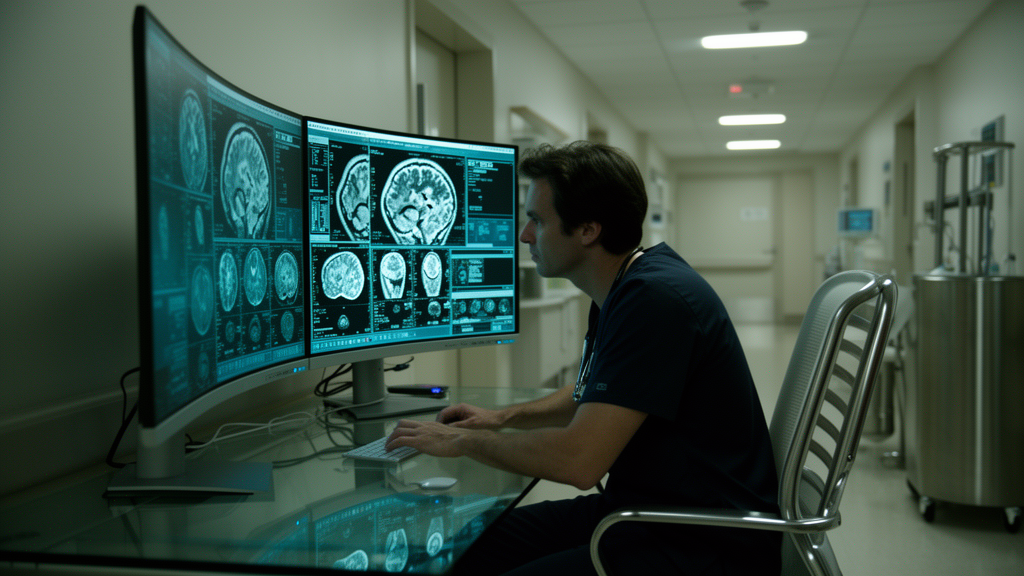
In a systematic review published in The Egyptian Journal of Neurology, Psychiatry and Neurosurgery, researcher Yan Pan reports that artificial intelligence technologies have swiftly progressed from theoretical exploration into clinical practice for acute ischemic stroke. Deep learning and machine learning models demonstrate measurable potential in automated image analysis, aiding in the identification of critical vascular blockages and the rapid evaluation of compromised cerebral tissue. Because acute ischemic stroke represents a major cause of disability and death worldwide, emergency medical management depends fundamentally on seizing every minute during the initial intervention window. The paper synthesizes evidence across the entire care pathway, detailing how computational models assist clinicians in evaluating extensive imaging data, reducing human-induced variations, and boosting diagnostic consistency during urgent acute-phase clinical encounters.
The most prominent clinical achievements highlighted in the review center on automated neuroimaging evaluation and anatomical scoring. Furthermore, these algorithmic tools reliably perform the automated detection of large vessel occlusions on diagnostic scans. This computational integration provides crucial technical support for shortening the critical “door-to-puncture” time window and optimizing patient screening, substantially improving the overall speed, consistency, and efficiency of acute radiological assessments when timely decisions are paramount.
Beyond immediate acute-phase imaging, the review surveys the broader implementation of artificial intelligence throughout the entire continuum of stroke care. The paper also examines the role of algorithmic systems in optimizing emergency treatment decisions, projecting patient prognosis, and guiding long-term rehabilitation management. By providing systematic analytical support across each sequential phase of care, artificial intelligence models aim to establish a theoretical and operational foundation that advances acute ischemic stroke care into an era characterized by intelligent and personalized diagnosis and treatment.
Despite these notable clinical accomplishments, the review identifies significant hurdles that hinder the transition of artificial intelligence from technical verification to standardized clinical implementation. The primary technical obstacles restricting widespread adoption across diverse medical centers and varied imaging devices are insufficient data standardization and limited model generalization. The author emphasizes that resolving discrepancies in data quality and ensuring that diagnostic algorithms generalize effectively across disparate hospital environments remain critical prerequisites before widespread clinical deployment can succeed safely.
In addition to technical performance constraints, the review explores pressing practical challenges regarding workflow integration, ethics, and regulatory compliance. Incorporating novel artificial intelligence platforms smoothly and efficiently into existing emergency clinical workflows remains a difficult operational undertaking for healthcare institutions. Medical teams face demanding regulatory and ethical standards that govern software utilization in acute clinical settings.
To address these persistent clinical and technical challenges, the paper outlines critical directions for future scientific research and system development. The author asserts that future research must prioritize the acquisition of high-quality real-world clinical data through large-scale, multi-center prospective studies. These prospective trials are necessary to determine definitively whether artificial intelligence-assisted decision-making ultimately improves patients’ long-term functional recovery and clinical outcomes. Concurrently, technical research must focus on advancing interpretable artificial intelligence systems to make algorithmic reasoning understandable to medical practitioners, thereby strengthening clinicians’ trust in automated recommendations and fostering effective, reliable human-machine collaboration.
Looking ahead, the review emphasizes that artificial intelligence in acute ischemic stroke care is intended to complement and enhance clinical experts’ professional experience rather than replace human clinicians. The ultimate objective is to construct a balanced collaborative system in which automated tools perform standardized computational analyses and deliver data-driven decision support. Within this cooperative framework, physicians leverage their professional expertise, comprehensive clinical judgment, and humanistic care to formulate final diagnoses and execute therapeutic decisions. By fostering deep integration and sustained collaborative progress, clinicians and computational systems can elevate diagnosis and treatment to unprecedented levels of precision and efficiency, ultimately maximizing patient benefits.
Subject of Research: Artificial intelligence applications in acute ischemic stroke diagnosis and management
Article Title: Research progress of artificial intelligence in the diagnosis and treatment of acute ischemic stroke
Article References: Pan, Y. (2026). Research progress of artificial intelligence in the diagnosis and treatment of acute ischemic stroke. The Egyptian Journal of Neurology, Psychiatry and Neurosurgery, 62(1), Article 197. https://doi.org/10.1186/s41983-026-01244-8
Image Credits: AI Generated
DOI: 10.1186/s41983-026-01244-8
Keywords: acute ischemic stroke, artificial intelligence, deep learning, machine learning, ischemic core, ischemic penumbra, large vessel occlusion, Alberta Stroke Program Early CT Score, automated image analysis, door-to-puncture time, treatment decision optimization, stroke rehabilitation, model generalization, interpretable artificial intelligence, data standardization, human-machine collaboration, clinical decision support
News Source: Blake Davidson. (November 25, 2026). Artificial Intelligence Enhances Acute Ischemic Stroke Imaging Analysis and Patient Triage. Scienmag.