Human bodies evolved under a steady gravitational pull, and every long-duration spaceflight exposes how much that constant load matters. As space agencies prepare for months-long transits to Mars and extended stays on the Moon, a new review in Frontiers in Space Technologies argues that artificial gravity, produced by rotating a spacecraft or a centrifuge, remains one of the most promising yet least proven countermeasures to the multi-system deconditioning that current exercise, nutrition and drug regimens cannot fully prevent.
The physics is straightforward. At a radial distance r and angular velocity ω, centripetal acceleration equals ω²r, so the same apparent gravity can be achieved with a large radius spinning slowly or a small radius spinning fast. But the two options are not physiologically equivalent. In a short-radius centrifuge, acceleration rises with distance from the axis, meaning an astronaut’s feet may experience far more load than the heart or head. Head movements in a rotating frame also generate Coriolis accelerations, cross-coupled vestibular cues that can trigger illusory motion, nausea and performance errors, with severity increasing with rotation rate. Radius, revolutions per minute, acceleration at anatomically relevant sites, exposure duration and concurrent exercise all combine to define the biological dose, not a single g-value.
The strongest evidence, the review finds, concerns the cardiovascular system. Entering microgravity shifts fluids toward the head, erases the upright hydrostatic pressure gradient, reduces plasma volume and degrades orthostatic tolerance after landing. Rotation can re-establish a footward pressure gradient and challenge cardiovascular control, a mechanistically compelling rationale. Yet the pivotal human data show only partial protection. In the 60-day AGBRESA bed-rest study, 24 healthy adults were split into three groups of eight, receiving 30 minutes of continuous centrifugation daily, six five-minute intermittent sessions, or no artificial gravity. Time to presyncope on a tilt test fell by 323 seconds in the continuous group, 296 seconds in the intermittent group and 801 seconds in controls, a statistically significant but incomplete attenuation. Plasma-volume changes did not explain the differences in tolerance, and several autonomic, ocular, balance and mobility changes persisted despite daily centrifugation.
Musculoskeletal outcomes are similarly nuanced. Microgravity drives net bone resorption, particularly at weight-bearing sites, and shrinks postural and lower-limb muscles, though the often-quoted one to two percent monthly bone loss should not be treated as universal, since mission duration, exercise adherence, nutrition and individual susceptibility all matter. Bed-rest studies suggest artificial gravity protocols can blunt selected indices of muscle deconditioning, especially when combined with active exercise such as squats or cycling, but passive centrifugation alone has not consistently preserved muscle volume or strength. Bone evidence is less mature because remodeling is slow and site-specific, and direct human data on tendons, ligaments and cartilage are essentially absent. The authors insist these connective-tissue outcomes be treated as explicit evidence gaps rather than presumed extensions of skeletal benefit.
The sensorimotor story is a double-edged sword. Artificial gravity provides vestibular and proprioceptive stimulation that could ease the transition back to planetary gravity, where impaired balance and locomotion can jeopardize landing and emergency egress. Within the AGBRESA cohort, 30 minutes of daily centrifugation was associated with better performance on some tasks administered during or right after rotation, and intermittent exposure produced less post-rotation illusory motion than continuous exposure. Neuroimaging from the same participants hints at altered sensory reweighting and attenuation of certain vestibular-network changes. But the review cautions that these overlapping analyses of one small cohort should not be read as independent trials or as broad proof of cognitive protection, and the intervention did not clearly prevent all declines in balance or mobility.
For many other systems, the evidence is thinner still. Spaceflight is associated with persistent hemolysis, altered immune-cell function, viral reactivation and inflammatory changes, while endocrine, circadian, sleep, cognitive and behavioral findings are heavily confounded by light-dark schedules, workload, isolation, radiation and nutrition. The review concludes that artificial gravity cannot presently be claimed to normalize immunity, circadian rhythms, sleep, cognition or collective mood. A stable gravity vector in a rotating habitat might improve environmental legibility and habitability, yet centrifugation sessions could equally disrupt schedules, provoke discomfort or transiently impair performance. Both benefit and harm remain plausible, and these domains demand prospective measurement with validated biomarkers and behavioral instruments.
The review also draws a careful line between artificial gravity and lower-body negative pressure, a related countermeasure that pulls fluid toward the legs by applying subatmospheric pressure around the lower body. LBNP can provide cardiovascular stress without rotating the crew member and may complement or, for some objectives, compete with centrifugation, but it creates no whole-body mechanical loading and no vestibular gravity reference, so it should not be described as an artificial-gravity technology. More broadly, the authors argue that countermeasures must be compared within a common mission-value framework weighing effect sizes, durability, adverse events, crew time, mass, power, maintenance and training burden, rather than ranked on a single physiological endpoint.
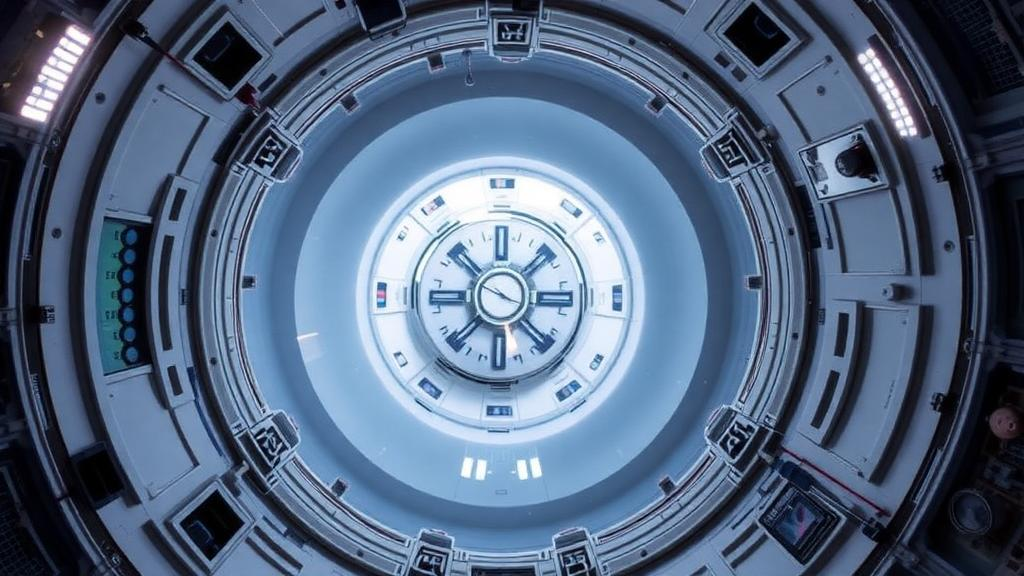
Engineering constraints loom as large as the biology. A short-radius centrifuge is the most plausible near-term option, but it brings steep acceleration gradients, motion sickness, constrained posture, crew-time demands, moving-part hazards and vibration. Large rotating habitats or tethered spacecraft can deliver a more uniform field at lower rotation rates and support normal locomotion, yet they impose formidable challenges in structural loads, mass balance, attitude control, docking, emergency response and transition zones between rotating and non-rotating sections. The review also warns that lunar gravity of about 0.16 g or Martian gravity of about 0.38 g cannot be assumed sufficient, because bone, muscle, cardiovascular regulation, vestibular adaptation and development likely have different dose-response thresholds, and no single number will satisfy every system.
Safety and ethics receive equally pointed treatment. Rotation can provoke sensory conflict, presyncope, excessive cardiovascular strain, cognitive distraction and performance errors, with risk rising with rotation rate and head movement. The authors call for a prospective safety protocol spanning acute, adaptation and chronic phases, recording motion sickness, vomiting, headache, presyncope, arrhythmia, sleep disruption and disorientation with predefined severity grades, plus continuous monitoring, automated stop criteria, independent stop authority and emergency procedures for sudden spin-down, power loss, imbalance, fire and medical incapacitation. On the ethical side, informed consent must distinguish uncertain benefit from established protection, and when artificial gravity becomes a mandatory mission procedure, oversight must shift from research consent to occupational risk governance, explicitly guarding against perceived coercion in a small, career-driven astronaut corps.
The bottom line is a staged research agenda rather than a verdict. The central translational question, the authors write, is not whether rotation can generate centripetal acceleration but which exposure profile yields a meaningful net operational benefit. Priorities include factorial dose-response trials varying g-level, duration, frequency and radius; head-to-head comparisons of artificial gravity alone versus combined with exercise and fluid countermeasures; adequately powered analyses of sex, age, anthropometry and individual susceptibility; longer-duration partial-gravity analogs; human-factors testing of operational tasks during rotation; and phased orbital demonstrators with standardized biomarkers. Artificial gravity targets the absence of gravity itself rather than each downstream consequence separately, a unique conceptual advantage, but it will become mission-enabling only if biological effectiveness, human acceptability and engineering feasibility are demonstrated together.
Subject of Research: Artificial gravity as a countermeasure to physiological deconditioning during long-duration human spaceflight
Article Title: Artificial gravity for long-duration human spaceflight: physiological rationale, evidence gaps, risks, and research priorities
Article References: Briard, M., & Baatout, S. (2026). Artificial gravity for long-duration human spaceflight: physiological rationale, evidence gaps, risks, and research priorities. Frontiers in Space Technologies, 7, Article 1967384. https://doi.org/10.3389/frspt.2026.1967384
Image Credits: AI Generated
DOI: 10.3389/frspt.2026.1967384
Keywords: artificial gravity, human spaceflight, microgravity, centrifugation, AGBRESA, orthostatic tolerance, bone loss, muscle deconditioning, spaceflight-associated neuro-ocular syndrome, sensorimotor adaptation, rotating habitats, countermeasures
News Source: Denise Maddox. (October 15, 2026). Artificial Gravity Shows Promise for Deep-Space Crews, but the Evidence Is Not Yet There. Scienmag.