Credit: N/A
The scholarly publisher and technology provider Pensoft and its self-developed publishing platform ARPHA welcome The International Journal of Universal Computer Science (J.UCS) to their portfolio. With this addition, the publisher, best known for a wide range of biodiversity-themed journals, steps into the field of computer science.
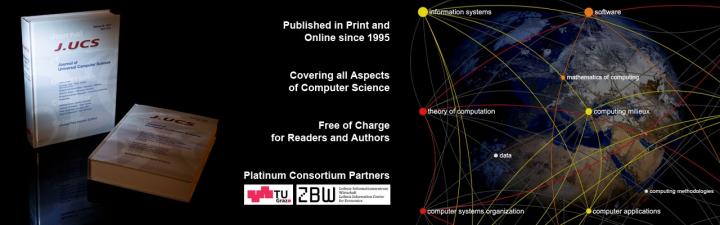
Since 1995, J.UCS has been publishing, digitally and in print, research articles and editorials on all aspects of computer science. With a free-of-charge policy for both authors and readers, and a review process usually taking between 6 and 10 weeks, its volumes have been documenting, connecting and reflecting novel aspects of computer science. J.UCS’ peer-reviewed monthly issues, as well as special issues on selected topics, continuously serve as one of the major knowledge bases for the research community in computer science. Currently, its Impact Factor stands at 1.139 (2020), and its CiteScore is at 2.0 (2020).
The journal is already publishing on a brand-new, user-friendly website7/6/2021 under Pensoft’s scholarly publishing platform ARPHA. Its latest issue features a model for forecasting air travel demand with machine learning; an analysis of the effect of different stimuli, such as video and sound on a user’s sense of presence in a virtual environment; and a new approach for solving the 15-puzzle problem using the artificial bee colony algorithm.
By moving to ARPHA, J.UCS now enjoys a long list of high-tech perks, which dramatically enhance the entire publishing process, from submission to publication, distribution and archiving. All users of the journal’s system – authors, editors, and reviewers, can benefit from ARPHA’s integrated approach, which ensures that once submitted, each manuscript goes through the whole cycle: from manuscript submission, review and copy/layout editing to publication, dissemination and archiving, without ever leaving ARPHA’s collaboration-focused online environment.
The easy-to-use platform offers features such as papers available in a machine-readable XML format, automated data export to aggregators, automated notifications and reminders, usage metrics and web-service integrations with major global indexing databases, which ensure that published articles are easy to discover, access, cite and reuse by both humans and machines all over the world.
“Since its foundation, J.UCS has built on and even created innovative features for digital libraries. By moving to the ARPHA platform, the J.UCS community can take advantage of the latest publishing features and technologies, including long-time archiving and review acknowledgement. Thus, the J.UCS team can concentrate on the journal’s core business and content quality, and can rely on professional service and support. Moving to the new platform was only possible due to the financial support of our consortium partners Graz University of Technology, ZBW,American University and California Polytechnic State University, and by in-kind support from Internet Studio Isser and photographer Christian Trummer for their graphical design contribution,” said Christian Gütl, Managing Editor-in-Chief.
###
Follow The International Journal of Universal Computer Science onFacebook, Twitter and LinkedIn.
Additional information
About ARPHA:
ARPHA is the first end-to-end, narrative- and data-integrated publishing solution that supports the full life cycle of a manuscript, from authoring to reviewing, publishing and dissemination. ARPHA provides accomplished and streamlined production workflows that can be customized according to the journal’s needs. The platform enables a variety of publishing models through a number of options for branding, production and revenue models to choose from.
About Pensoft:
Pensoft is an independent academic publishing company, well-known worldwide for its innovations in the field of semantic publishing, as well as for its cutting-edge publishing tools and workflows. In 2013, Pensoft launched the first ever end to end XML-based authoring, reviewing and publishing workflow, as demonstrated by the Pensoft Writing Tool (PWT) and the Biodiversity Data Journal (BDJ), now upgraded to the ARPHA Publishing Platform. Flagship titles include: Research Ideas and Outcomes (RIO), One Ecosystem, ZooKeys, Biodiversity Data Journal, PhytoKeys, MycoKeys and many more.
Contacts:
Christian Gütl, Managing Editor-in-Chief of The International Journal of Universal Computer Science
[email protected]
Lyubomir Penev, founder and CEO at Pensoft and ARPHA
[email protected]
Media Contact
Lyubomir Penev
[email protected]