• HOME
  • NEWS
  • EXPLORE
    • CAREER
      • Companies
      • Jobs
    • EVENTS
    • iGEM
      • News
      • Team
    • PHOTOS
    • VIDEO
    • WIKI
  • BLOG
  • COMMUNITY
    • FACEBOOK
    • INSTAGRAM
    • TWITTER
Thursday, June 25, 2026
BIOENGINEER.ORG
No Result
View All Result
  • Login
  • HOME
  • NEWS
  • EXPLORE
    • CAREER
      • Companies
      • Jobs
        • Lecturer
        • PhD Studentship
        • Postdoc
        • Research Assistant
    • EVENTS
    • iGEM
      • News
      • Team
    • PHOTOS
    • VIDEO
    • WIKI
  • BLOG
  • COMMUNITY
    • FACEBOOK
    • INSTAGRAM
    • TWITTER
  • HOME
  • NEWS
  • EXPLORE
    • CAREER
      • Companies
      • Jobs
        • Lecturer
        • PhD Studentship
        • Postdoc
        • Research Assistant
    • EVENTS
    • iGEM
      • News
      • Team
    • PHOTOS
    • VIDEO
    • WIKI
  • BLOG
  • COMMUNITY
    • FACEBOOK
    • INSTAGRAM
    • TWITTER
No Result
View All Result
Bioengineer.org
No Result
View All Result
Home NEWS Science News

Army researcher promotes cooperation between humans, autonomous machines

Bioengineer by Bioengineer
November 12, 2019
in Science News
Reading Time: 3 mins read
0
IMAGE
Share on FacebookShare on TwitterShare on LinkedinShare on RedditShare on Telegram

IMAGE

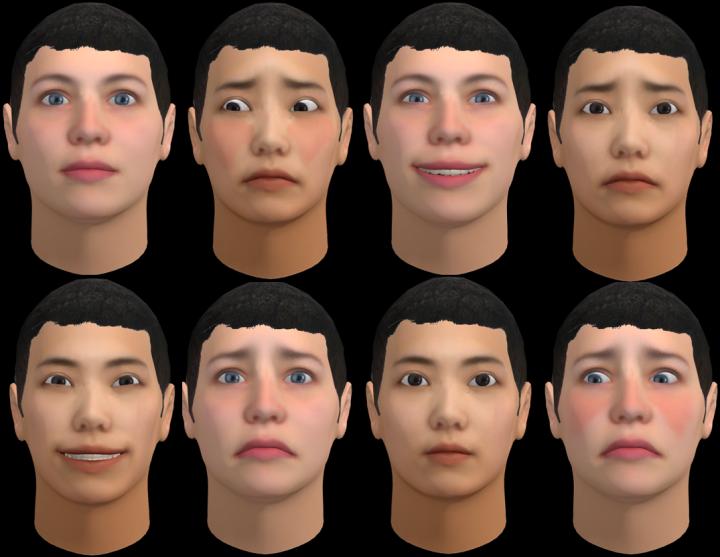
Credit: (U.S. Army illustration by Dr. Celso M. de Melo)

The trust between humans and autonomous machines is a top priority for Army researchers — as machines become integral to society, it is critical to understand the impact on human decision-making.

Dr. Celso M. de Melo, a computer scientist from the U.S. Army Combat Capabilities Development Command’s Army Research Laboratory at its ARL West campus in Playa Vista, California, along with Japan’s Gifu University Professor Kazunori Terada, share common research interests, in particular, on human-machine cooperation and the social effects of emotion in human-machine interaction. Their research shows people readily engage in social categorization distinguishing humans from machines, which leads to reduced cooperation with machines.

A simple cultural cue-the ethnicity of the machine’s virtual face-mitigated this bias for participants from two distinct cultures (Japan and United States), the researchers said.

“Our research shows that situational cues of affiliative intent-namely, expressions of emotion-overrode expectations of coalition alliances from social categories,” de Melo said. “When machines were from a different culture, participants showed the usual bias when competitive emotion was shown — such as joy following exploitation and in contrast, participants cooperated just as much with humans as machines that expressed cooperative emotion – such as joy following cooperation.”

A fundamental challenge for the adoption of AI in the Army, this research is particularly relevant for the Army’s Next Generation Combat Vehicle modernization priority, as it proposes solutions to promote effective human-machine teaming, de Melo said.

“Research reveals a fundamental bias, whereby humans make decisions with machines that are less favorable than if the partners were humans,” de Melo said. “It is as if machines are treated, by default, as out-group members. The research advances two solutions for overcoming this bias based on social categorization: associating positive social groups with machines – and emotion, and expression of emotion by machines that communicate an affiliative intent.”

The next step is to apply and test these findings in Army-relevant domains, such as warfighter interaction with autonomous (ground and air) vehicles, robots and virtual partners, he said.

###

To read the research paper in full, go to Plos One Journal.

The U.S. Army engages its scientists and engineers to develop science and technology solutions to build the Army of tomorrow. Officials plan to complete the Modernization Strategy by 2028.

The CCDC Army Research Laboratory (ARL) is an element of the U.S. Army Combat Capabilities Development Command. As the Army’s corporate research laboratory, ARL discovers, innovates and transitions science and technology to ensure dominant strategic land power. Through collaboration across the command’s core technical competencies, CCDC leads in the discovery, development and delivery of the technology-based capabilities required to make Soldiers more lethal to win our Nation’s wars and come home safely. CCDC is a major subordinate command of the U.S. Army Futures Command.

Media Contact
Joyce M. Conant
[email protected]
410-278-8603

Original Source

https://journals.plos.org/plosone/article?id=10.1371/journal.pone.0224758

Related Journal Article

http://dx.doi.org/10.1371/journal.pone.0224758

Tags: Calculations/Problem-SolvingComputer ScienceResearch/DevelopmentRobotry/Artificial IntelligenceTechnology/Engineering/Computer Science
Share12Tweet8Share2ShareShareShare2

Related Posts

Energy-Saving Membrane Technology Developed by KAIST and Georgia Tech Enables Crude Oil Separation Without Boiling

June 25, 2026

Cracking the Code: How Cancer Evades Antibody-Drug Conjugates and New Strategies to Overcome Resistance

June 25, 2026

Chiral Laser Gyroscopes Surpass Lock-In Limit

June 25, 2026

Boosting Genomic Equity: Africa’s National Genome Projects

June 25, 2026
Please login to join discussion

POPULAR NEWS

  • Saying Goodbye to PGY-6: Pediatric Fellowship Realities

    103 shares
    Share 41 Tweet 26
  • Multi-Hospital Study Reveals Long Covid Burden Is Twice as High as Current Estimates

    92 shares
    Share 36 Tweet 23
  • Detection of EDCs in Breast Milk and Infant Urine Up to Six Months Highlights Early Exposure Risks

    77 shares
    Share 31 Tweet 19
  • New Drug Candidate Developed at McMaster Shows Potential for Treating Brain Cancer

    58 shares
    Share 23 Tweet 15

About

We bring you the latest biotechnology news from best research centers and universities around the world. Check our website.

Follow us

Recent News

Energy-Saving Membrane Technology Developed by KAIST and Georgia Tech Enables Crude Oil Separation Without Boiling

Cracking the Code: How Cancer Evades Antibody-Drug Conjugates and New Strategies to Overcome Resistance

Chiral Laser Gyroscopes Surpass Lock-In Limit

Subscribe to Blog via Email

Enter your email address to subscribe to this blog and receive notifications of new posts by email.

Join 82 other subscribers
  • Contact Us

Bioengineer.org © Copyright 2023 All Rights Reserved.

Welcome Back!

Login to your account below

Forgotten Password?

Retrieve your password

Please enter your username or email address to reset your password.

Log In
No Result
View All Result
  • Homepages
    • Home Page 1
    • Home Page 2
  • News
  • National
  • Business
  • Health
  • Lifestyle
  • Science

Bioengineer.org © Copyright 2023 All Rights Reserved.