Credit: Courtesy University of Pennsylvania
RESEARCH TRIANGLE PARK, N.C. — New photonics research paves the way for improved lasers, high-speed computing and optical communications for the Army.
Photonics has the potential to transform all manners of electronic devices by storing and transmitting information in the form of light, rather than electricity. Using light’s speed and the way information can be layered in its various physical properties can increase the speed of communication while reducing wasted energy; however, light sources such as lasers need to be smaller, stronger and more stable to achieve that, researchers said.
“Single-mode, high power lasing is used in a wide range of applications that are important to the Army and help support the warfighter including optical communications, optical sensing and LIDAR ranging,” said Dr. James Joseph, program manager, ARO, an element of the U.S. Army Combat Capabilities Development Command, known as DEVCOM, Army Research Laboratory. “The research results out of UPenn mark a significant step towards creating more efficient and fieldable laser sources.”
The way information can be layered with this technology could also have important implications for photonic computers and communication systems.
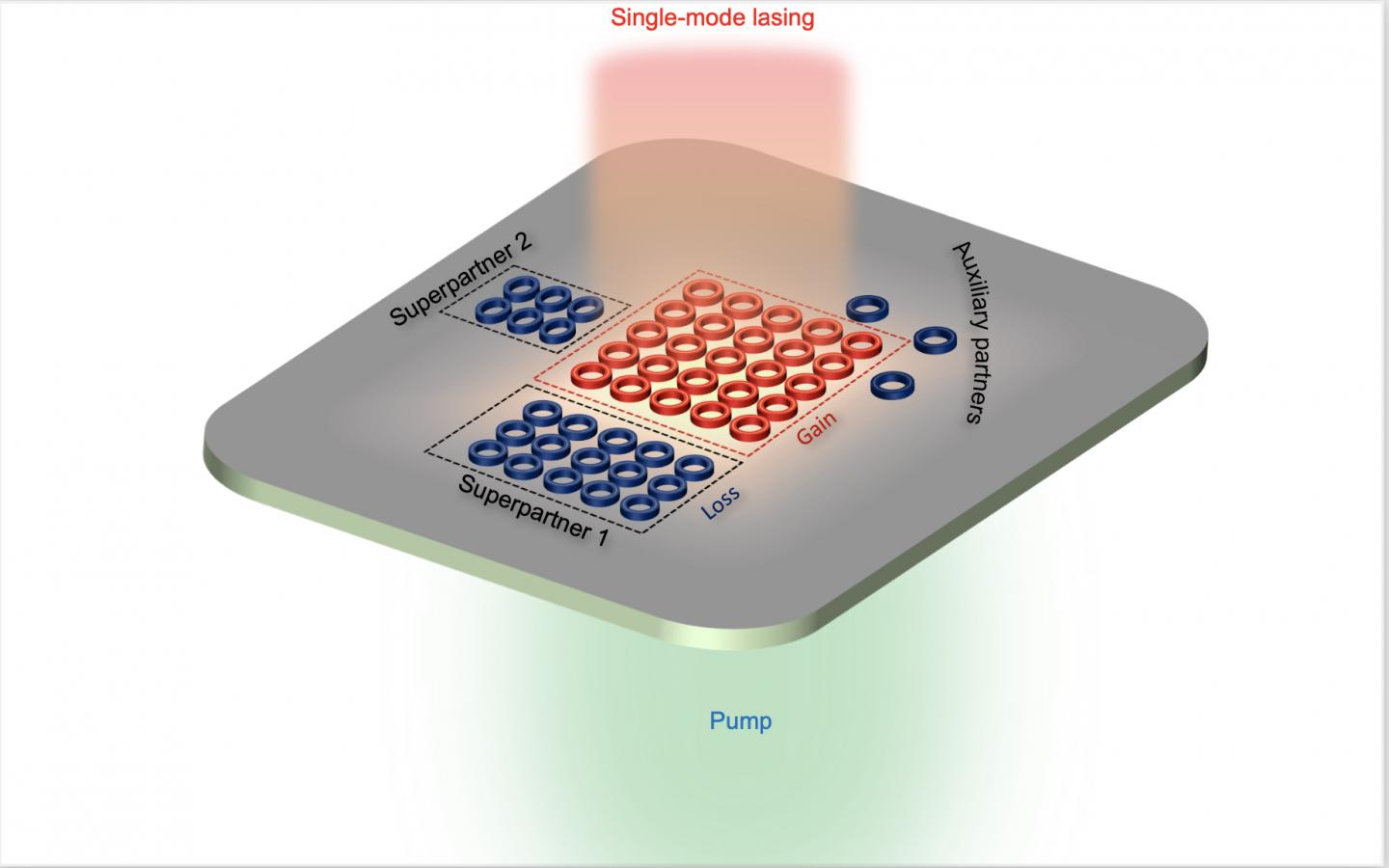
Army-funded researchers designed and built two-dimensional arrays of closely packed micro-lasers that have the stability of a single micro-laser but can collectively achieve power density orders of magnitude higher, paving the way for improved lasers, high-speed computing and optical communications for the Army.
In order to preserve the information manipulated by a photonic device, its lasers must be exceptionally stable and coherent. So-called single-mode lasers eliminate noisy variations within their beams and improve their coherence, but as a result, are dimmer and less powerful than lasers that contain multiple simultaneous modes.
Researchers from the University of Pennsylvania and Duke University, with Army funding, designed and built two-dimensional arrays of closely packed micro-lasers that have the stability of a single micro-laser but can collectively achieve power density orders of magnitude higher. They published a study in the peer-reviewed journal Science demonstrating the super-symmetric micro-laser array.
Robots and autonomous vehicles that use LiDAR for optical sensing and ranging, manufacturing and material processing techniques that use lasers, are some of many other potential applications of this research.
“One seemingly straightforward method to achieve a high-power, single-mode laser is to couple multiple identical single-mode lasers together to form a laser array,” said Dr. Liang Feng, associate professor in the departments of Materials Science and Engineering and Electrical and Systems Engineering at University of Pennsylvania. “Intuitively, this laser array would have an enhanced emission power, but because of the nature of complexity associated with a coupled system, it will also have multiple super-modes. Unfortunately, the competition between modes makes the laser array less coherent.”
Coupling two lasers produces two super-modes, but that number increases quadratically as lasers are arrayed in the two-dimensional grids eyed for photonic sensing and LiDAR applications.
“Single mode operation is critical because the radiance and brightness of the laser array increase with number of lasers only if they are all phase-locked into a single super-mode,” said Xingdu Qiao, doctoral candidate at University of Pennsylvania. “Inspired by the concept of supersymmetry from physics, we can achieve this kind of phase-locked single-mode lasing in a laser array by adding a dissipative super-partner.”
In particle physics, super-symmetry is the theory that all elementary particles of the two main classes, bosons and fermions, have a yet undiscovered super-partner in the other class. The mathematical tools that predict the properties of each particle’s hypothetical super-partner can also be applied to the properties of lasers.
Compared to elementary particles, fabricating a single micro-laser’s super-partner is relatively simple. The complexity lies in adapting super-symmetry’s mathematical transformations to produce an entire super-partner array that has the correct energy levels to cancel out all but the desired single mode of the original.
Prior to this research, super-partner laser arrays could only have been one-dimensional, with each of the laser elements aligned in a row. By solving the mathematical relationships that govern the directions in which the individual elements couple to one another, this new study demonstrates an array with five rows and five columns of micro-lasers.
“When the lossy super-symmetric partner array and the original laser array are coupled together, all the super-modes except for the fundamental mode are dissipated, resulting in single-mode lasing with 25 times the power and more than 100 times the power density of the original array,” said Dr. Zihe Gao, a post-doctoral fellow in Feng’s program, “We envision a much more dramatic power scaling by applying our generic scheme for a much larger array even in three dimensions. The engineering behind it is the same.”
The study also shows that the technique is compatible with the team’s earlier research on vortex lasers, which can precisely control orbital angular momentum, or how a laser beam spirals around its axis of travel. The ability to manipulate this property of light could enable photonic systems encoded at even higher densities than previously imagined.
“Bringing super-symmetry to two-dimensional laser arrays constitutes a powerful toolbox for potential large-scale integrated photonic systems,” Feng said.
###
In addition to the Army, the National Science Foundation and a Sloan Research Fellowship also supported this research.
Visit the laboratory’s Media Center to discover more Army science and technology stories
DEVCOM Army Research Laboratory is an element of the U.S. Army Combat Capabilities Development Command. As the Army’s corporate research laboratory, ARL is operationalizing science to achieve transformational overmatch. Through collaboration across the command’s core technical competencies, DEVCOM leads in the discovery, development and delivery of the technology-based capabilities required to make Soldiers more successful at winning the nation’s wars and come home safely. DEVCOM is a major subordinate command of the Army Futures Command.
Media Contact
Lisa Bistreich-Wolfe
[email protected]
Original Source
https:/
Related Journal Article
http://dx.