• HOME
  • NEWS
  • EXPLORE
    • CAREER
      • Companies
      • Jobs
    • EVENTS
    • iGEM
      • News
      • Team
    • PHOTOS
    • VIDEO
    • WIKI
  • BLOG
  • COMMUNITY
    • FACEBOOK
    • INSTAGRAM
    • TWITTER
Sunday, May 17, 2026
BIOENGINEER.ORG
No Result
View All Result
  • Login
  • HOME
  • NEWS
  • EXPLORE
    • CAREER
      • Companies
      • Jobs
        • Lecturer
        • PhD Studentship
        • Postdoc
        • Research Assistant
    • EVENTS
    • iGEM
      • News
      • Team
    • PHOTOS
    • VIDEO
    • WIKI
  • BLOG
  • COMMUNITY
    • FACEBOOK
    • INSTAGRAM
    • TWITTER
  • HOME
  • NEWS
  • EXPLORE
    • CAREER
      • Companies
      • Jobs
        • Lecturer
        • PhD Studentship
        • Postdoc
        • Research Assistant
    • EVENTS
    • iGEM
      • News
      • Team
    • PHOTOS
    • VIDEO
    • WIKI
  • BLOG
  • COMMUNITY
    • FACEBOOK
    • INSTAGRAM
    • TWITTER
No Result
View All Result
Bioengineer.org
No Result
View All Result
Home NEWS Science News Chemistry

Argonaute proteins help fine-tune gene expression

Bioengineer by Bioengineer
October 28, 2019
in Chemistry
Reading Time: 2 mins read
0
IMAGE
Share on FacebookShare on TwitterShare on LinkedinShare on RedditShare on Telegram

IMAGE

Credit: © 2019 Heno Hwang


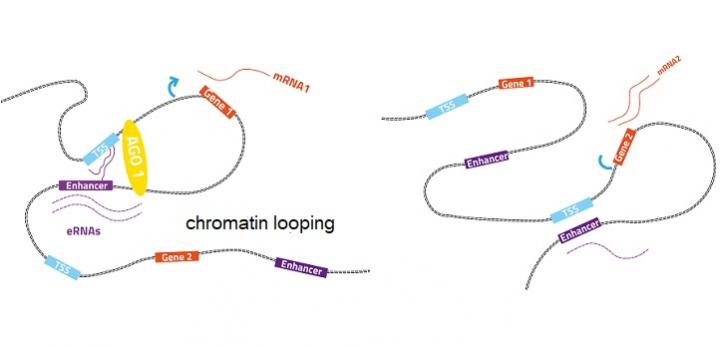
A nuclear protein bound to RNA molecules affects chromatin structure and gene expression.

The finding adds to the understanding of a gene silencing pathway called RNA interference (RNAi). The discovery of this pathway in the late 1990s resulted in the 2006 Nobel Prize in Physiology or Medicine being awarded to American scientists, Craig Mello and Andrew Fire.

Argonaute proteins (AGO) that are bound to RNA are known to have a role in RNA interference inside the cytoplasm. But, despite their known presence in the nucleus, the AGO’s role there is not clear.

Now, environmental epigeneticist, Valerio Orlando, together with his team at KAUST and colleagues in Italy and Japan, have uncovered the role of Argonaute proteins in the nucleus, using a combination of genome-wide approaches.

One of the four known Argonaute proteins, AGO1, was found to be present in the nucleus and was more prevalent than other Argonaute proteins on chromatin, the nuclear material that is composed of DNA and its associated network of molecules.

AGO1 was found to bind to “enhancer” regions on DNA, which are responsible for making sure that the right genes are expressed at the right time. This binding was mediated by long nonprotein-coding RNA molecules, called enhancer RNAs.

Turning off AGO1 in human cells led to extensive changes in the gene expression program. It also led to changes in enhancer RNA levels, in the shape of chromatin, and how its different parts interact.

“The effect of AGO1 on 3D genome architecture was unexpected,” says KAUST epigeneticist Muhammad Shuaib. “Current advances in chromatin structure suggest that changes in its organization can lead to abnormal characteristics in an organism and to diseases,” explains Shuaib. “But the factors involved in establishing and maintaining this architecture, the dynamics of chromatin organization, and its contribution to gene regulation is largely unknown.

Shuaib says that the group’s work not only establishes AGO1 as a new player in the field of 3D chromatin organization, “but also creates a paradigm for future investigations of the nonconventional role of RNA interference components in the nucleus.”

Next, the team plans to study how AGO1 associated with nonprotein-coding RNAs maintains chromatin organization and how its depletion affects the outcome of gene copying inside the nucleus.

###

Media Contact
Carolyn Unck
[email protected]
966-054-470-0408

Original Source

https://discovery.kaust.edu.sa/en/article/895/argonaute-proteins-help-fine-tune-gene-expression

Related Journal Article

http://dx.doi.org/10.1016/j.cels.2019.09.005

Tags: BiochemistryBiologyCell BiologyGenetics
Share12Tweet8Share2ShareShareShare2

Related Posts

New Drexel Study Reveals Key to Keeping Students on Track in Physics Learning — Chemistry

New Drexel Study Reveals Key to Keeping Students on Track in Physics Learning

May 15, 2026
Reversible Glue Technology Powers Up with Electric Activation — Chemistry

Reversible Glue Technology Powers Up with Electric Activation

May 15, 2026

Sweet as Honey: Unveiling a New Heat Transport Regime in Ultrathin Semiconductors

May 15, 2026

High-Precision Boltzmann Luminescent Nanothermometry Achieved Through Predictive Rules

May 15, 2026
Please login to join discussion

POPULAR NEWS

  • Research Indicates Potential Connection Between Prenatal Medication Exposure and Elevated Autism Risk

    844 shares
    Share 338 Tweet 211
  • New Study Reveals Plants Can Detect the Sound of Rain

    730 shares
    Share 291 Tweet 182
  • Salmonella Haem Blocks Macrophages, Boosts Infection

    62 shares
    Share 25 Tweet 16
  • Breastmilk Balances E. coli and Beneficial Bacteria in Infant Gut Microbiomes

    58 shares
    Share 23 Tweet 15

About

We bring you the latest biotechnology news from best research centers and universities around the world. Check our website.

Follow us

Recent News

Tau T205 Phosphorylation Controls Memory and Engrams

Phocaeicola dorei Eases Liver Fibrosis via Efferocytosis

Boosting Aging Positivity and Activity in Older Couples

Subscribe to Blog via Email

Success! An email was just sent to confirm your subscription. Please find the email now and click 'Confirm' to start subscribing.

Join 82 other subscribers
  • Contact Us

Bioengineer.org © Copyright 2023 All Rights Reserved.

Welcome Back!

Login to your account below

Forgotten Password?

Retrieve your password

Please enter your username or email address to reset your password.

Log In
No Result
View All Result
  • Homepages
    • Home Page 1
    • Home Page 2
  • News
  • National
  • Business
  • Health
  • Lifestyle
  • Science

Bioengineer.org © Copyright 2023 All Rights Reserved.