Scientists at Flinders University have used sub-surface imaging and aerial surveys to see through floodplains in the Red Lily Lagoon area of West Arnhem Land in Northern Australia.
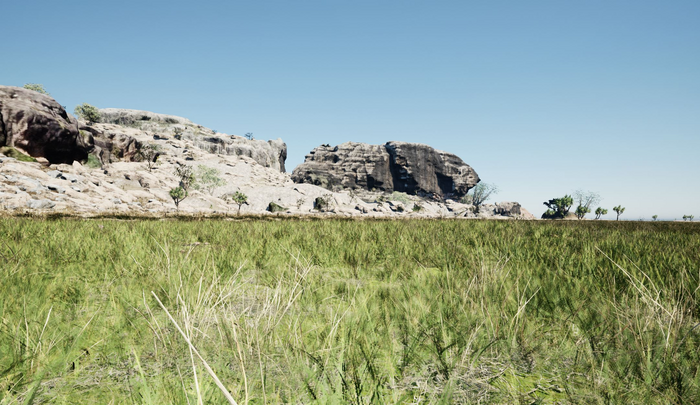
Credit: Dr Jarrad Knowlessar, Flinders University Research Associate.
Scientists at Flinders University have used sub-surface imaging and aerial surveys to see through floodplains in the Red Lily Lagoon area of West Arnhem Land in Northern Australia.
These ground-breaking methods showed how this important landscape in the Northern Territory was altered as sea levels rose about 8,000 years ago.
Their discovery shows that the ocean had reached this, now inland region, which has important implications for understanding the archaeological record of Madjedbebe—the oldest archaeological site in Australia.
The findings also provide a new way to understand the rock art in the region, which is recognised globally for its significance and distinctive style.
By examining how sediments now buried beneath the flood plains changed as sea levels rose, the researchers can see how the transformation of Red Lily Lagoon had resulted in the growth of mangroves that have supported animal and marine life in a region where ancient Indigenous rock art is located. This transformation has, in turn, fostered an environment that has inspired the subjects and animals in the ancient rock art.
In their findings published in in the scientific journal PLOS ONE today, the researchers say environmental changes at the lagoon are reflected in the rock art because fish, crocodiles and birds were featured in the art when the floodplain transformed to support freshwater habitats for new species.
Senior Author and Research Associate in the College of Humanities, Arts, and Social Sciences at Flinders University, Dr Jarrad Knowlessar, says the mapping fundamentally changes our archaeological understanding of the stunning landscape in Arnhem Land.
“This is a key landscape for understanding the early human occupation of Australia. Our reconstruction of Red Lily Lagoon enables effective predictive modelling of prominent cultural sites and provides an important method to interpret the presence and provenance of Indigenous cultural material.”
“The timing of rock art aligns with the broader environmental changes we understand took place in this landscape. This is evident through changes in subject matter in the art, such as large macropods, and the appearance of estuarine animal species such as fish and crocodiles in the art. The inclusion of freshwater species, such as fish and birds, occurs in the most recent artistic styles of this region, and this reflects the phases of environmental change when the freshwater floodplains made up the landscape.”
“Based on the results of this study, all Pleistocene sites in western Arnhem Land were near the ocean and, subsequently, mangrove swamps at some point during the transformation of the landscape. This has important implications for the paleogeographic settings of these sites, which must be considered when interpreting changes in stone artefacts, food resources, and the isotope composition of materials from this period of the first Australians.”
Co-author, Associate Professor Ian Moffat, says Electric Resistivity Tomography (ERT) is a rapid, low-cost, non-invasive method that can map large areas of the Australian landscape to better understand their ancient history.
“We are showcasing how ERT data can be used to develop landscape models that are useful when it comes to understanding known locations as well as predicting where buried archaeological sites might be. We have demonstrated that the landscapes of this region can be effectively mapped using non-invasive methods. This has important implications for locating new sites but also for developing a more nuanced understanding of the regional geography, and its impact on past human behaviour.”
“Red Lily Lagoon has exceptional archaeological significance in Arnhem Land as it is situated at one of the easternmost points of the East Alligator River floodplain, where the modern river, the Arnhem Plateau, creates a significant boundary between the low-lying floodplains and the sandstone highlands, which have been occupied by humans for over 60,000 years and are the location of countless significant sites, including some of the most iconic rock art panels in Australia.”
Traditional owner and co-author Alfred Nayinggull described the importance of this research as “We want people to see and want people to know what’s been happening many thousand years ago in the past. “
The new PLOS ONE paper “Reconstructing archaeological palaeolandscapes using geophysical and geomatic survey techniques: An example from Red Lily Lagoon, Arnhem Land, Australiais will be available at https://journals.plos.org/plosone/article?id=10.1371/journal.pone.0283006.
Journal
PLoS ONE
DOI
10.1371/journal.pone.0283006
Method of Research
Survey
Article Title
Reconstructing archaeological palaeolandscapes using geophysical and geomatic survey techniques: An example from Red Lily Lagoon, Arnhem Land, Australiais
Article Publication Date
4-May-2023