


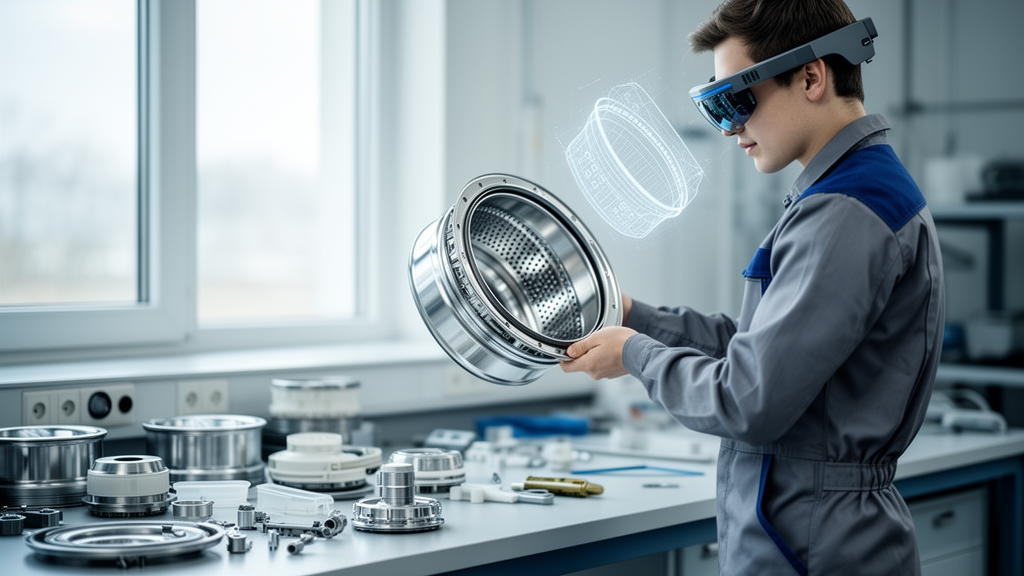
Researchers have extended an industrial augmented reality (AR) and artificial intelligence (AI) disassembly station so that it can now guide workers through the inspection of components recovered from end-of-life washing machines, connecting automated condition assessment, human confirmation, and reuse documentation in a single worker-facing workflow. The study, published as a Brief Research Report in Frontiers in Virtual Reality, describes the system-level integration rather than a finished industrial inspection solution, and its authors are explicit that the results establish integrated feasibility and preliminary validation, not inspection reliability.
The work builds on an earlier AR-AI station developed within the EU-funded CREDIT project, which aims to create a system for inspecting recovered parts for reusability during the disassembly of washing machines. In the previous setup, a monitor-based AR interface delivered adaptive disassembly instructions while a YOLO AI model verified that the correct parts had been removed, checking for the presence of a component before each step and confirming its recovery by checking its absence in subsequent images from an Intel RealSense camera. The new extension adds a second decision layer after recovery: the worker is guided to a component-specific inspection procedure, receives visual or sensor-based condition information, confirms or overrules the suggested assessment, assigns the component to a reuse, refurbishment, or rejection pathway, and documents the result.
The station itself is designed around ergonomics as much as automation. A washing machine is lifted 1.00 meter and tilted at a 45-degree angle, deliberately avoiding a 90-degree tilt that could damage the washing unit. A touchscreen monitor presents disassembly steps in various media formats, the application includes a notification feature for reporting issues, and a predictive monitoring system adjusts instructions based on the condition of parts. With the inspection upgrade, inspection steps have been introduced into the existing system, providing both instructions on how to perform the inspection and input buttons for the worker to send results to the washing machine manufacturer’s spare part management system.
Two components receive particular attention because they are the most valuable targets for reuse: printed circuit boards (PCBs) and the washing unit. Washing machines typically contain two to three PCBs, including one controlling the motor and pump and one or two for the user-interface panel. According to the washing machine manufacturer, PCB failures are frequently associated with short circuits that produce large visible burn marks on the board. For visual inspection, the team placed a white height-adjustable table next to the AR station, attached an adjustable lamp, and mounted an Intel RealSense 435D camera at the last joint of the lamp directly behind the light. The same camera model was chosen because it is already used by the AR system, for compatibility reasons.
During disassembly, workers are instructed by the AR system to place the PCB on the inspection table under the camera, where an AI classification model evaluates the images. A multi-source development dataset of 858 cleaned, balanced images was assembled, combining public PCB images, Roboflow data, web-search images, AI-generated synthetic examples, and self-captured washing-machine PCBs. The Burnt_PCB class drew on 429 images, including Roboflow data, targeted web searches, ChatGPT/DALLE and Google Gemini generated examples, and Photoshop-generated burnt variants derived from self-acquired washing-machine PCB images. AI-generated and Photoshop-generated examples were used only as supplementary development data and were excluded from the independent real-world evaluation. Duplicate and near-duplicate images were removed using perceptual hashing and deep-feature similarity before training.
Seven model architectures were fine-tuned and compared: the CNN-based YOLOv11, ResNet50, ResNet152, EfficientNetB3, and EfficientNetB7, the transformer DeiT-Base, and a self-supervised DINO-CaIT model. Generalization was tested on an independent real-world dataset of Gorenje PCB samples: videos of 4 burnt and 13 good boards, 17 physical PCBs in total, were recorded under realistic handling conditions and decoded at one frame per second, yielding 326 unseen images with 64 Burnt_PCB and 262 Good_PCB frames. The authors stress that multiple frames from the same physical board are correlated observations, so the reported measures are preliminary frame-level results rather than validation across 326 independent PCBs.
The frame-level results reveal a striking imbalance between sensitivity and specificity. ResNet50 correctly classified 62 of the 64 burnt frames (sensitivity 0.969) at 66.0 frames per second, but also misclassified 220 of the 262 good frames as burnt, a specificity of just 0.160. YOLOv11 detected 58 burnt frames (sensitivity 0.906) with 182 false positives among the good frames, giving a specificity of 0.305, an F1-score of 0.382, a ROC-AUC of 0.606, and an inference speed of 35.2 FPS. Because the evaluation set is imbalanced, raw accuracy alone was deemed unreliable; a trivial classifier predicting Good_PCB for every input would achieve 80.4 percent accuracy without any discriminative capability. YOLOv11 was retained as the preferred current screening candidate based on the joint consideration of sensitivity, specificity, F1-score, ROC-AUC, and speed, while ResNet50 was kept as a high-recall baseline.
These numbers mean that a positive frame-level prediction cannot be used directly as a component-rejection decision. The AI therefore operates as a preliminary screening and warning mechanism whose output is reviewed by the worker, who may acquire additional views where necessary and manually enters the confirmed or overruled assessment through the AR interface; inspection results are not transferred automatically. This human-in-the-loop design is central to the workflow because it keeps the worker in control. The authors note that false positives primarily increase manual review effort, whereas a false negative is more critical because a damaged PCB could proceed toward reuse. They also caution that hidden burn marks require multi-view acquisition, since a single image is not sufficient when the damaged area sits under a component, and that shadows and uncontrolled lighting can visually resemble burn damage.
The washing unit inspection takes a different, sensor-based route. The worker positions the washing tub on a sealing plate, aligns the gaskets with the main and secondary openings, fixes the tub with four hand clamps, seals the side opening, and locks the motor so the drive wheel transmits rotation to the pulley. After calibrating the pressure sensor to ambient pressure, the pneumatic valve pressurizes the tub interior to a defined level, the valve is closed, and pressure loss over time is recorded. A stable pressure curve indicates sufficient tightness, while significant pressure loss points to leakage in the tub housing or sealing areas. The system performs several safety checks, aborting the measurement if a safety switch is not activated or becomes disconnected, and requires a two-hand safety operation so the operator cannot reach into rotating components.
Experimentally measured pressure-decay curves showed a tight unit declining from approximately 0.10 bar to 0.086 bar, while a unit with a damaged radial shaft seal decayed faster and fell below approximately 0.08 bar within the same interval. That threshold was established empirically from comparative measurements of 12 market-returned washing units, five sufficiently tight and seven with varying degrees of radial shaft seal damage, and the authors emphasize it is an empirical decision level for the investigated setup and sample, not a universally validated industrial acceptance criterion. In the same test sequence, bearing condition is assessed by rotating the drum at a constant 25 Hz via the motor-driven pulley while an accelerometer mounted on the tub near the bearings records the vibration response, which is interpreted through established characteristic bearing frequencies such as BPFO, BPFI, BSF, and FTF. The bearing evaluation included three healthy bearings and one with a deliberately induced, pronounced cage defect, the only fault type physically tested; inner-race, outer-race, and rolling-element defects were not physically tested. The authors conclude that the study demonstrates system-level feasibility of extending AR-AI disassembly toward inspection-aware reuse decision support, while larger independent sample sets, controlled PCB acquisition, improved model calibration, quantitatively validated condition-assessment procedures, and formal evaluation of the human-in-the-loop workflow, including effects on trust, cognitive load, task time, and error rate, remain the next research steps.
Subject of Research: Integration of inspection-aware augmented reality workflows with AI and sensor-based condition assessment for reusing components from end-of-life washing machines
Article Title: Inspection-aware industrial augmented reality: integrated concepts and preliminary validation for extending an AR-AI station for component recovery from washing machines
Article References: Lorenz, M., Ali, M. J., Terzer, G., Mihelič, A., Own, A., Knopp, S., & Čepon, G. (2026). Inspection-aware industrial augmented reality: integrated concepts and preliminary validation for extending an AR-AI station for component recovery from washing machines. Frontiers in Virtual Reality, 7, 1868037. https://doi.org/10.3389/frvir.2026.1868037
Image Credits: AI Generated
DOI: 10.3389/frvir.2026.1868037
Keywords: augmented reality, artificial intelligence, circular economy, washing machines, PCB inspection, disassembly, component reuse, condition monitoring, human-in-the-loop, burn damage classification, pressure-loss testing, vibration analysis
News Source: Denise Maddox. (October 29, 2026). AR-guided disassembly station learns to inspect washing machine parts for reuse. Scienmag.



