• HOME
  • NEWS
  • EXPLORE
    • CAREER
      • Companies
      • Jobs
    • EVENTS
    • iGEM
      • News
      • Team
    • PHOTOS
    • VIDEO
    • WIKI
  • BLOG
  • COMMUNITY
    • FACEBOOK
    • INSTAGRAM
    • TWITTER
Tuesday, September 1, 2026
BIOENGINEER.ORG
No Result
View All Result
  • Login
  • HOME
  • NEWS
  • EXPLORE
    • CAREER
      • Companies
      • Jobs
        • Lecturer
        • PhD Studentship
        • Postdoc
        • Research Assistant
    • EVENTS
    • iGEM
      • News
      • Team
    • PHOTOS
    • VIDEO
    • WIKI
  • BLOG
  • COMMUNITY
    • FACEBOOK
    • INSTAGRAM
    • TWITTER
  • HOME
  • NEWS
  • EXPLORE
    • CAREER
      • Companies
      • Jobs
        • Lecturer
        • PhD Studentship
        • Postdoc
        • Research Assistant
    • EVENTS
    • iGEM
      • News
      • Team
    • PHOTOS
    • VIDEO
    • WIKI
  • BLOG
  • COMMUNITY
    • FACEBOOK
    • INSTAGRAM
    • TWITTER
No Result
View All Result
Bioengineer.org
No Result
View All Result
Home NEWS Science News

ANU scientists make new high-tech liquid materials

Bioengineer by Bioengineer
February 9, 2017
in Science News
Reading Time: 2 mins read
0
Share on FacebookShare on TwitterShare on LinkedinShare on RedditShare on Telegram
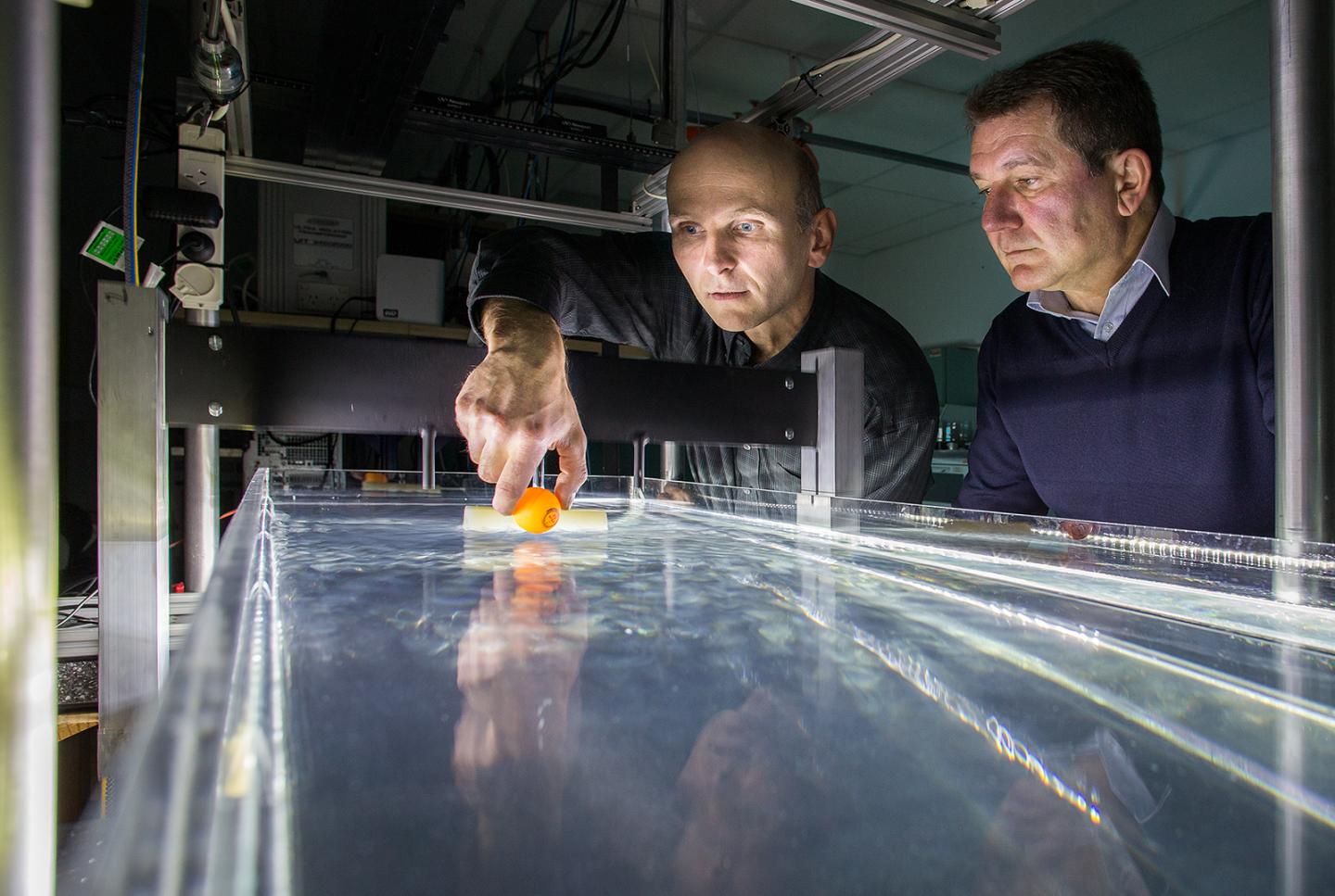
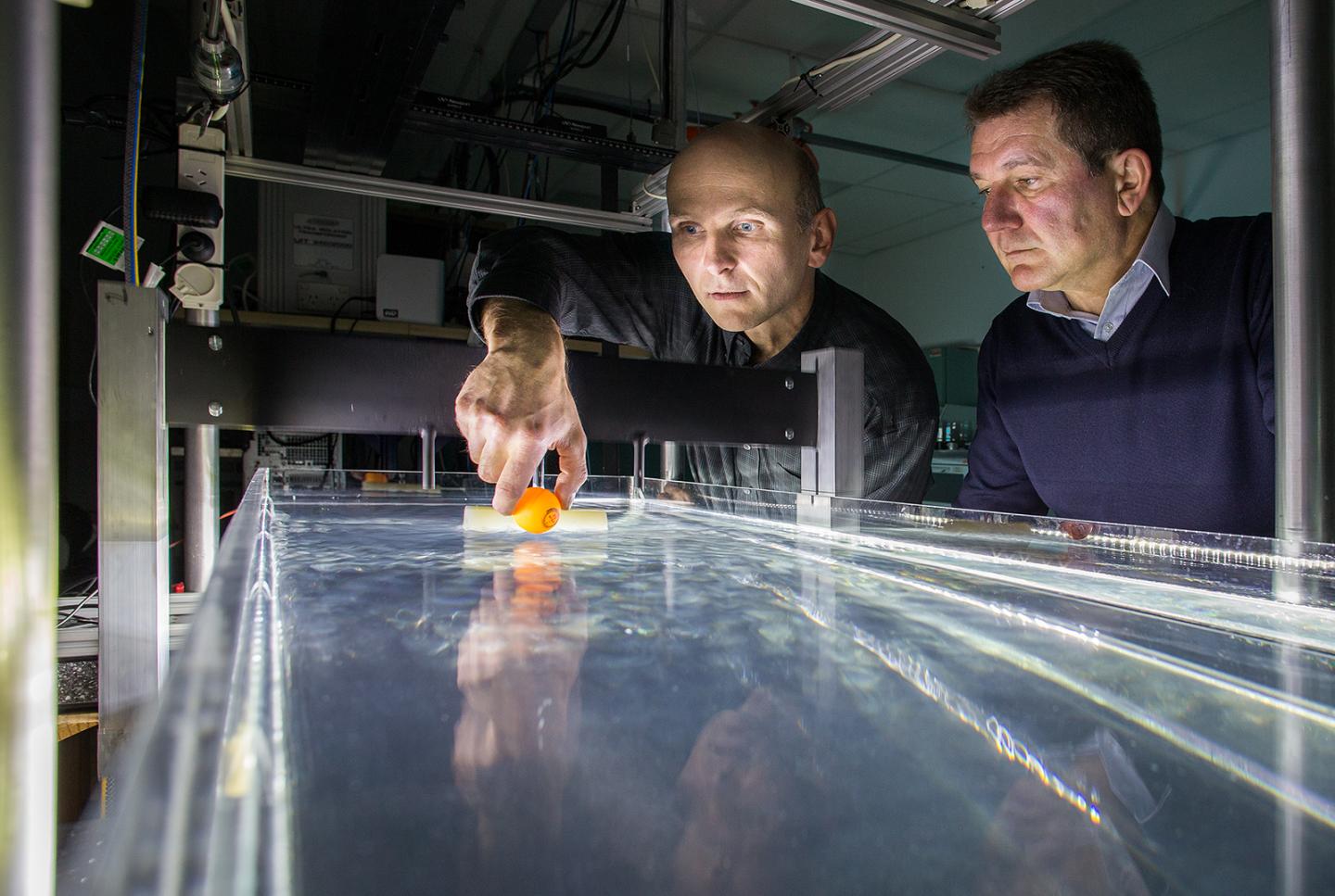
IMAGE

Credit: Stuart Hay, ANU

Scientists at The Australian National University (ANU) have controlled wave-generated currents to make previously unimaginable liquid materials for new technological innovations, including techniques to manipulate micro-organisms.

The new kind of dynamic material could be revolutionary, similar to other materials created in recent decades that have been used for invisibility cloaking, superlenses and high-efficiency antennae.

Research group leader Professor Michael Shats from ANU said the currents made a liquid behave like materials with regular structures such as crystals.

"It's an incredibly powerful new tool that will work at the surface of almost any liquid," said Professor Shats from the ANU Research School of Physics and Engineering.

"By changing waves, we can change the flow patterns. This allows us to remote-control the nature of the material."

The flow patterns can be changed at will, so the liquid-based materials are more dynamic and flexible than solid materials.

"These flow patterns are effectively two-dimensional materials at the interface between the liquid and the gas above it," Professor Shats said.

The research is published in Nature Communications.

Lead author Dr Nicolas Francois from the ANU Research School of Physics and Engineering said each current was like a Lego brick.

"Now we have created the brick, people will be able to make complex structures we cannot imagine now," he said.

"If you use conducting liquids you can create an interface with designed electrical properties. Or with biocompatible substances you can guide micro-organisms or trap them."

The team observed the flow patterns in a tank of water by generating a wave pattern with two oscillators and tracking fluid particles. They also modelled the flow with computer simulations and theoretical calculations.

###

Dr Hua Xia and Dr Horst Punzmann from the ANU Research School of Physics and Engineering also contributed to the research.

FOR INTERVIEW:

Professor Michael Shats
ANU Research School of Physics and Engineering
T: +61 2 6125 0038
M: +61 405 146 173
E: [email protected]

Dr Nicolas Francois

ANU Research School of Physics and Engineering
T: +61 2 6125 7588
M: +61 419 121 399
E: [email protected]

For media assistance, contact Will Wright from the ANU Media Team on +61 2 6125 7979, +61 478 337 740 or [email protected]

Media Contact

Professor Michael Shats
[email protected]
61-405-146-173
@ANUmedia

http://www.anu.edu.au/media

############

Story Source: Materials provided by Scienmag
Share12Tweet8Share2ShareShareShare2

Related Posts

β-Sitosterol from Ipomoea carnea Jacq. As a promising anti-inflammatory agent: Evidence from in silico modeling and in vitro validation

β-Sitosterol from Ipomoea carnea Jacq. As a promising anti-inflammatory agent: Evidence from in silico modeling and in vitro validation

August 31, 2026
Design, fabrication and characterization of a wearable Fiber Bragg grating sensor for cardiorespiratory monitoring using finger plethysmography

Design, fabrication and characterization of a wearable Fiber Bragg grating sensor for cardiorespiratory monitoring using finger plethysmography

August 31, 2026

KAIST opens the era of industrial-scale microbial foods, proposing growth strategies for the next-generation protein market

August 31, 2026

Virologist awarded $2 million NIH grant to investigate how virus-infected cells live and die

August 31, 2026
Please login to join discussion

POPULAR NEWS

  • β-Sitosterol from Ipomoea carnea Jacq. As a promising anti-inflammatory agent: Evidence from in silico modeling and in vitro validation

    29 shares
    Share 12 Tweet 7
  • Design, fabrication and characterization of a wearable Fiber Bragg grating sensor for cardiorespiratory monitoring using finger plethysmography

    29 shares
    Share 12 Tweet 7
  • KAIST opens the era of industrial-scale microbial foods, proposing growth strategies for the next-generation protein market

    29 shares
    Share 12 Tweet 7
  • Virologist awarded $2 million NIH grant to investigate how virus-infected cells live and die

    29 shares
    Share 12 Tweet 7

About

We bring you the latest biotechnology news from best research centers and universities around the world. Check our website.

Follow us

Recent News

β-Sitosterol from Ipomoea carnea Jacq. As a promising anti-inflammatory agent: Evidence from in silico modeling and in vitro validation

Design, fabrication and characterization of a wearable Fiber Bragg grating sensor for cardiorespiratory monitoring using finger plethysmography

KAIST opens the era of industrial-scale microbial foods, proposing growth strategies for the next-generation protein market

Subscribe to Blog via Email

Enter your email address to subscribe to this blog and receive notifications of new posts by email.

Join 85 other subscribers
  • Contact Us

Bioengineer.org © Copyright 2023 All Rights Reserved.

Welcome Back!

Login to your account below

Forgotten Password?

Retrieve your password

Please enter your username or email address to reset your password.

Log In
No Result
View All Result
  • Homepages
    • Home Page 1
    • Home Page 2
  • News
  • National
  • Business
  • Health
  • Lifestyle
  • Science

Bioengineer.org © Copyright 2023 All Rights Reserved.