• HOME
  • NEWS
  • EXPLORE
    • CAREER
      • Companies
      • Jobs
    • EVENTS
    • iGEM
      • News
      • Team
    • PHOTOS
    • VIDEO
    • WIKI
  • BLOG
  • COMMUNITY
    • FACEBOOK
    • INSTAGRAM
    • TWITTER
Friday, June 26, 2026
BIOENGINEER.ORG
No Result
View All Result
  • Login
  • HOME
  • NEWS
  • EXPLORE
    • CAREER
      • Companies
      • Jobs
        • Lecturer
        • PhD Studentship
        • Postdoc
        • Research Assistant
    • EVENTS
    • iGEM
      • News
      • Team
    • PHOTOS
    • VIDEO
    • WIKI
  • BLOG
  • COMMUNITY
    • FACEBOOK
    • INSTAGRAM
    • TWITTER
  • HOME
  • NEWS
  • EXPLORE
    • CAREER
      • Companies
      • Jobs
        • Lecturer
        • PhD Studentship
        • Postdoc
        • Research Assistant
    • EVENTS
    • iGEM
      • News
      • Team
    • PHOTOS
    • VIDEO
    • WIKI
  • BLOG
  • COMMUNITY
    • FACEBOOK
    • INSTAGRAM
    • TWITTER
No Result
View All Result
Bioengineer.org
No Result
View All Result
Home NEWS Science News Biology

Ants: Jam-free traffic champions

Bioengineer by Bioengineer
October 22, 2019
in Biology
Reading Time: 2 mins read
0
IMAGE
Share on FacebookShare on TwitterShare on LinkedinShare on RedditShare on Telegram

IMAGE

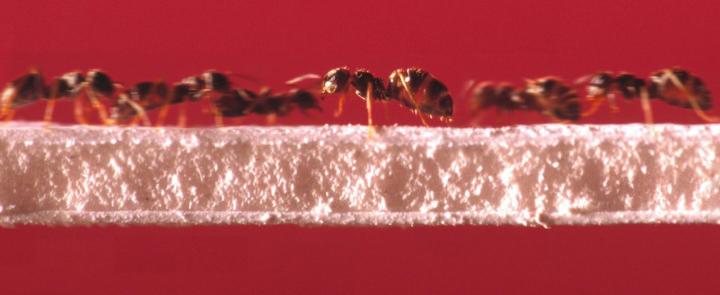
Credit: Emmanuel PERRIN/CRCA/CNRS Photothèque

Whether they occur on holiday routes or the daily commute, traffic jams affect cars as well as pedestrians. Scientists at the Research Center on Animal Cognition (CNRS/Université Toulouse III – Paul Sabatier) and the University of Arizona (United States) have demonstrated that ant colonies, however, are spared these problems and circulate easily, even in the event of extremely dense traffic, thus ensuring consistent efficiency in their foraging. These findings appear in the 22 October 2019 edition of eLife.

Traffic jams are a perfect example of what happens when too many individuals circulate together in the same space. Movements in large ant colonies, however, seem to sidestep this problem. To solve the mystery of how ants manage traffic so wonderfully, researchers conducted 170 filmed experiments to observe ants commuting between their nest and a food source. Tests took into account the width of the path and the number of individuals included in the study (between 400 and 25,600) in order to vary the density – the number of insects per unit of surface.

What they saw surprised them: when density increases, ant flows (1) swell and then become constant, whereas human traffic, above a certain density threshold, slows to zero flow and causes a jam (2). Ants, on the other hand, accelerate until a maximum flow or capacity on the path is reached. When traffic becomes too dense and causes too many collisions between ants, they change tactics, preferring to avoid time-consuming collisions instead of continuing to accelerate. Similarly, researchers noted that at excessively high density levels, ants refrain from joining the flow of traffic and wait for it to thin out instead.

While ant traffic is comparable to pedestrian and vehicle flows in many ways, it is also fundamentally different. Ants, protected by their exoskeleton, are not afraid of collisions and can accelerate where we humans prefer to slow down. In addition, movements in ant colonies share a common goal: foraging, which is carried out effectively regardless of density. Ants seem to avoid the traffic jam trap by continuously adapting their traffic rules to suit local crowding, whereas car traffic follows invariable rules such as stopping at a red light regardless of traffic.

###

Notes

(1) Number of individuals covering a given distance per unit of time.

(2) Variation in flow according to density is illustrated by a bell curve.

Media Contact
Veronique Etienne
[email protected]
33-144-965-137

Original Source

https://www.cnrs.fr/en/ants-jam-free-traffic-champions

Related Journal Article

http://dx.doi.org/10.7554/eLife.48945

Tags: BehaviorBiologyEntomology
Share12Tweet8Share2ShareShareShare2

Related Posts

Natural Hallucinogens: Evolution’s Ecological Tools, Not Mere Chemical Byproducts

June 25, 2026

This Famous Butterfly Revealed: Three Distinct Species Hidden in One

June 25, 2026

Scientists Attack Soybean Cyst Nematode by Starving Its Food Source

June 25, 2026

Decoding the Secret Code of a Crucial Immune Sensor

June 24, 2026
Please login to join discussion

POPULAR NEWS

  • Saying Goodbye to PGY-6: Pediatric Fellowship Realities

    103 shares
    Share 41 Tweet 26
  • Multi-Hospital Study Reveals Long Covid Burden Is Twice as High as Current Estimates

    92 shares
    Share 36 Tweet 23
  • Detection of EDCs in Breast Milk and Infant Urine Up to Six Months Highlights Early Exposure Risks

    77 shares
    Share 31 Tweet 19
  • New Drug Candidate Developed at McMaster Shows Potential for Treating Brain Cancer

    58 shares
    Share 23 Tweet 15

About

We bring you the latest biotechnology news from best research centers and universities around the world. Check our website.

Follow us

Recent News

Tracking Lanthanide-Labeled Microplastics in Plants

POSTECH Researchers Slash Cost of Reconstituted Cell-Free Systems by 95%

AI and Physics Collaborate to Design Advanced Hydrogen Storage Materials

Subscribe to Blog via Email

Success! An email was just sent to confirm your subscription. Please find the email now and click 'Confirm' to start subscribing.

Join 82 other subscribers
  • Contact Us

Bioengineer.org © Copyright 2023 All Rights Reserved.

Welcome Back!

Login to your account below

Forgotten Password?

Retrieve your password

Please enter your username or email address to reset your password.

Log In
No Result
View All Result
  • Homepages
    • Home Page 1
    • Home Page 2
  • News
  • National
  • Business
  • Health
  • Lifestyle
  • Science

Bioengineer.org © Copyright 2023 All Rights Reserved.