TMDU researchers demonstrate proof of concept of antisense nucleic acid therapy to prevent the spread of α-synuclein pathologies in synucleinopathies.
Credit: Department of Neurology and Neurological Science, TMDU
TMDU researchers demonstrate proof of concept of antisense nucleic acid therapy to prevent the spread of α-synuclein pathologies in synucleinopathies.
Tokyo, Japan – Parkinson’s disease (PD), as well as many other neurodegenerative disorders, has shown a link between the abnormal aggregation of a protein called α-synuclein (aSyn) and neuronal death. These aggregates, known as Lewy bodies and Lewy neurites depending on their subcellular localization, can spread by continuously causing normal endogenous aSyn to misfold. The complex nature of this aggregation process poses significant challenges in disease management. Now, promising research from scientists in Japan suggests potential breakthroughs in developing effective treatment strategies for PD.
In a study published in Volume 12, Issue 75 of the journal Acta Neuropathologica Communications on May 14, 2024, a research team from Tokyo Medical and Dental University (TMDU) explored the use of antisense oligonucleotides (ASOs) to reduce the expression of aSyn and improve symptoms in a mouse model of PD.
ASOs are compounds that can be engineered to induce the target mRNA-specific degradation, which in turn decreases the levels of its corresponding protein. Even though they are not the only drugs that can control the expression of aSyn, ASOs have a crucial advantage over other approaches, as lead author Professor Tetsuya Nagata explains: “Currently, antibody drugs and vaccines targeting aSyn are under development for aSyn-related neuropathies, but their effects may not prevent the disease from progressing inside cells. In contrast, nucleic acid drugs like ASOs that specifically control intracellular levels of normal aSyn, while also suppressing pathogenic aSyn propagation, could offer higher safety and efficacy by both retaining the natural physiological functions of the protein while inhibiting the spread of pathogenic aSyn.”
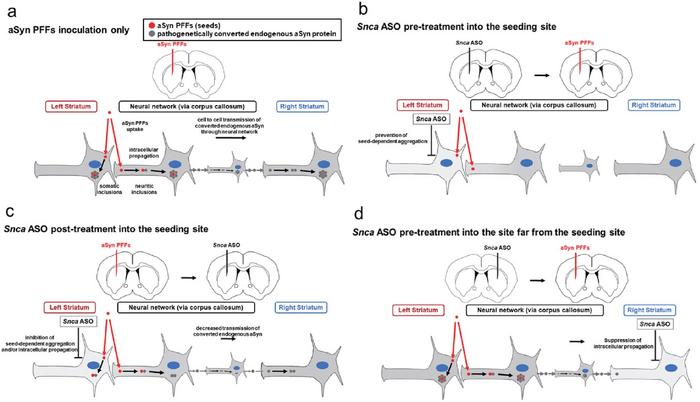
Considering that PD often emerges and then spreads out from specific regions in the brain, the researchers tested whether administering ASOs locally at diseased sites could be a sound treatment or preventive strategy. To this end, they injected ASOs directly into either the left or right striatum (a critical component of the motor and reward systems) of mice brain and analyzed the spread of aSyn pathologies throughout various brain regions using the presence of Lewy body-like and Lewy neurite-like pathologies as indicators.
When ASOs were injected into the left striatum two weeks before inoculation of the mice’s brain with disease-causing fibrils at the same site, a significant decrease of over 90% in Lewy pathology-like neuronal inclusion was observed. Compared to the control group, this pre-treatment effectively prevented the spread of abnormal fibrils-induced aggregate towards multiple regions of the brain. Even when ASOs were administered at the same time or even after inoculation with fibrillar aSyn, there was a notable inhibitory effect in the left striatum and other areas of the brain.
The researchers also tested whether the administration of ASOs at locations distant from the initial disease site would protect other brain regions. Accordingly, they injected ASOs in the right stratum two weeks before inoculation at the left striatum and visualized pathologic aSyn aggregates via immunostaining. Interestingly, this approach worked well as the density of these aSyn aggregates was much lower in the right striatum and right motor cortex near the SO administration site.
Together, the results of this study suggest that ASO-based treatments are worth pursuing in our strife against neurodegenerative disorders. “For the first time, we demonstrated in vivo that suppressing aSyn expression can inhibit the progression of pathology from Lewy neurites to Lewy bodies, with some of these effects being reversible,” highlights another author Professor Takanori Yokota. “We also observed the inhibitory effect of ASO on pathology progression in regions distant from the injection site of fibrous aSyn. This suggests the potential for treating PD, dementia with Lewy bodies, multiple system atrophy, and other aSyn-based diseases at various stages by reducing endogenous aSyn via ASOs without completely depleting this vital protein.”
We certainly hope these findings will put us one step closer to preventing PD and similar diseases right on their tracks.
###
The article, “Effects of local reduction of endogenous α-synuclein using antisense oligonucleotides on the fibril-induced propagation of pathology through the neural network in wild-type mice,” was published in Acta Neuropathologica Communications at DOI: 10.1186/s40478-024-01766-3.
Journal
Acta Neuropathologica Communications
DOI
10.1186/s40478-024-01766-3
Article Title
Effects of local reduction of endogenous α-synuclein using antisense oligonucleotides on the fibril-induced propagation of pathology through the neural network in wild-type mice