
Sixty-six million years ago, a cataclysmic event unfolded on Earth that would alter the course of life for countless species, resulting in the extinction of all known non-avian dinosaurs. This was a pivotal moment that saw the end of the Cretaceous Period unleashed by an asteroid impact near Mexico’s Yucatán Peninsula. Yet as devastation rocked the planet, certain lineages of birds, specifically the ancestors of contemporary waterfowl, managed to endure this mass extinction event remarkably well. In particular, Antarctica emerged as a potential sanctuary, with fossil evidence suggesting it harbored a temperate climate along with lush vegetation that may have supported the earliest representatives of modern birds.
In a groundbreaking scientific revelation published in the esteemed journal Nature, researchers unveiled a remarkable fossil that sheds new light on the origins of modern avian diversity. The fossil, a flawlessly preserved skull of an extinct bird named Vegavis iaai, dates back approximately 69 million years and was discovered during a 2011 expedition conducted by the Antarctic Peninsula Paleontology Project. This finding is significant, as it coincides with the reign of the formidable Tyrannosaurus rex in North America, further bridging the narrative of prehistoric life on Earth.
The nearly complete skull exhibits distinct characteristics, including a long, pointed beak and an unexpectedly unique brain shape that stands out among previously known Mesozoic birds. The features identified in Vegavis are strikingly aligned with modern birds, particularly within the lineage that encompasses today’s waterfowl. This provides the earliest, most compelling evidence of an evolutionary expansion that would lead to the diverse avian life we observe across the globe today.
Lead author Dr. Christopher Torres, currently a professor at the University of the Pacific, emphasized the transformative potential of this new fossil, asserting that it could help resolve substantial debates among paleontologists regarding Vegavis’s positioning within the avian tree of life. Originally proposed two decades ago by Dr. Julia Clarke and team, Vegavis was classified as a primitive member of modern birds nested within the waterfowl lineage. However, the conventional understanding of its evolutionary significance was challenged by the scarcity of additional fossil evidence until now.
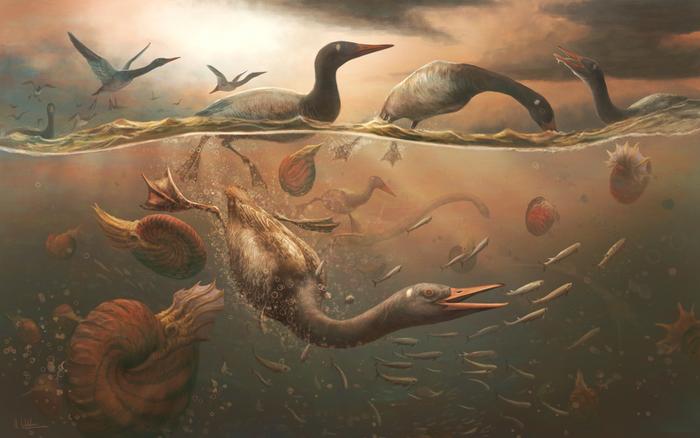
The newly examined specimen offers valuable insights due to its nearly intact skull, thereby enhancing our understanding of the anatomical features that distinguish Vegavis from other Mesozoic birds. Tracing the contours and structure of the skull provided critical evidence regarding brain and beak development, further linking Vegavis to contemporary avian species. Notably, the fossil shows signs of robust jaw muscles, suggesting it was well-adapted for foraging in a challenging marine environment, overcoming water resistance while diving for fish—a feeding behavior that diverges from modern waterfowl habits.
These anatomical features not only enhance our perception of Vegavis’s ecological role but also imply a distinctive method of locomotion; rather than relying solely on their wings, these early birds likely utilized their feet for propulsion while swimming—an adaptation reminiscent of certain modern species such as grebes and loons. The insights gleaned from this fossil underscore the evolutionary significance of Antarctica in the early diversification of modern birds during a time of significant environmental upheaval.
The implications of this research extend beyond the mere cataloging of fossils; they highlight Antarctica’s crucial role in the evolutionary narrative of birds at a time when avian life was undergoing profound transformation. The fossil record indicates that while some bird species across the globe were experiencing radical changes—many reflecting features far removed from modern birds—Antarctica was undergoing a different evolutionary trajectory, promoting the advent of more recognizable avian forms.
The ongoing exploration to unravel how the ancient Antarctic ecosystem contributed to the shaping of modern bird lineages represents an exciting field of study for paleontologists and ecologists alike. This research is emblematic of a broader inquiry into the impacts of geographical isolation on evolutionary processes—a theme profoundly situated within the annals of Earth’s history.
As Dr. Matthew Lamanna notes, Antarctica remains a vital frontier in understanding life during the Age of Dinosaurs. Ongoing excavation efforts and studies promise to unveil further treasures hidden beneath the ice and sediment that will illuminate connections to the biological diversity we observe today. Furthermore, this discovery has broad educational implications, serving as a framework for nurturing the next generation of scientists engaging in multi-disciplinary explorations of global biodiversity.
The broader ecological narratives being woven through decades of paleontological study not only inform our understanding of historical life forms but also resonate with contemporary issues regarding biodiversity and extinction. These ongoing dialogues inspire initiatives aimed at fostering scientific literacy among the public, unveiling the intricate relationships between past and present ecosystems.
Ultimately, the research surrounding Vegavis iaai illuminates how geological and environmental contexts can shape evolutionary outcomes. From understanding adaptation mechanisms in birds to promoting interdisciplinary collaboration among researchers, the excavation of this exciting fossil will undoubtedly sustain debates and spark curiosity in the minds of future generations of scientists and enthusiasts alike.
This landmark finding inspires not only further academic inquiry but also generates a pressing call for greater conservation and appreciation of our planet’s delicate ecosystems—both ancient and modern. Advancements in technology and research methods allow today’s scientists to delve into the distant past, unearthing stories that shape our understanding of life on Earth, fostering an appreciation that transcends time.
Subject of Research: Birds and their evolutionary history
Article Title: Cretaceous Antarctic bird skull elucidates early avian ecological diversity
News Publication Date: 5-Feb-2025
Web References: Antarctic Peninsula Paleontology Project
References: Nature Journal
Image Credits: Mark Witton, 2025
Keywords: Paleontology, Vegavis, Modern Birds, Antarctica, Evolution, Cretaceous Period, Fossil Record, Extinction Events, Biodiversity, Bird Phylogeny, Ecological Adaptation, Scientific Research.
Tags: ancient ecosystems and birdsAntarctic Cretaceous fossilAntarctic Peninsula Paleontology Projectavian diversity researchclimate impact on birdsextinction of non-avian dinosaursfossil evidence in Antarcticamass extinction eventorigins of modern birdsprehistoric bird evolutionTyrannosaurus rex eraVegavis iaai discovery