• HOME
  • NEWS
  • EXPLORE
    • CAREER
      • Companies
      • Jobs
    • EVENTS
    • iGEM
      • News
      • Team
    • PHOTOS
    • VIDEO
    • WIKI
  • BLOG
  • COMMUNITY
    • FACEBOOK
    • INSTAGRAM
    • TWITTER
Tuesday, May 5, 2026
BIOENGINEER.ORG
No Result
View All Result
  • Login
  • HOME
  • NEWS
  • EXPLORE
    • CAREER
      • Companies
      • Jobs
        • Lecturer
        • PhD Studentship
        • Postdoc
        • Research Assistant
    • EVENTS
    • iGEM
      • News
      • Team
    • PHOTOS
    • VIDEO
    • WIKI
  • BLOG
  • COMMUNITY
    • FACEBOOK
    • INSTAGRAM
    • TWITTER
  • HOME
  • NEWS
  • EXPLORE
    • CAREER
      • Companies
      • Jobs
        • Lecturer
        • PhD Studentship
        • Postdoc
        • Research Assistant
    • EVENTS
    • iGEM
      • News
      • Team
    • PHOTOS
    • VIDEO
    • WIKI
  • BLOG
  • COMMUNITY
    • FACEBOOK
    • INSTAGRAM
    • TWITTER
No Result
View All Result
Bioengineer.org
No Result
View All Result
Home NEWS Science News Biology

Ant queens control insulin to boost lifespan and reproduction

Bioengineer by Bioengineer
September 1, 2022
in Biology
Reading Time: 3 mins read
0
Ant worker
Share on FacebookShare on TwitterShare on LinkedinShare on RedditShare on Telegram

In most of the animal world, there’s a sad trade-off to make: The more babies you have, the shorter you live.
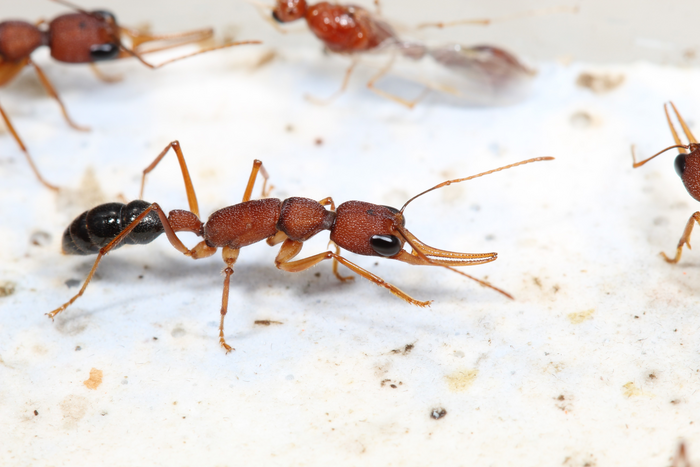
Ant worker

Credit: Hua Yan

In most of the animal world, there’s a sad trade-off to make: The more babies you have, the shorter you live.

But ants buck the system. The queens — the only individuals in a nest that reproduce — also live five, 10, up to 30 times longer than their genetically identical worker sisters. How do they pull off what the rest of animalkind cannot?

A new study from University of Florida biologist Hua Yan and his colleagues at New York University finds that ant queens implement a dual-control system for insulin, the metabolism-controlling hormone that explains much of the trade-off between reproduction and lifespan. Queens massively boost their insulin production, which promotes egg development. But their ovaries also produce an insulin blocker that slows down the aging process.

“Hopefully this finding allows us to better understand the aging process in many animals,” said Yan, an assistant professor of biology at UF who also studies how ants communicate with pheromones to organize their society.

Whether mammals, including humans, could ever benefit from partially blocking the insulin pathway remains an open question. Calorie restriction, which decreases insulin production, can increase lifespan in mammals but hurts reproduction.

The research team published their work on Sept. 1 in Science. Yan and NYU researchers Comzit Opachaloemphan and Francisco Carmona-Aldana led the study, which was supervised by NYU professors Claude Desplan and Danny Reinberg.

They studied Harpegnathos saltator ants, also known as Indian jumping ants, because of a helpful transformation the ants undergo. When a queen dies, the remaining workers duel to decide which ants will become new pseudo-queens capable of laying eggs. The pseudo-queens acquire longer lifespans, but the process is also reversible if they encounter a true queen. That gave Yan and the research team the perfect system to study how lifespan extension can be switched on and off.

They discovered that pseudo-queens produce much more insulin, which they expected. Insulin helps convert food into energy, and reproduction is an energy-intensive process.

“It’s straightforward, the pseudo-queen is reproductive, so they need insulin. But insulin normally shortens lifespan, yet they have much longer lifespan – why?” Yan pondered. “There must be something in the insulin signaling of the ants that differentially regulates reproduction and longevity.”

The research team found this extra layer of control in the form of an insulin blocker, called Imp-L2, which is produced by the newly active ovaries of the pseudo-queen. This insulin blocker slows down the part of the insulin pathway normally responsible for accelerating the aging process, but leaves the reproduction-boosting side of insulin signaling intact.

In a sense, the ants get to have their cake and eat it too, coupling egg-laying with a long life.


Journal

Science

Method of Research

Experimental study

Subject of Research

Animals

Article Title

Insulin signaling in the long-lived reproductive caste of ants

Article Publication Date

1-Sep-2022

COI Statement

The authors declare no competing interests

Share12Tweet8Share2ShareShareShare2

Related Posts

Qualcomm Co-Founder Andrew Viterbi Donates $5 Million to Propel AI-Driven Research at Sanford Burnham Prebys Medical Discovery Institute — Biology

Qualcomm Co-Founder Andrew Viterbi Donates $5 Million to Propel AI-Driven Research at Sanford Burnham Prebys Medical Discovery Institute

May 5, 2026
Scientists Identify Seven Distinct Pneumonia Subphenotypes Through Human Lung Analysis — Biology

Scientists Identify Seven Distinct Pneumonia Subphenotypes Through Human Lung Analysis

May 5, 2026

Study Reveals Most Birds Have Yet to Evolve Optimal Wing Shapes for Flight

May 5, 2026

Fungi Harness Ancient Antimicrobial Proteins to Combat Hosts and Their Microbiomes

May 5, 2026

POPULAR NEWS

  • Research Indicates Potential Connection Between Prenatal Medication Exposure and Elevated Autism Risk

    835 shares
    Share 334 Tweet 209
  • New Study Reveals Plants Can Detect the Sound of Rain

    721 shares
    Share 288 Tweet 180
  • Scientists Investigate Possible Connection Between COVID-19 and Increased Lung Cancer Risk

    68 shares
    Share 27 Tweet 17
  • Salmonella Haem Blocks Macrophages, Boosts Infection

    61 shares
    Share 24 Tweet 15

About

We bring you the latest biotechnology news from best research centers and universities around the world. Check our website.

Follow us

Recent News

Survey Reveals Unique Healthcare Experiences of Individuals with Poor Mental Health

Shriners Children’s St. Louis Researcher Secures $3 Million Grant to Develop In Utero Bone Strengthening Treatments

Investigating Delays in Elderly Healthcare Post-Violence

Subscribe to Blog via Email

Enter your email address to subscribe to this blog and receive notifications of new posts by email.

Join 82 other subscribers
  • Contact Us

Bioengineer.org © Copyright 2023 All Rights Reserved.

Welcome Back!

Login to your account below

Forgotten Password?

Retrieve your password

Please enter your username or email address to reset your password.

Log In
No Result
View All Result
  • Homepages
    • Home Page 1
    • Home Page 2
  • News
  • National
  • Business
  • Health
  • Lifestyle
  • Science

Bioengineer.org © Copyright 2023 All Rights Reserved.