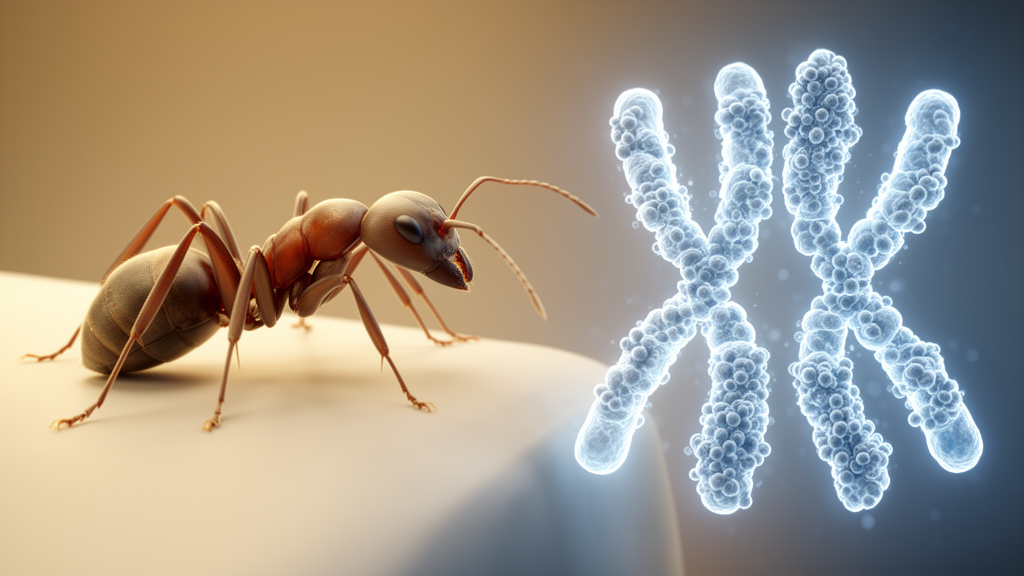
Fluorescence in situ hybridization of 18S ribosomal DNA in 15 ant species found that most of the newly mapped karyotypes carried rDNA clusters on a single chromosome pair, generally in a pericentromeric or other intrachromosomal region. The study also reviewed ant cytogenetic data published since an earlier review and concluded that the results reinforce a single rDNA site per haploid genome as the likely ancestral condition in Formicidae.
This was a molecular cytogenetic study of 15 species from nine genera and four ant subfamilies, with data for six genera published for the first time. Colonies were collected from Amazonian and Atlantic rainforest sites in French Guiana and Brazil, including Kourou, Petit Saut, Oiapoque in Amapá State, and Viçosa in Minas Gerais. The investigators prepared mitotic metaphase chromosomes from larval cerebral ganglia, mapped an 18S rDNA probe by FISH and analyzed at least 20 metaphases per species.
The mapping produced varied diploid chromosome numbers, from 2n=12 in Neoponera unidentata to 2n=46 in Megalomyrmex aff. incisus. Most species had rDNA clusters on one chromosome pair in a pericentromeric region. Azteca andreae and Cephalotes minutus instead had sites on chromosome short arms, while two species had clusters on the short arms of several pairs: Camponotus cameroni had four rDNA-bearing pairs, and Solenopsis saevissima had two. The results therefore were not a uniform pattern across every chromosome number or genus.
Data available since the 2021 review expanded the available ant cytogenetic dataset to 103 species or subspecies, 28 genera and six subfamilies. Among the 40 taxa added since that review, the study counted 36 with a single rDNA-bearing chromosome pair, two species with two pairs, and C. cameroni with four pairs. That count concerns the newly added taxa rather than the entire 103-taxon compilation. The single-pair condition was therefore interpreted as ancestral in ants, consistent with the authors’ broader proposal that it may also represent the ancestral condition in Hymenoptera.
The updated data strengthened an association between the position and multiplicity of rDNA sites. Species with multiple sites generally placed them in terminal or short-arm regions, whereas most species with one intrachromosomal site retained a single pair. Under a model proposed by Hirai in 2020, terminal sequences may associate during the meiotic bouquet, potentially allowing ectopic recombination and dispersing rDNA clusters among chromosomes. Intrachromosomal positions would restrict such interactions. The authors also proposed that haploid ant males cannot undergo the same ectopic recombination because recombination in hymenopterans occurs in diploid females; they presented this as a possible reason that repetitive-DNA evolution could be slower in Hymenoptera than in diplodiploid insects.
The findings did not support chromosomal fission as the main explanation for rDNA dispersion. An increase in chromosome number was not consistently accompanied by more rDNA-bearing pairs. For example, S. geminata and S. saevissima both had 2n=32 chromosomes but carried one and two rDNA-bearing pairs, respectively. C. cameroni had 2n=36 and four pairs, whereas studied Camponotus species with 2n=40 had one or two. Mycocepurus smithii sexual and asexual karyomorphs retained one rDNA-bearing pair despite chromosome numbers of 2n=14, 2n=11, and 2n=9. These observations weaken a simple association between higher chromosome number and greater rDNA dispersion, although the authors did not exclude fissions as one possible mechanism in particular lineages.
Patterns also varied substantially among genera. The two newly mapped Brachymyrmex species had rDNA sites in the same pericentromeric region, whereas Strumigenys species with the same 2n=18 count carried sites on different chromosome pairs. In Cyphomyrmex, the mapped sites occupied different chromosome pairs and arms, which the authors considered consistent with possible rearrangements involving rDNA regions. Native Argentine Solenopsis invicta had two rDNA-bearing pairs, while invasive or established populations from Argentina, the United States and Taiwan showed substantial variation: females had between one and 11 rDNA-bearing chromosomes depending on ploidy, and males had haploid through tetraploid karyotypes with one to nine such chromosomes. Hybridization and insecticide exposure were proposed as possible causes, not established mechanisms.
The mapping data also have taxonomic and reproductive significance. Camponotus rufipes has one rDNA-bearing pair and C. renggeri has two, a distinction that accompanied other ecological, molecular and behavioral evidence that they are separate species. Pseudoponera stigma and P. gilberti differ in both karyotype and rDNA location. In M. smithii, rDNA mapping also documented differences in homolog size, particularly in the 2n=11 asexual karyomorph, within the broader pattern of diploid-structure decay in a parthenogenetic lineage.
The analysis has clear limits. Molecular cytogenetic information remains sparse for several large genera, and some genera in this study were represented by only one species, preventing wider comparisons within those groups. FISH detects the mapped rDNA clusters but does not by itself establish the rearrangements or selective processes that produced them. The authors therefore treated ectopic recombination, hybridization, insecticide exposure and lineage-specific fissions as hypotheses to be tested rather than demonstrated universal causes. Even with these constraints, the new maps expand the comparative evidence and support an ancestral single-pair arrangement accompanied by non-random terminal or short-arm positioning in lineages where multiple rDNA sites occur.
Subject of Research: Chromosomal mapping of 18S rDNA in 15 ant species and implications for the evolution of ribosomal gene sites
Article Title: Physical chromosomal mapping of major ribosomal genes in 15 ant species with a review of hypotheses regarding evolution of the number and position of NORs in ants
Article References: Damasceno, M. T. D. S., Teixeira, G. A., Ferreira, P. C., Lod, R. B., Barros, L. A. C., & de Aguiar, H. J. A. C. (2024). Physical chromosomal mapping of major ribosomal genes in 15 ant species with a review of hypotheses regarding evolution of the number and position of NORs in ants. Comparative Cytogenetics, 18, 105-122. https://doi.org/10.3897/compcytogen.18.125235
Image Credits: AI Generated
DOI: 10.3897/compcytogen.18.125235
Keywords: ants, Formicidae, ribosomal DNA, chromosome mapping, fluorescence in situ hybridization, cytogenetics, nucleolar organizer regions, karyotype evolution, Physical, chromosomal, mapping, major
News Source: Drew Townsend. (October 20, 2026). Ant chromosome maps support one ribosomal site as the ancestral state. Scienmag.