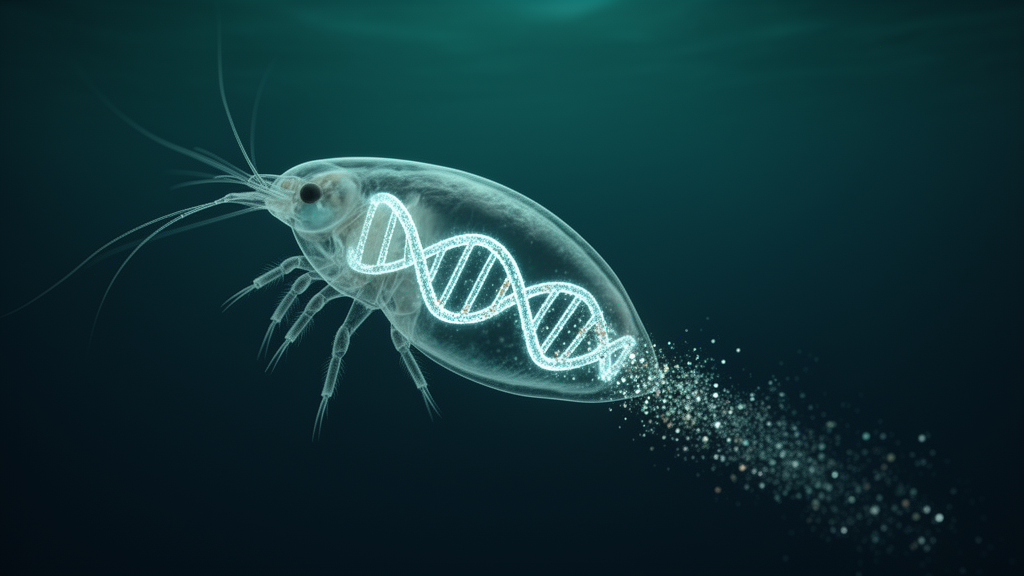
A review of animal chromatin diminution concludes that the genetically programmed removal of DNA can provide a useful model for studying genome-size evolution, cellular differentiation and possible genetic isolation. The article synthesizes observations from copepods, nematodes and other animals with broader hypotheses about the biological role of eliminated DNA. It emphasizes that the process has no established single function, and that several of the functional and evolutionary interpretations remain hypotheses.
Chromatin diminution, also termed programmed DNA elimination, removes chromosomal material during early development. In metazoans, this generally involves the loss of chromosomal fragments, predominantly heterochromatin, from cells of the somatic lineage. In protozoa, the process can remove entire chromosomes or sequences interspersed among genic loci.
The phenomenon is species-specific, and the diploid chromosome number after diminution may remain unchanged or change. Theodor Boveri first described chromatin diminution in 1887, and the review describes a research history extending for more than a century. During the fourth embryonic cleavage division, 94% of nuclear DNA is excised from the chromosomes of somatic-line cells, while germline cells retain their genome unchanged throughout development.
The diploid chromosome number remains unchanged, and the review states that the remaining 6% is sufficient for normal adult functions. Because this large fraction can be removed without disrupting somatic ontogeny, the authors treat the eliminated DNA as non-coding for the somatic lineage. The review positions C. kolensis as a model for investigating the C-value enigma: the large differences in genome size that do not correspond directly to differences in gene number or biological complexity.
Eukaryotic genome sizes can vary by more than 200,000-fold, while much of the excess DNA is non-coding. Proposed explanations have included selective neutrality, regulatory and structural functions, mutational pressure from insertions and deletions, and the possibility that genome-size changes are themselves subject to natural selection. The review presents C. kolensis as an experimental system for testing what happens when nearly all non-coding material is removed from a developing somatic genome.
Molecular analyses indicate that the eliminated material is not structurally simple. The review describes repeated sequences, spacers, mosaic fragments and direct and inverted repeats that are often highly similar or identical to consensus sequences. One eliminated repeat showed 97–98% sequence homology between Moscow and Baikal populations, with closely matching sequences retained in somatic cells.
The authors argue that this conservation is difficult to reconcile with a purely “junk” classification. They hypothesize that some eliminated sequences may have germline functions, including roles in meiosis or germ-cell maturation, but the review does not establish those functions directly. Chromatin diminution in C. kolensis is also associated with a lasting change in interphase-nuclear architecture.
Before diminution, embryonic cells have relatively homogeneous, diffuse nuclei. After the process, condensed heterochromatic segments and chromocenters become detectable, including chromocenters adjacent to the nuclear membrane, giving the nuclei an appearance resembling that of differentiated cells. The review interprets this transition as coinciding with the maternal-to-zygotic transition and as evidence that diminution may participate in the regulation of differentiation between somatic and germ lineages.
Timing experiments provide additional evidence for nuclear control of the process. In a cited irradiation experiment, high radiation doses that impaired nuclear-genome function stopped chromatin diminution. The authors infer that the mechanisms regulating the morphogenetic function of C. kolensis nuclei are triggered during the fourth cleavage division, when chromatin reduction occurs.
This finding supports initiation through zygotic nuclear activity, although the review does not identify the individual regulatory factors or establish the full molecular pathway. Experiments in C. kolensis also found that chromosome-aberration frequencies were 30–50 times lower after diminution than before it. That change was larger than the roughly 15- to 16-fold reduction predicted if aberration frequency simply scaled with the amount of remaining DNA.
The review discusses a model in which aberrations arise disproportionately in DNA associated with nuclear-matrix attachment regions and diminution removes a disproportionate share of those regions. The proposed reduction in DNA–matrix contact points remains an assumption in this explanatory model rather than a directly demonstrated result. The review also considers how non-coding DNA might influence recombination and genome evolution.
One hypothesis proposes that non-coding sequences separate genes, exons, introns, regulatory elements and structural features, thereby increasing opportunities for recombination and generating a wider range of sequence variants. Under this model, genome reduction after adaptation to a narrow ecological niche could limit further exploration of sequence space. A separate evolutionary model places chromatin diminution within incomplete genome reduction: somatic cells shed DNA that is unnecessary for later development, whereas germline cells retain sequences needed for meiosis and early embryogenesis.
Possible reproductive isolation is also examined. Russian and German C. kolensis populations differ in the timing of diminution and in the distribution of eliminated chromatin during anaphase, while German Cyclops insignis reportedly undergo diminution whereas Russian populations do not. Models combining genome reduction, altered chromosome order and hybrid meiosis propose a route to reproductive barriers.
These scenarios are hypothetical, and the review does not demonstrate that chromatin diminution caused speciation.
Subject of Research: Review of programmed DNA elimination, genome reduction and cellular differentiation in animals
Article Title: Chromatin diminution as a tool to study some biological problems
Article References: Grishanin, A. (2024). Chromatin diminution as a tool to study some biological problems. Comparative Cytogenetics, 18, 27-49. https://doi.org/10.3897/compcytogen.17.112152
Image Credits: AI Generated
DOI: 10.3897/compcytogen.17.112152
Keywords: chromatin diminution, programmed DNA elimination, genome reduction, non-coding DNA, copepods, Cyclops kolensis, nuclear architecture, cell differentiation, genetic isolation, C-value enigma, Chromatin, diminution
News Source: Juliet Wilcox. (October 20, 2026). Animal chromatin-diminution review links DNA elimination with genome reduction and cell differentiation. Scienmag.