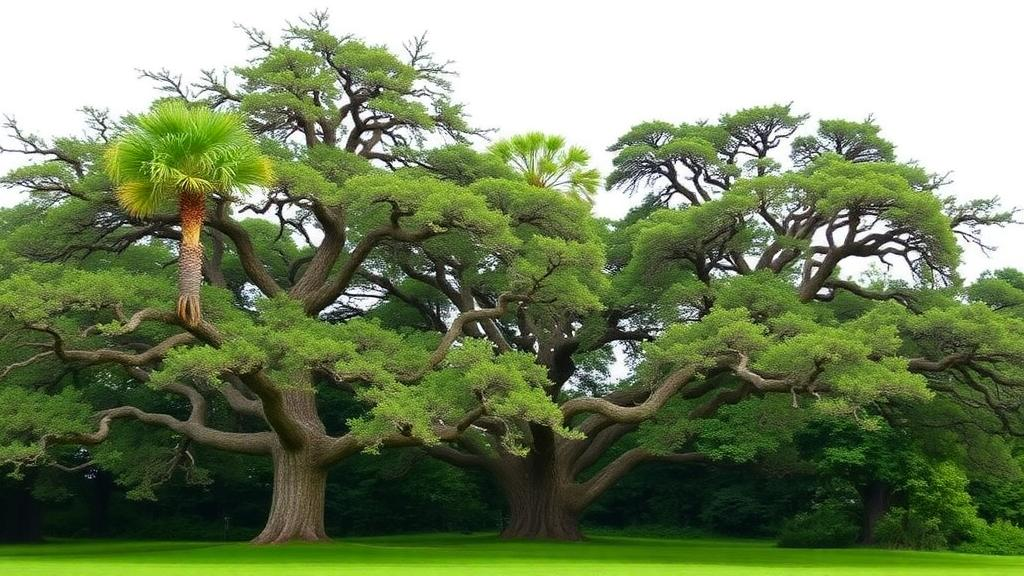
Some of the oldest cultivated trees on Earth are running out of a nutrient that most ecologists rarely worry about. A new study of Torreya grandis, the Chinese nutmeg tree whose ancient plantations in Zhejiang Province have been tended for up to sixteen centuries, shows that these millennial giants face a progressive and potentially severe depletion of potassium in their soils, and that the shortage is quietly unraveling the nutrient-recycling machinery that has sustained them for generations. The findings, published in the journal Plant and Soil, offer a rare long-term window into how the chemistry of a forest ecosystem changes over timescales that span the rise and fall of dynasties.
The research team, led by Mengyuan Chang and Zongxing Wang of Zhejiang A&F University, took advantage of an extraordinary natural experiment: a chronosequence of Torreya grandis stands ranging from 100 to 1,600 years old. Because the trees in each age group grow under broadly similar climate and management traditions, differences among the groups can be attributed largely to age itself. The researchers sampled the full leaf-litter-soil continuum, measuring concentrations of carbon, nitrogen, phosphorus, and potassium in green leaves, fallen litter, and soil at two depths, and then calculated how efficiently the trees resorbed each nutrient before leaf drop.
The soil results told a story of slow but relentless change. Organic carbon and total nitrogen in the soil actually increased as stands aged, a pattern consistent with centuries of litter accumulation and organic matter buildup. Total phosphorus remained relatively stable across all age groups in both the 0-10 and 10-20 centimeter layers. But potassium broke the pattern dramatically: soil total potassium declined consistently with tree age, signaling what the authors describe as progressive potassium depletion. In other words, the very nutrient that plants need in large quantities for enzyme activation, stomatal regulation, and stress tolerance was steadily draining away from the system over the centuries.
The trees themselves reflected this depletion. Leaf concentrations of carbon, nitrogen, and potassium all decreased with tree age, while leaf phosphorus held comparatively steady. This divergence matters because leaf chemistry is a sensitive indicator of what a tree can actually extract from its environment. A falling leaf potassium concentration in the oldest stands suggests that the trees were no longer able to take up enough of the element to maintain the internal concentrations seen in their younger counterparts, even as they continued to photosynthesize and grow on the accumulated organic capital of their soils.
Perhaps the most striking result concerned nutrient resorption efficiency, the process by which trees withdraw valuable nutrients from senescing leaves before they fall, effectively recycling their own biochemical investments. Resorption efficiencies of nitrogen, phosphorus, and potassium all declined substantially as tree age increased, but potassium resorption showed by far the largest drop, plummeting from about 75 percent in the youngest stands to just 32 percent in the oldest. For a tree, losing the ability to salvage three-quarters of the potassium in its leaves before abscission represents a fundamental shift in nutrient economy, forcing greater dependence on an increasingly depleted soil pool.
The drivers behind these shifts were traced through statistical modeling of soil chemistry. Nitrogen resorption efficiency responded primarily to soil nitrogen availability, specifically the concentrations of nitrate and ammonium, the two inorganic forms plants can absorb directly. Phosphorus and potassium resorption, by contrast, were more sensitive to soil potassium levels and pH. This dissociation suggests that different nutrients are governed by different environmental levers, and that a one-size-fits-all fertilization strategy would fail to address the specific bottlenecks emerging in ancient stands.
To integrate these relationships, the team employed structural equation modeling, a technique that allows researchers to test networks of hypothesized cause-and-effect pathways simultaneously. The analysis revealed that tree age influences nutrient resorption efficiency primarily indirectly, through its effects on soil nutrient stoichiometry and on the stoichiometry of leaves and litter. Crucially, potassium-related imbalances exerted the most negative influence on resorption efficiency of any factor examined. The implication is that potassium is not merely one nutrient among several running low; it acts as a keystone element whose scarcity destabilizes the balance of nitrogen and phosphorus cycling throughout the ecosystem.
This finding resonates with a growing body of global evidence. A 2023 meta-analysis cited in the study highlighted that potassium limitation is far more widespread in terrestrial ecosystems than classical nutrient-paradigm thinking, which has long focused on nitrogen and phosphorus, would suggest. Potassium is unusual among macronutrients because it does not form part of any organic structural compound; it exists in plant tissue as a free ion, which means it is easily leached from litter and soils and cannot be locked into stable organic pools the way nitrogen and phosphorus can. Over sixteen centuries of continuous cultivation and harvest, that mobility appears to have worked against the ancient Torreya stands.
The study also touches on the concept of stoichiometric homeostasis, the ability of organisms to maintain stable internal elemental ratios despite variation in what their environment supplies. As the ancient trees aged, their capacity to buffer against shifting soil chemistry appears to have weakened, leaving them increasingly exposed to the elemental imbalances developing around their roots. Combined with the region’s history of high atmospheric nitrogen deposition, which earlier work on Torreya plantations suggested can blunt the benefits of conventional fertilization, the picture that emerges is one of multiple nutrient stresses compounding one another in the oldest stands.
For conservationists, the practical implications are concrete. The authors argue that soil test-based nutrient management, including targeted potassium fertilization and measures to prevent soil acidification, could help sustain the ancient Torreya grandis forests, which are both culturally treasured and economically important for their edible nuts. More broadly, the study underscores that ancient trees are not simply younger trees scaled up in time; they occupy a distinct biogeochemical state shaped by centuries of nutrient cycling, and protecting them may require understanding and correcting elemental deficits that only become visible across millennial timescales. As the world’s oldest living trees face mounting pressures from climate change and land-use intensification, this research suggests that what lies beneath them, in the slow chemistry of their soils, may matter as much as what threatens them above ground.
Subject of Research: Long-term soil potassium depletion and nutrient resorption dynamics in millennial-aged Torreya grandis forests
Article Title: Potassium depletion and reduced nitrogen resorption intensifies the nutrient constraints in millennial-aged Torreya grandis forests
Article References: Chang, M., Wang, Z., Fan, Y., Jin, S., & Xie, H. (2026). Potassium depletion and reduced nitrogen resorption intensifies the nutrient constraints in millennial-aged Torreya grandis forests. Plant and Soil. https://doi.org/10.1007/s11104-026-09116-z
Image Credits: AI Generated
DOI: 10.1007/s11104-026-09116-z
Keywords: Torreya grandis, potassium depletion, nutrient resorption, ecological stoichiometry, ancient trees, chronosequence, soil science, forest ecology, stoichiometric homeostasis, leaf-litter-soil continuum, nitrogen cycling, soil acidification
News Source: Gavin Prescott. (October 6, 2026). Ancient Torreya Trees Are Quietly Starving for Potassium, Century-Long Study Reveals. Scienmag.