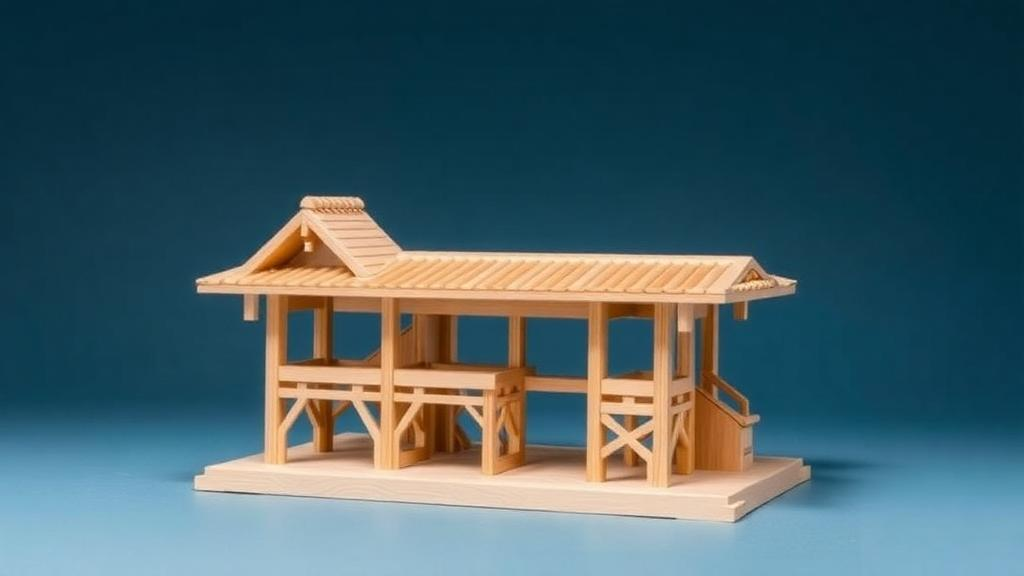
For centuries, Japanese carpenters have built temples, furniture and houses without a single nail or drop of glue, relying instead on intricately carved wooden joints that lock together by geometry alone. Now a team of engineers in Ireland has brought that ancient philosophy into the age of 3D printing, testing whether joinery-inspired interlocking joints printed from biodegradable plastic can hold engineering structures together. The study, published in Results in Engineering, systematically measured the strength of three joint designs and revealed surprising trade-offs between geometry, stiffness and failure behaviour that could shape how modular, repairable products are made in the future.
The research, led by Laoise Reynolds with Omid Sam-Daliri, Yadong Jiang and Pouyan Ghabezi, was motivated by a persistent problem in modern manufacturing. Conventional assembly relies on adhesives, mechanical fasteners or metallurgical joining, all of which carry inherent drawbacks. Adhesive bonds can trap voids and microcracks during manufacture, degrade under moisture, corrosive agents and temperature swings, and demand meticulous surface preparation. Fasteners and welds add weight, create stress concentrations, complicate recycling and make disassembly difficult. As industries push toward modular, repairable and environmentally responsible design, the researchers saw an opportunity in Sashimono, the traditional Japanese woodworking technique that achieves precise, load-bearing assembly with no extra joining elements at all.
Rather than copying traditional wooden joints exactly, the team designed three Japanese-joinery-inspired configurations suited to thermoplastic parts: a Dovetail joint, a T joint and a C joint. Each was printed in polylactic acid, or PLA, a biodegradable thermoplastic derived from plant sugars that is a staple of fused deposition modelling, the most widely used form of 3D printing. PLA offers a low processing temperature, good dimensional stability and a strong sustainability profile, making it an ideal candidate for prototyping interlocking concepts aimed at low-to-medium load-bearing applications. The parts were printed flat on a Prusa MK4 printer with a 0.4 mm nozzle, a 0.2 mm layer height, 100 percent infill and a plus-or-minus 45 degree raster orientation, with a dimensional tolerance of 0.05 mm on the interlocking features so the components could be pressed together by hand with a secure fit.
The experimental campaign was exhaustive. For each joint family, the researchers varied three geometric parameters: neck thickness, a shape-specific feature such as the dovetail angle, the C-joint radius or the T-joint neck length, and the number of interlocking notches, from one to three. Five specimens were printed and tested for every parameter combination, amounting to 270 printed pieces and 135 completed assemblies, roughly 40 hours of printing time. Standard dog-bone specimens were also printed as a continuous reference. Every assembly was pulled to failure on an Instron 4467 universal testing machine at a crosshead speed of 2 mm per minute, while a stereo camera system running GOM ARAMIS digital image correlation captured full-field strain maps on the specimen surface every two seconds, revealing exactly where deformation concentrated and where cracks began.
The continuous printed PLA reference achieved an ultimate tensile strength of 44.4 plus or minus 2.5 MPa with an effective elastic modulus of 2511 MPa, failing in a brittle manner from a localised strain zone that peaked near 20 percent. The interlocking joints, by contrast, reached only a fraction of that strength, a result the authors stress is expected for a proof-of-concept mechanical screening of geometric interlocks. The best performer was the C joint with a 5 mm neck thickness and a single notch, which achieved about 7 MPa, roughly 84 percent below the solid reference but the highest of all tested configurations. Notably, the C joint with a 3 mm neck was far weaker at 4.6 MPa, while thickening the neck to 7 mm also reduced strength to 5.0 MPa, showing that more material does not automatically mean better performance.
Digital image correlation explained why. In the thin-necked C joint, strain concentrated between 6 and 12 percent around the narrow neck, which snapped off in a sudden brittle fracture. The 5 mm version spread strain more evenly, reached about 15 percent local strain and failed progressively with only partial detachment of the neck. The 7 mm joint deformed the most of all, with recorded strains up to 37 percent, absorbing energy through plastic deformation before large chunks of material finally separated. Radius played its own role: increasing the C-joint radius from 3 mm to 5 mm boosted tensile strength by about 31 percent, but the joints also failed more abruptly, while the smallest radius allowed extensive plastic deformation without any visible cracking.
The number of notches produced opposite effects in different joint families, one of the study’s most intriguing findings. In the C joint, adding notches reduced tensile strength, from 5.8 MPa with one notch to 4.9 MPa with three, a drop of nearly 16 percent, while stiffness climbed sharply, with the effective elastic modulus rising about 66 percent. More notches restricted deformation, making the joint appear stiffer but weaker. The Dovetail joint behaved in exactly the reverse manner: three notches delivered 6.1 MPa, a 27.6 percent improvement over a single notch, with stiffness nearly doubling. DIC imaging showed the three-notch dovetail redistributing load after the first crack formed, sustaining additional force before a second brittle fracture appeared, a progressive failure pattern that contrasts with the single catastrophic break of simpler designs.
Dovetail geometry itself proved sensitive to angle and thickness in unexpected ways. Increasing the dovetail angle from 55 to 62.5 degrees raised tensile strength by about 21 percent, yet further thickening the neck from 5 mm to 10 mm cut strength by 38 percent while more than tripling the strain at break, from 1.7 to 5.3 percent. Thicker dovetails absorbed far more deformation, with local strains reaching 64 percent before damage spread, but they did so at lower overall strength and stiffness. The T joint emerged as the weakest family, with its single-notch configuration managing only 2.0 MPa, though adding notches transformed it dramatically: three notches lifted strength to 5.9 MPa, a 188 percent improvement, and produced the highest effective elastic modulus of any configuration at 1350 MPa. DIC revealed the middle notch bearing the brunt of the load, cracking first and then transferring strain to the remaining notches in a staged, progressive collapse.
The authors are careful to frame the scope of their conclusions. The study sits within a Design for Assembly context but did not measure quantitative DFA metrics such as assembly time, assembly force, disassembly cycles, wear or manufacturing cost, and the reported comparisons are descriptive rather than statistically tested. The findings apply specifically to PLA, the tested geometries and static tensile loading. Even so, the message is striking: centuries-old joinery wisdom, translated into printed thermoplastic, can produce tool-free, adhesive-free, fully reversible connections whose strength and failure mode can be tuned almost at will through geometry. A designer can now choose a configuration that prioritises strength, like the multi-notch dovetail, or one that maximises stiffness, like the three-notch T joint, simply by adjusting parameters that a desktop printer can produce overnight.
That tunability is precisely what makes the work resonate beyond the laboratory. In an era of circular-economy targets, products that snap together, come apart cleanly and can be repaired or reconfigured component by component represent a genuine alternative to glued and bolted construction. The Irish team’s demonstration that digital image correlation can pinpoint exactly where printed interlocks concentrate strain gives future designers a practical map of weak points to avoid. The C joint, with its combination of the highest tensile strength and progressive, deformation-tolerant failure, is flagged as the most promising candidate for further development. If subsequent studies confirm that these printed joints survive repeated assembly cycles and real-world loading, the ancient art of Sashimono may find an unlikely second life inside everything from flat-pack furniture to modular drone frames, all built without a screw, a rivet or a bead of glue.
Subject of Research: Mechanical performance of 3D-printed PLA interlocking joints inspired by traditional Japanese joinery
Article Title: Design for assembly of 3D-printed structures using joinery-inspired interlocking joints
Article References: Reynolds, L., Sam-Daliri, O., Jiang, Y., & Ghabezi, P. (2026). Design for assembly of 3D-printed structures using joinery-inspired interlocking joints. Results in Engineering, 32, Article 113437. https://doi.org/10.1016/j.rineng.2026.113437
Image Credits: AI Generated
DOI: 10.1016/j.rineng.2026.113437
Keywords: 3D printing, Japanese joinery, PLA, interlocking joints, dovetail joint, digital image correlation, design for assembly, tensile testing, additive manufacturing, fused deposition modelling, sustainable design, mechanical testing
News Source: Denise Maddox. (October 12, 2026). Ancient Japanese Joinery Meets 3D Printing in Glue-Free Plastic Structures. Scienmag.