• HOME
  • NEWS
  • EXPLORE
    • CAREER
      • Companies
      • Jobs
    • EVENTS
    • iGEM
      • News
      • Team
    • PHOTOS
    • VIDEO
    • WIKI
  • BLOG
  • COMMUNITY
    • FACEBOOK
    • INSTAGRAM
    • TWITTER
Friday, May 15, 2026
BIOENGINEER.ORG
No Result
View All Result
  • Login
  • HOME
  • NEWS
  • EXPLORE
    • CAREER
      • Companies
      • Jobs
        • Lecturer
        • PhD Studentship
        • Postdoc
        • Research Assistant
    • EVENTS
    • iGEM
      • News
      • Team
    • PHOTOS
    • VIDEO
    • WIKI
  • BLOG
  • COMMUNITY
    • FACEBOOK
    • INSTAGRAM
    • TWITTER
  • HOME
  • NEWS
  • EXPLORE
    • CAREER
      • Companies
      • Jobs
        • Lecturer
        • PhD Studentship
        • Postdoc
        • Research Assistant
    • EVENTS
    • iGEM
      • News
      • Team
    • PHOTOS
    • VIDEO
    • WIKI
  • BLOG
  • COMMUNITY
    • FACEBOOK
    • INSTAGRAM
    • TWITTER
No Result
View All Result
Bioengineer.org
No Result
View All Result
Home NEWS Science News Biology

Ancient fossilized tracks suggest multicellular life far older than previously thought

Bioengineer by Bioengineer
February 13, 2019
in Biology
Reading Time: 2 mins read
1
IMAGE
Share on FacebookShare on TwitterShare on LinkedinShare on RedditShare on Telegram

Controversial discovery suggests early complex organisms may have originated 2.1 billion years ago–more than 1.5 billion years sooner than previous evidence indicated.
IMAGE

Credit: Abder El Albani


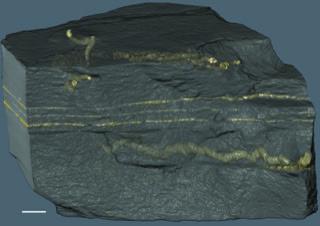
Newly discovered fossilized tracks suggest multicellular life could be 1.5 billion years older than previously thought, according to a new study by an international team of researchers including scientists at the University of Alberta.

“The preservation of fossilized tracks, or trace fossils, suggests that multicellular organisms that could move around to reach food resources may already have existed 2.1 billion years ago, more than 1.5 billion years older than previously thought,” explained Kurt Konhauser, professor in the University of Alberta’s Department of Earth and Atmospheric Sciences and co-author on the study.

Ancient fossilized tracks suggest multicellular organisms originated 2.1 billion years ago.

The sample that contains the fossilized tracks of early multicellular life. Image courtesy of Abder El Albani.

The fossils, found in the Francevillian Series Formation, located in Gabon, Africa, are likely the result of ancient mucus trails, left by multicellular life such as modern amoeboid cells in the search for food. The samples range from 6 millimeters across and 170 millimeters in length through the sediment layers. But despite their small size, the paper on this discovery has sparked international controversy.

“The question arising from this research then is why do we go 1.5 billion years before we see similar features in the rock record?” asked Konhauser. “We don’t see anything like this again until 585 million years ago.”

Some speculate that this early emergence of complex life went extinct due to some environmental factor. Others suggest that similar fossilized traces may have existed but were not preserved, or simply gone unnoticed elsewhere.

“The broader community is right to be skeptical about the interpretation,” said Konhauser. “However, one of the current paradigms relating to the evolution of multicellular organisms is oxygen availability, and 2.1 billion years ago there was no shortage of oxygen in shallow marine waters.”

Future research will examine similar well-oxygenated, shallow-marine environments that are between 2.1 billion and 500 million years old.

###

This research was conducted in collaboration with Abder El Albani of the University of Poitiers in Poitiers, France. The paper, “Organism motility in an oxygenated shallow-marine environment 2.1 billion years ago,” was published this week in Proceedings of the National Academy of Sciences USA (doi: 10.1073/pnas.1815721116).

Media Contact
Katie Willis
[email protected]
780-248-1215

Original Source

https://www.ualberta.ca/science/science-news/2019/february/multicellular-life-tracks

Related Journal Article

http://dx.doi.org/10.1073/pnas.1815721116

Tags: BiologyEarth ScienceEvolutionGeology/SoilMicrobiology
Share12Tweet8Share2ShareShareShare2

Related Posts

Supercomputer Simulations Uncover How Bacterial Enzyme Pumps Sodium Ions, Opening Doors to Novel Antibiotics — Biology

Supercomputer Simulations Uncover How Bacterial Enzyme Pumps Sodium Ions, Opening Doors to Novel Antibiotics

May 15, 2026
New Astrobiology Special Collection Highlights Emerging Evidence Supporting Land-Based Origins of Life — Biology

New Astrobiology Special Collection Highlights Emerging Evidence Supporting Land-Based Origins of Life

May 14, 2026

Revolutionizing Textiles: Engineered Protein Fibers Pave the Way for Sustainable, Recyclable Fabrics

May 14, 2026

URI Master’s Student Emilio Pedroza Lopez Awarded Prestigious NSF Graduate Research Fellowship

May 14, 2026
Please login to join discussion

POPULAR NEWS

  • Research Indicates Potential Connection Between Prenatal Medication Exposure and Elevated Autism Risk

    843 shares
    Share 337 Tweet 211
  • New Study Reveals Plants Can Detect the Sound of Rain

    729 shares
    Share 291 Tweet 182
  • Salmonella Haem Blocks Macrophages, Boosts Infection

    62 shares
    Share 25 Tweet 16
  • Breastmilk Balances E. coli and Beneficial Bacteria in Infant Gut Microbiomes

    58 shares
    Share 23 Tweet 15

About

We bring you the latest biotechnology news from best research centers and universities around the world. Check our website.

Follow us

Recent News

Digital Health Fear Patterns in Older Cancer Patients

A*STAR Scientists Unveil Novel Technique to Decipher RNA Structure’s Impact on Health and Disease

Smart Hydrogels Revolutionize Information Security with Photo-Patterning and Multi-Stimuli Responsive Structural Colors

Subscribe to Blog via Email

Enter your email address to subscribe to this blog and receive notifications of new posts by email.

Join 82 other subscribers
  • Contact Us

Bioengineer.org © Copyright 2023 All Rights Reserved.

Welcome Back!

Login to your account below

Forgotten Password?

Retrieve your password

Please enter your username or email address to reset your password.

Log In
No Result
View All Result
  • Homepages
    • Home Page 1
    • Home Page 2
  • News
  • National
  • Business
  • Health
  • Lifestyle
  • Science

Bioengineer.org © Copyright 2023 All Rights Reserved.