Finding shed light on role of migration in Neolithic to Bronze Age transition and emergence of Indo-European languages
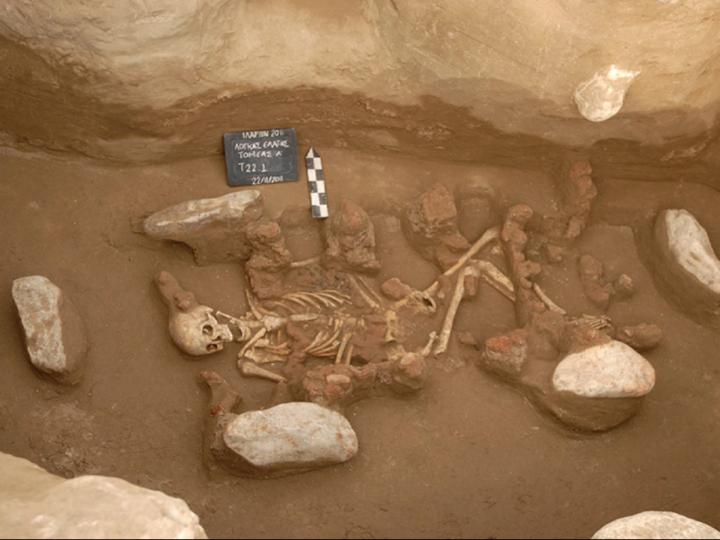
Credit: Ephorate of Antiquities of Kozani, Hellenic Ministry of Culture, Greece. Courtesy of Dr Georgia Karamitrou-Mentessidi.
The first civilisations to build monumental palaces and urban centres in Europe are more genetically homogenous than expected, according to the first study to sequence whole genomes gathered from ancient archaeological sites around the Aegean Sea. The study has been published in the journal Cell.
Despite marked differences in burial customs, architecture, and art, the Minoan civilization in Crete, the Helladic civilization in mainland Greece and the Cycladic civilization in the Cycladic islands in the middle of the Aegean Sea, were genetically similar during the Early Bronze age (5000 years ago).
The findings are important because it suggests that critical innovations such as the development of urban centres, metal use and intensive trade made during the transition from the Neolithic to the Bronze Age were not just due to mass immigration from east of the Aegean as previously thought, but also from the cultural continuity of local Neolithic groups.
The study also finds that by the Middle Bronze Age (4000-4,600 years ago), individuals from the northern Aegean were considerably different compared to those in the Early Bronze Age. These individuals shared half their ancestry with people from the Pontic-Caspian steppe, a large geographic region stretching between the Danube and the Ural rivers and north of the Black Sea, and were highly similar to present-day Greeks.
The findings suggest that migration waves from herders from the Pontic-Caspian steppe, or populations north of the Aegean that bear Pontic-Caspian Steppe like ancestry, shaped present-day Greece. These potential migration waves all predate the appearance of the earliest documented form of Greek, supporting theories explaining the emergence of Proto-Greek and the evolution of Indo-European languages in either Anatolia or the Pontic-Caspian Steppe region.
The team took samples from well-preserved skeletal remains at archaeological sites. They sequenced six whole genomes, four from all three cultures during the Early Bronze Age and two from a Helladic culture during the Middle Bronze Age.
The researchers also sequenced the mitochondrial genomes from eleven other individuals from the Early Bronze Age. Sequencing whole genomes provided the researchers with enough data to perform demographic and statistical analyses on population histories.
Sequencing ancient genomes is a huge challenge, particularly due to the degradation of the biological material and human contamination. A research team at the CNAG-CRG, played an important role in overcoming this challenge through using machine learning.
According to Oscar Lao, Head of the Population Genomics Group at the CNAG-CRG, “Taking an advantage that the number of samples and DNA quality we found is huge for this type of study, we have developed sophisticated machine learning tools to overcome challenges such as low depth of coverage, damage, and modern human contamination, opening the door for the application of artificial intelligence to palaeogenomics data.”
“Implementation of deep learning in demographic inference based on ancient samples allowed us to reconstruct ancestral relationships between ancient populations and reliably infer the amount and timing of massive migration events that marked the cultural transition from Neolithic to Bronze Age in Aegean,” says Olga Dolgova, postdoctoral researcher in the Population Genomics Group at the CNAG-CRG.
The Bronze Age in Eurasia was marked by pivotal changes on the social, political, and economic levels, visible in the appearance of the first large urban centres and monumental palaces. The increasing economic and cultural exchange that developed during this time laid the groundwork for modern economic systems–including capitalism, long-distance political treaties, and a world trade economy.
Despite their importance for understanding the rise of European civilisations and the spread of Indo-European languages, the genetic origins of the peoples behind the Neolithic to Bronze Age transition and their contribution to the present-day Greek population remain controversial.
Future studies could investigate whole genomes between the Mesolithic and Bronze Age in the Armenian and Caucasus to help further pinpoint the origins of migration into the Aegean, and to better integrate the genomic data with the existing archaeological and linguistic evidence.
###
Media Contact
Omar Jamshed
[email protected]
Related Journal Article
http://dx.