• HOME
  • NEWS
  • EXPLORE
    • CAREER
      • Companies
      • Jobs
    • EVENTS
    • iGEM
      • News
      • Team
    • PHOTOS
    • VIDEO
    • WIKI
  • BLOG
  • COMMUNITY
    • FACEBOOK
    • INSTAGRAM
    • TWITTER
Thursday, May 14, 2026
BIOENGINEER.ORG
No Result
View All Result
  • Login
  • HOME
  • NEWS
  • EXPLORE
    • CAREER
      • Companies
      • Jobs
        • Lecturer
        • PhD Studentship
        • Postdoc
        • Research Assistant
    • EVENTS
    • iGEM
      • News
      • Team
    • PHOTOS
    • VIDEO
    • WIKI
  • BLOG
  • COMMUNITY
    • FACEBOOK
    • INSTAGRAM
    • TWITTER
  • HOME
  • NEWS
  • EXPLORE
    • CAREER
      • Companies
      • Jobs
        • Lecturer
        • PhD Studentship
        • Postdoc
        • Research Assistant
    • EVENTS
    • iGEM
      • News
      • Team
    • PHOTOS
    • VIDEO
    • WIKI
  • BLOG
  • COMMUNITY
    • FACEBOOK
    • INSTAGRAM
    • TWITTER
No Result
View All Result
Bioengineer.org
No Result
View All Result
Home NEWS Science News Biology

Ancient beetle discovery gives clue to gymnosperm pollination

Bioengineer by Bioengineer
August 16, 2018
in Biology
Reading Time: 2 mins read
0
Share on FacebookShare on TwitterShare on LinkedinShare on RedditShare on Telegram
IMAGE

Credit: NIGPAS

Plant-insect interactions, one of the critical bedrocks for modern ecosystems, are largely dominated by insect-angiosperm relationships owing to the hegemony enjoyed by flowering plants since the Late Cretaceous. Gymnosperm-insect interactions, on the other hand, are far less well understood, particularly in terms of pollination modes.

Insect-mediated pollination in gymnosperms and potentially prior to the rise of flowering plants is critical for understanding not only the complex biology of these plants today but also the ecology of pre-angiospermous ecosystems and the history of pollination specializations on gymnosperms.

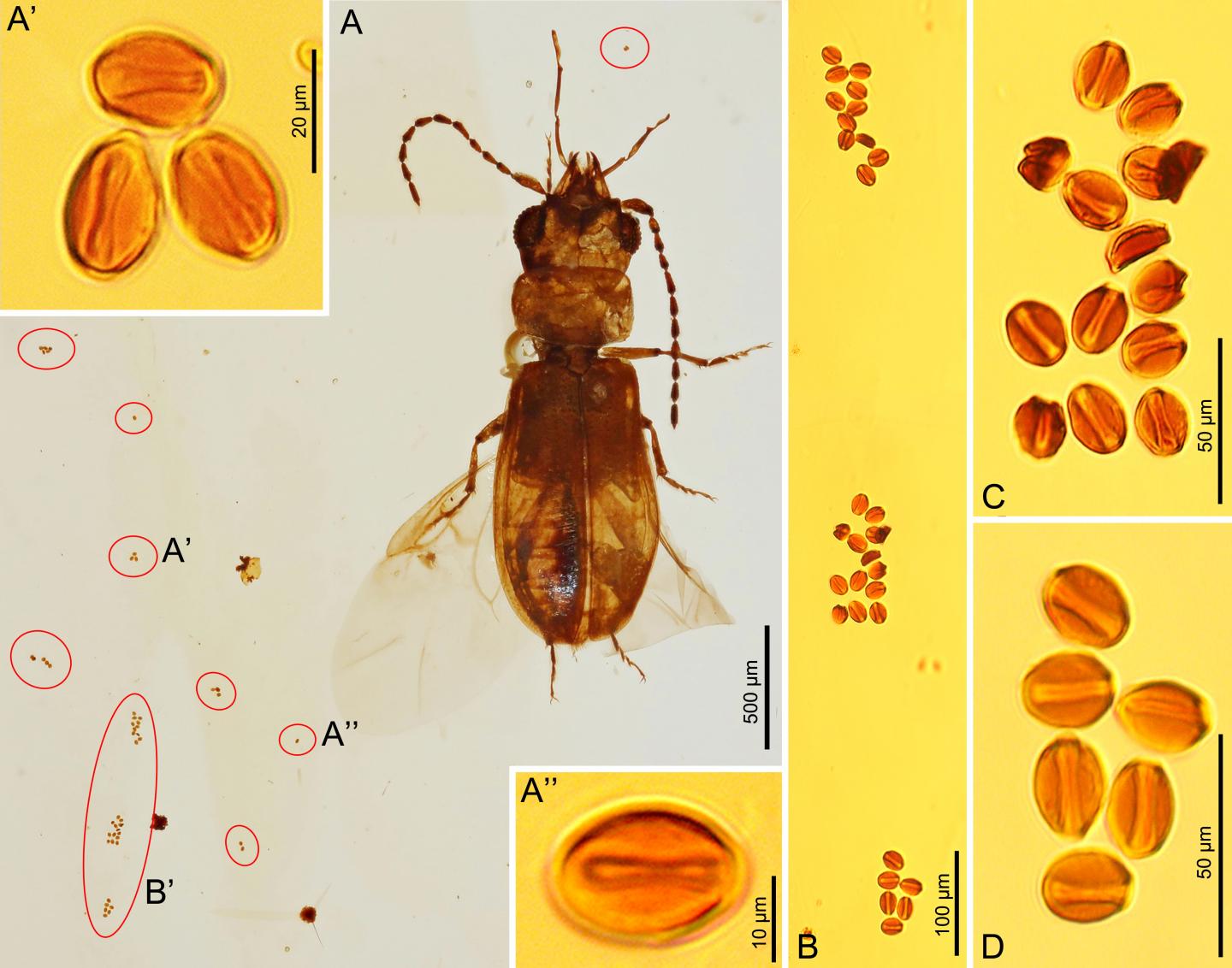
A new mid-Cretaceous (99-million-year-old) boganiid beetle with specialized pollen feeding adaptations was reported in Current Biology on August 16, 2018. This discovery suggests an ancient origin for beetle pollination of cycads long before the rise of flowering plants.

Phylogenetic analyses of the beetle and associated pollen grains conducted by Dr. CAI Chenyang from the Nanjing Institute of Geology and Palaeontology of the Chinese Academy of Sciences (NIGPAS) and his colleagues indicated that it was probably a pollinator of early cycads.

Unlike modern wind-pollinated conifers and Ginkgo, cycads are unusual in that they are an ancient group of gymnosperms pollinated by insects, such as beetles and rarely thrips. Little is known about the early evolution of their pollination mode before the rise of angiosperms, or flowering plants, although cycads are well documented from the mid-Mesozoic.

The researchers discovered a new genus and species of boganiid beetle, named Cretoparacucujus cycadophilus Cai and Escalona, 2018, preserved with many tiny cycad pollen grains and possessing specialized mandibular patches for the transport of cycad pollen.

Most importantly, morphology-based phylogenetic placement of the species reveals it belongs to a clade of relict genera with a disjunct distribution encompassing southeastern Africa and southwestern Australia. The species are also specialist pollinators of the same clade of modern cycads. Thus, both morphological and phylogenetic evidence support the determination of the fossil as a cycad-associated insect species.

The fossil represents the earliest definitive fossil evidence for cycad-insect interactions, and illuminates the ancient history of the establishment of complex entomophily in cycads. It also indicates a probable ancient origin of beetle pollination of cycads at least in the early stage of the Jurassic, some 176 million years ago, long before flowering-plant dominance and the radiation of their pollinators such as bees and butterflies later in the Cretaceous.

###

Media Contact

CHEN Xiaozheng
[email protected]

http://english.cas.cn/

Original Source

http://english.cas.cn/ http://dx.doi.org/10.1016/j.cub.2018.06.036

Share12Tweet8Share2ShareShareShare2

Related Posts

“‘Last Titan’: Discovery of Southeast Asia’s Largest Dinosaur Unveiled” — Biology

“‘Last Titan’: Discovery of Southeast Asia’s Largest Dinosaur Unveiled”

May 14, 2026
Study Offers In-Depth Analysis of Changes in Toxin-Producing Phytoplankton Populations — Biology

Study Offers In-Depth Analysis of Changes in Toxin-Producing Phytoplankton Populations

May 14, 2026

UMass Chan Scientists Pioneer Gene Editing Technology That Rewrites Entire Genome Chapters

May 13, 2026

Scientists Observe Rice Plants Capturing and Eliminating Fall Armyworm Caterpillars

May 13, 2026
Please login to join discussion

POPULAR NEWS

  • Research Indicates Potential Connection Between Prenatal Medication Exposure and Elevated Autism Risk

    842 shares
    Share 337 Tweet 211
  • New Study Reveals Plants Can Detect the Sound of Rain

    729 shares
    Share 291 Tweet 182
  • Salmonella Haem Blocks Macrophages, Boosts Infection

    62 shares
    Share 25 Tweet 16
  • Breastmilk Balances E. coli and Beneficial Bacteria in Infant Gut Microbiomes

    57 shares
    Share 23 Tweet 14

About

We bring you the latest biotechnology news from best research centers and universities around the world. Check our website.

Follow us

Recent News

“‘Last Titan’: Discovery of Southeast Asia’s Largest Dinosaur Unveiled”

Alpine Fires Surge in Central Africa Mountains

Physical Activity Mitigates Sedentary Risks in Elderly

Subscribe to Blog via Email

Enter your email address to subscribe to this blog and receive notifications of new posts by email.

Join 82 other subscribers
  • Contact Us

Bioengineer.org © Copyright 2023 All Rights Reserved.

Welcome Back!

Login to your account below

Forgotten Password?

Retrieve your password

Please enter your username or email address to reset your password.

Log In
No Result
View All Result
  • Homepages
    • Home Page 1
    • Home Page 2
  • News
  • National
  • Business
  • Health
  • Lifestyle
  • Science

Bioengineer.org © Copyright 2023 All Rights Reserved.