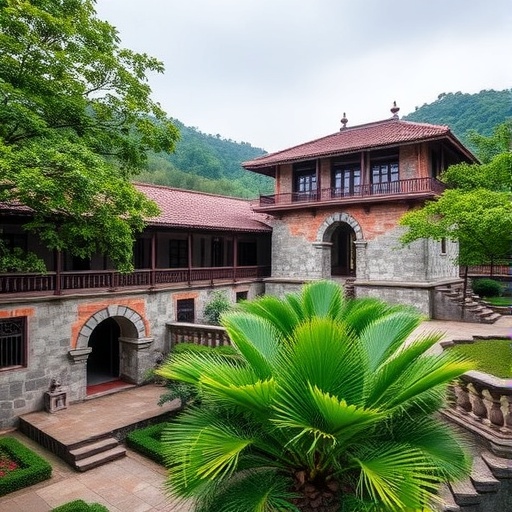
Ancient masonry on Hainan Island, China, serves as a remarkable natural archive where centuries-old architectural remnants foster a surprisingly diverse array of epilithic plants, revealing a profound and previously underappreciated integration of cultural and biological heritage. This ecological phenomenon emerges from complex interactions between geographical gradients, architectural characteristics, and human influence. A comprehensive new study led by Hua-Feng Wang and colleagues at Hainan University elucidates these drivers, offering groundbreaking insights that support more holistic conservation strategies capable of safeguarding both biodiversity and the integrity of historic structures.
The pressure mounting from rapid urbanization in China, especially in tropical regions with hot, humid climates, has long posed threats to the preservation of ancient masonry constructions. These environmental stresses accelerate material degradation and compromise the longevity of historic architectures. At the same time, these very stone facades act as microhabitats for a range of vascular plants, ferns, and climbing species collectively known as epilithic flora. These plants do not merely survive passively; they actively modulate surface microclimates by regulating humidity and temperature, influencing weathering rates in both protective and detrimental ways. Despite their ecological and structural significance, scholarly attention has often been restricted to localized case studies, leaving large-scale patterns and drivers insufficiently understood.
Published in Tropical Plants on December 26, 2025, Wang’s team presents an extensive island-wide analysis that reconceptualizes ancient masonry as a unique ecological niche. Their experimental approach combines meticulous field surveys with advanced statistical modeling to untangle the interplay between physical site attributes, landscape context, and human socioeconomic factors influencing epilithic plant diversity. By doing so, they provide an empirical foundation for more informed, ecologically balanced preservation practices that align cultural heritage conservation with native biodiversity protection.
The research encompassed surveys of 44 historic buildings spread across urban, suburban, and rural sites throughout Hainan Island. Detailed inventories documented architectural parameters such as age, spatial footprint, structural height, and type, while simultaneously recording surrounding environmental and socio-economic variables. The results showed that most structures dated back to the 15th and 16th centuries, boasting an average footprint exceeding 8,000 square meters. Residential buildings predominated, revealing patterns of settlement distribution shaped by Hainan’s rich multicultural history and contemporary urbanization pressures.
Statistical analyses revealed compelling findings regarding species richness and distribution patterns. Contrary to expectations, no statistically significant differences were observed in epilithic plant diversity across urbanization gradients or between temporal strata defined by the buildings’ ages. This suggests that ancient masonry functions as relatively self-contained ecological units, resilient to external landscape transformations and human-induced change. The suburban sites did show a marginally higher species richness, hinting at nuanced local effects warranting further investigation.
The floristic inventory was impressive in scope and composition, cataloging over 25,000 individual plants representing 255 species, spanning 196 genera and 80 families. The Moraceae family, including the ubiquitous Ficus pumila, dominated the assemblage alongside a variety of fern taxa, underscoring the mixed vascular and cryptogamic plant communities supported by these stone habitats. Functional analyses indicated a prevalence of herbaceous, perennial, and wild native species, many with ornamental value and a minority possessing edible qualities, highlighting the cultural as well as ecological roles of these epiliths.
Employing multifactorial linear regression models and analysis of variance (ANOVA) tests, the team decoded the spatiotemporal drivers of plant abundance and diversity. Positive correlations emerged between epiphytic richness and variables such as longitude, building area, architectural age, local economic development metrics, and proximate commercial activity. Contrariwise, annual passenger traffic, a proxy for human disturbance intensity, manifested consistently negative effects. These patterns spotlight the dual role of human activity as both facilitator and perturbator of ancient masonry ecosystems.
Taxon-specific responses to environmental and anthropogenic variables further exposed the complexity behind community assemblages. Different functional groups, including herbaceous perennials, climbers, and ferns, varied in their sensitivity to factors like urban intensity, architectural features, and socioeconomic context. Such differential responses reveal intricate ecological dynamics shaped by microhabitat heterogeneity and underscore the necessity for tailored management strategies targeting distinct plant groups to optimize conservation outcomes.
The research reimagines ancient masonry not merely as static cultural artifacts but as dynamic “vertical green spaces” that contribute to urban biodiversity by harboring specialized plant communities. This vertical dimension of green infrastructure offers novel ecosystem services: microclimate amelioration, habitat provision for native flora, and the preservation of botanical diversity endangered in more intensively transformed environments. Recognizing and leveraging these functions could transform heritage conservation approaches, integrating ecological benefits alongside cultural values.
However, the study also cautions against laissez-faire management, as unchecked proliferation of large or aggressive species risks compromising structural integrity through physical disruption or chemical weathering. Accordingly, Wang’s team advocates selective management regimes that prioritize beneficial native species enhancing ecoservice delivery while controlling high-risk taxa. Such data-driven frameworks promise more sustainable integration of biodiversity conservation within heritage preservation paradigms.
Funded by the National Natural Science Foundation of China, this work represents one of the few island-wide efforts to bridge the disciplinary chasm between plant ecology, urban geography, and conservation science, filling a critical knowledge gap concerning the biotic dimension of historic masonry structures. The open-access publication in Tropical Plants ensures accessibility to broad academic and practitioner audiences, facilitating interdisciplinary discourse and informing policy development in tropical heritage contexts facing accelerating environmental transformations.
By unveiling ancient architecture as a nexus of cultural and biological heritage, this study invites rethinking preservation frameworks toward multifunctional landscapes that honor the intertwined legacies of human craftsmanship and natural evolution. Such integrative perspectives are increasingly essential in a world where cultural landmarks and biodiversity hotspots coexist amid expanding urban landscapes and climatic shifts, underscoring the urgency of inclusive, evidence-based stewardship.
Subject of Research: Not applicable
Article Title: Conserving the biotic heritage of ancient masonry: differential drivers of plant colonization on Hainan Island, China
News Publication Date: 26-Dec-2025
References:
DOI: 10.48130/tp-0025-0033
Keywords: Engineering, Agriculture, Plant sciences
Tags: architectural microhabitats for floraconservation strategies for biodiversitycultural and biological heritage integrationecological interactions in architectureepilithic plant diversityHainan Island ancient architecturepreservation of historic masonrystudy of ancient structures and ecologysustainable heritage conservation practicestropical climate plant ecologyurbanization impact on ancient structuresvascular plants on masonry