• HOME
  • NEWS
  • EXPLORE
    • CAREER
      • Companies
      • Jobs
    • EVENTS
    • iGEM
      • News
      • Team
    • PHOTOS
    • VIDEO
    • WIKI
  • BLOG
  • COMMUNITY
    • FACEBOOK
    • INSTAGRAM
    • TWITTER
Tuesday, July 7, 2026
BIOENGINEER.ORG
No Result
View All Result
  • Login
  • HOME
  • NEWS
  • EXPLORE
    • CAREER
      • Companies
      • Jobs
        • Lecturer
        • PhD Studentship
        • Postdoc
        • Research Assistant
    • EVENTS
    • iGEM
      • News
      • Team
    • PHOTOS
    • VIDEO
    • WIKI
  • BLOG
  • COMMUNITY
    • FACEBOOK
    • INSTAGRAM
    • TWITTER
  • HOME
  • NEWS
  • EXPLORE
    • CAREER
      • Companies
      • Jobs
        • Lecturer
        • PhD Studentship
        • Postdoc
        • Research Assistant
    • EVENTS
    • iGEM
      • News
      • Team
    • PHOTOS
    • VIDEO
    • WIKI
  • BLOG
  • COMMUNITY
    • FACEBOOK
    • INSTAGRAM
    • TWITTER
No Result
View All Result
Bioengineer.org
No Result
View All Result
Home NEWS Science News Chemistry

Ancient architecture inspires a window to the future

Bioengineer by Bioengineer
October 2, 2023
in Chemistry
Reading Time: 2 mins read
0
Ancient architecture inspires a window to the future
Share on FacebookShare on TwitterShare on LinkedinShare on RedditShare on Telegram

A centuries-old technique for constructing arched stone windows has inspired a new way to form tailored nanoscale windows in porous functional materials called metal-organic frameworks (MOFs).
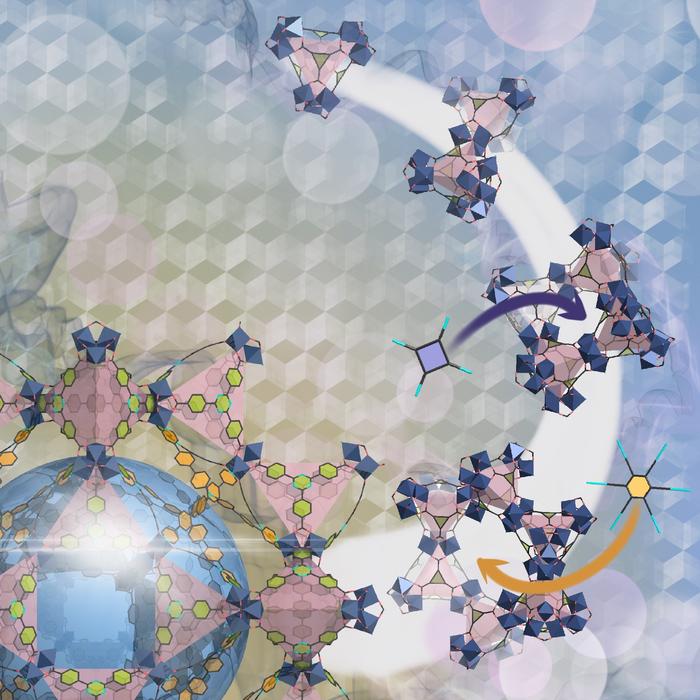
Ancient architecture inspires a window to the future

Credit: © 2023 KAUST.

A centuries-old technique for constructing arched stone windows has inspired a new way to form tailored nanoscale windows in porous functional materials called metal-organic frameworks (MOFs).

The method uses a molecular version of an architectural arch-forming “centring formwork“ template to direct the formation of MOFs with pore windows of predetermined shape and size.[1]. New MOFs designed and made in this way range from narrow-windowed materials with gas separation potential to larger-windowed structures with potential medical applications due to their excellent oxygen-adsorption capacity.

“One of the most challenging goals in new structure design is the precise control of structure formation,” says Aleksandr Sapianik, a postdoc in the group of Mohamed Eddaoudi, who led the research. For reticular chemistry — the assembly of molecular building blocks into porous crystalline materials such as MOFs — the centering formwork concept might offer that precise control, the team realized.

The starting point of the research was a zeolite-like MOF (ZMOF), which usually features pentagonal windows framed by building blocks called supertetrahedra (ST). “Our goal was to control ST arrangement to change from this well-known topology to one not reported before with these building blocks,” Sapianik says.

The team developed centring structure-directing agents (cSDA) to control ST alignment and form ZMOF windows of new shapes and sizes. One set of cSDAs, designed to tighten the angle between adjoining ST units, created small windows. Another set, designed to expand the angle between ST units, gave larger windows.

“MOF pore size and volume are important parameters that affect their application,” says Marina Barsukova, a postdoc in Eddaoudi’s team. One large-windowed ZMOF the team designed, Fe-sod-ZMOF-320, showed the highest oxygen adsorption capacity of any MOF known. “This property is important in the medical and aerospace industries, where the high capacity would increase oxygen storage in a cylinder, or enable smaller cylinders for easier transport,” Barsukova says. The same ZMOFs also performed well for storage of methane and hydrogen, which are potential fuels. Other ZMOFs in the family with narrow windows showed potential for gas separation of molecular mixtures.

The cSDA concept offers multiple benefits enhancing MOF performance, says Vincent Guillerm, a research scientist in Eddaoudi’s group. “The cSDA partitions big windows into smaller ones, which our preliminary results suggest will be useful for chemical separations,” he says. “It also offers additional internal pore surface, which can help to improve gas storage, and reinforces the MOF framework, which should improve the material’s stability,” he adds.

“The centring approach we have developed is another powerful strategy in the repertoire of reticular chemistry, offering great potential for made-to-order MOFs for applications in energy security and environmental sustainability,” Eddaoudi says.


Journal

Nature Synthesis

DOI

10.1038/s44160-023-00401-8

Article Title

Face-directed assembly of tailored isoreticular MOFs using centring structure-directing agents

Article Publication Date

2-Oct-2023

Share12Tweet8Share2ShareShareShare2

Related Posts

Salt adaptation linked to higher disease risk, Mizzou study finds

Salt adaptation linked to higher disease risk, Mizzou study finds

July 6, 2026
Intelligent Microgrid Management Promises Lower Household Energy Bills and Reduced Diesel Emissions — Chemistry

Intelligent Microgrid Management Promises Lower Household Energy Bills and Reduced Diesel Emissions

July 4, 2026

Graz University of Technology Deciphers the Structural Secrets of MOF Thin Films

July 2, 2026

Breaking Thermodynamic Limits: Wavelength-Driven Catalysis Advances Ammonia Synthesis

July 2, 2026

POPULAR NEWS

  • Detection of EDCs in Breast Milk and Infant Urine Up to Six Months Highlights Early Exposure Risks

    77 shares
    Share 31 Tweet 19
  • New Drug Candidate Developed at McMaster Shows Potential for Treating Brain Cancer

    58 shares
    Share 23 Tweet 15
  • Saying Goodbye to PGY-6: Pediatric Fellowship Realities

    103 shares
    Share 41 Tweet 26
  • KTU Researchers Explore Ultrasound’s Role in Enhancing Blood Flow Beyond Diagnostics

    53 shares
    Share 21 Tweet 13

About

We bring you the latest biotechnology news from best research centers and universities around the world. Check our website.

Follow us

Recent News

Flame retardant BDE-209 targets molecularly linked to ulcerative colitis

Ultra-high frequency particle impacts mimic rockbursts to shatter hard rock

Kidney transplant outcomes in older adults studied by German researchers

Subscribe to Blog via Email

Enter your email address to subscribe to this blog and receive notifications of new posts by email.

Join 83 other subscribers
  • Contact Us

Bioengineer.org © Copyright 2023 All Rights Reserved.

Welcome Back!

Login to your account below

Forgotten Password?

Retrieve your password

Please enter your username or email address to reset your password.

Log In
No Result
View All Result
  • Homepages
    • Home Page 1
    • Home Page 2
  • News
  • National
  • Business
  • Health
  • Lifestyle
  • Science

Bioengineer.org © Copyright 2023 All Rights Reserved.