• HOME
  • NEWS
  • EXPLORE
    • CAREER
      • Companies
      • Jobs
    • EVENTS
    • iGEM
      • News
      • Team
    • PHOTOS
    • VIDEO
    • WIKI
  • BLOG
  • COMMUNITY
    • FACEBOOK
    • INSTAGRAM
    • TWITTER
Wednesday, September 23, 2026
BIOENGINEER.ORG
No Result
View All Result
  • Login
  • HOME
  • NEWS
  • EXPLORE
    • CAREER
      • Companies
      • Jobs
        • Lecturer
        • PhD Studentship
        • Postdoc
        • Research Assistant
    • EVENTS
    • iGEM
      • News
      • Team
    • PHOTOS
    • VIDEO
    • WIKI
  • BLOG
  • COMMUNITY
    • FACEBOOK
    • INSTAGRAM
    • TWITTER
  • HOME
  • NEWS
  • EXPLORE
    • CAREER
      • Companies
      • Jobs
        • Lecturer
        • PhD Studentship
        • Postdoc
        • Research Assistant
    • EVENTS
    • iGEM
      • News
      • Team
    • PHOTOS
    • VIDEO
    • WIKI
  • BLOG
  • COMMUNITY
    • FACEBOOK
    • INSTAGRAM
    • TWITTER
No Result
View All Result
Bioengineer.org
No Result
View All Result
Home NEWS Science News Biology

An OU-led study sheds new insight on forest loss and degradation in Brazilian Amazon

Bioengineer by Bioengineer
April 29, 2021
in Biology
Reading Time: 2 mins read
0
IMAGE
Share on FacebookShare on TwitterShare on LinkedinShare on RedditShare on Telegram

IMAGE

Credit: Xiangming Xiao

An international team led by Xiangming Xiao, George Lynn Cross Research Professor in the Department of Microbiology and Plant Biology, University of Oklahoma College of Arts and Sciences, published a paper in the April issue of the journal Nature Climate Change that has major implications on forest policies, conservation and management practices in the Brazilian Amazon. Xiao also is director of OU’s Center for Earth Observation and Modeling. Yuanwei Qin, a research scientist at the Center for Earth Observation and Modeling, is the lead author of the study.

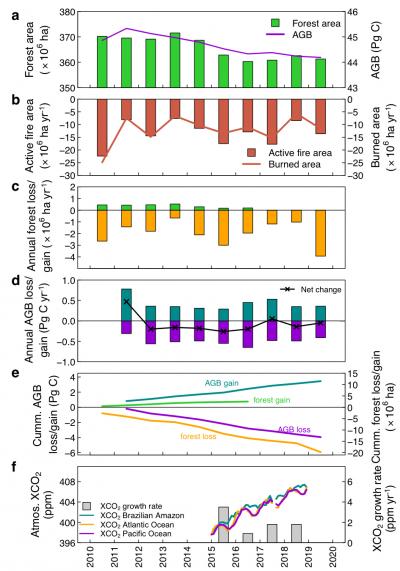
For the study described in the paper, “Carbon loss from forest degradation exceeds that from deforestation in the Brazilian Amazon,” Xiao, Qin and a team of research scientists and faculty from institutes and universities in the United States, France, the United Kingdom, Denmark and China used satellite data to track spatial-temporal changes of forest area and aboveground biomass in the Brazilian Amazon from 2010 to 2019. They discovered that carbon loss from forest degradation was greater than that resulting from deforestation in the region, which indicates forest degradation should become a high priority in policies, conservation and management.

Tropical forests in the Amazon account, Qin notes, for approximately 50% of the rainforests in the world and are important for global biodiversity, hydrology, climate and the carbon cycle. Accurate and timely data on vegetation aboveground biomass and forest area in the region at various spatial and temporal scales are also essential for data-based policies and decision making. This international team harnessed diverse data for monitoring, reporting and verification of tropical forests. The paper published in Nature Climate Change is a follow-up of a previous study published in Nature Sustainability in 2019, which reported improved estimates of forest areas in the Brazilian Amazon.

###

Media Contact
Zack Higbee
[email protected]

Related Journal Article

http://dx.doi.org/10.1038/s41558-021-01026-5

Tags: BiologyMicrobiology
Share12Tweet8Share2ShareShareShare2

Related Posts

Ocean Particles Forge Lasting Bonds Between Bacteria and Plankton, Year-Long Study Finds

Ocean Particles Forge Lasting Bonds Between Bacteria and Plankton, Year-Long Study Finds

September 23, 2026
AI Reads Three Layers of Breast Cancer Biology at Once to Sharpen Subtype Diagnosis

AI Reads Three Layers of Breast Cancer Biology at Once to Sharpen Subtype Diagnosis

September 23, 2026

Mother and Baby Do Not Share a Metabolic Fingerprint at Birth, Study Finds

September 23, 2026

New AI Tool MANTRA Reads Leukemia Data in Multiple Dimensions to Reveal Hidden Patient Subgroups

September 23, 2026
Please login to join discussion

POPULAR NEWS

  • Why the First 1000 Days Decide the Fate of Global Health Equity

    29 shares
    Share 12 Tweet 7
  • Ocean Particles Forge Lasting Bonds Between Bacteria and Plankton, Year-Long Study Finds

    29 shares
    Share 12 Tweet 7
  • Designer Salts Called Ionic Liquids Are Reshaping How Metal Nanoparticles Are Made and Used in Medicine

    29 shares
    Share 12 Tweet 7
  • Urban Millipedes Reveal Surprisingly Picky Diets in China’s Fragmented Forests

    29 shares
    Share 12 Tweet 7

About

We bring you the latest biotechnology news from best research centers and universities around the world. Check our website.

Follow us

Recent News

Why the First 1000 Days Decide the Fate of Global Health Equity

Ocean Particles Forge Lasting Bonds Between Bacteria and Plankton, Year-Long Study Finds

Designer Salts Called Ionic Liquids Are Reshaping How Metal Nanoparticles Are Made and Used in Medicine

Subscribe to Blog via Email

Enter your email address to subscribe to this blog and receive notifications of new posts by email.

Join 85 other subscribers
  • Contact Us

Bioengineer.org © Copyright 2023 All Rights Reserved.

Welcome Back!

Login to your account below

Forgotten Password?

Retrieve your password

Please enter your username or email address to reset your password.

Log In
No Result
View All Result
  • Homepages
    • Home Page 1
    • Home Page 2
  • News
  • National
  • Business
  • Health
  • Lifestyle
  • Science

Bioengineer.org © Copyright 2023 All Rights Reserved.