Acute myeloid leukemia (AML) is an aggressive form of blood cancer. It is caused by mutations in a large number of genes that are acquired in the course of a person’s life. One of these genes – the tumor suppressor gene TP53 – plays a key role. Normally, TP53 helps to prevent the development of tumors. Blood cancer patients in whom this gene is mutated, however, face an extremely poor prognosis, as their genes are resistant to conventional chemotherapeutic agents. Intensive research is therefore being carried out into new therapeutic approaches, such as CAR (chimeric antigen receptor) T-cells, which are already being used successfully for other cancers of the blood.
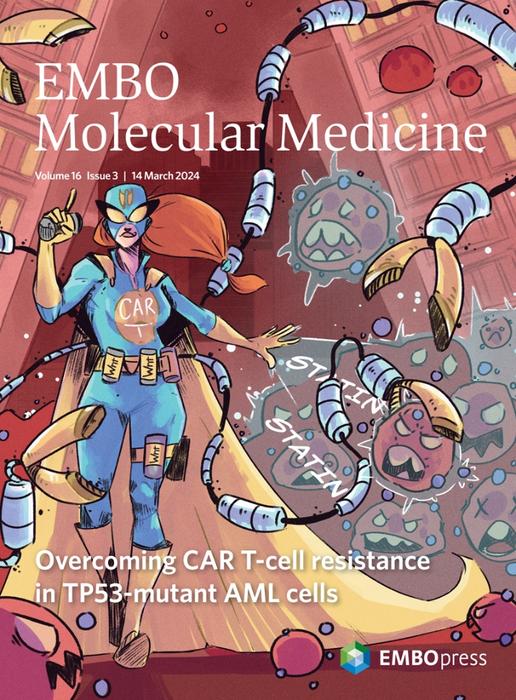
Credit: Copyright: EMBO Press, Illustration: DrawImpacts
Acute myeloid leukemia (AML) is an aggressive form of blood cancer. It is caused by mutations in a large number of genes that are acquired in the course of a person’s life. One of these genes – the tumor suppressor gene TP53 – plays a key role. Normally, TP53 helps to prevent the development of tumors. Blood cancer patients in whom this gene is mutated, however, face an extremely poor prognosis, as their genes are resistant to conventional chemotherapeutic agents. Intensive research is therefore being carried out into new therapeutic approaches, such as CAR (chimeric antigen receptor) T-cells, which are already being used successfully for other cancers of the blood.
Mutation in blood cancer cells weakens immunotherapy defense cells
An international research team led by Professors Markus Manz and Steffen Boettcher from the University of Zurich (UZH) and the Department of Medical Oncology and Hematology at the University Hospital Zurich (USZ) has now shown that TP53-mutant AML cells are also significantly more resistant to a new type of immunotherapy – CAR T-cell therapy – than AML cells without the mutated gene. “The reason for the poorer effect of CAR T-cells with mutated TP53 is that these immune cells are exhausted more quickly and are therefore less active against the cancer cells,” says Steffen Boettcher, chief of service at USZ.
In CAR T-cell therapy, certain immune cells – the T-cells – are extracted from a patient’s blood. These immune cells are then genetically modified in the lab so that they form numerous new contact points (CARs) on their surface. Reintroduced into the patient, these CAR T-cells are able to recognize certain surface structures on the tumor cells, which enables the CAR T-cells to identify the cancer cells and destroy them in a targeted manner. Various CAR T-cell products are currently being tested against AML in early clinical trials.
Concomitant pharmacotherapies or advanced CAR T-cells are effective against resistant cancer cells
In their study, the researchers not only examined the mechanism underlying the resistance of mutated AML cells to CAR T-cell immunotherapy; they also found out how the endurance of CAR T-cells can be increased and a weak point of TP53-mutant AML cells can be exploited to overcome this resistance. Through additional pharmacological concomitant therapies or further genetic improvement of the CAR T-cells, they were able to drastically increase the effectiveness of CAR T-cells against TP53-mutant AML cells to the point where there was no longer any therapeutic difference compared to non-mutated AML cells.
“This proof-of-principle study shows that concurrent pharmacological therapies and genetically engineered CAR T-cells are promising strategies to develop more effective and tolerable immunotherapies for patients with TP53-mutant AML,” says head of clinic Markus Manz.
Journal
EMBO Molecular Medicine
DOI
10.1038/s44321-024-00024-2
Method of Research
Experimental study
Subject of Research
Human tissue samples
Article Title
Targeting the mevalonate or Wnt pathways to overcome CAR T-cell resistance in TP53-mutant AML cells
Article Publication Date
14-Mar-2024