• HOME
  • NEWS
  • EXPLORE
    • CAREER
      • Companies
      • Jobs
    • EVENTS
    • iGEM
      • News
      • Team
    • PHOTOS
    • VIDEO
    • WIKI
  • BLOG
  • COMMUNITY
    • FACEBOOK
    • INSTAGRAM
    • TWITTER
Monday, July 6, 2026
BIOENGINEER.ORG
No Result
View All Result
  • Login
  • HOME
  • NEWS
  • EXPLORE
    • CAREER
      • Companies
      • Jobs
        • Lecturer
        • PhD Studentship
        • Postdoc
        • Research Assistant
    • EVENTS
    • iGEM
      • News
      • Team
    • PHOTOS
    • VIDEO
    • WIKI
  • BLOG
  • COMMUNITY
    • FACEBOOK
    • INSTAGRAM
    • TWITTER
  • HOME
  • NEWS
  • EXPLORE
    • CAREER
      • Companies
      • Jobs
        • Lecturer
        • PhD Studentship
        • Postdoc
        • Research Assistant
    • EVENTS
    • iGEM
      • News
      • Team
    • PHOTOS
    • VIDEO
    • WIKI
  • BLOG
  • COMMUNITY
    • FACEBOOK
    • INSTAGRAM
    • TWITTER
No Result
View All Result
Bioengineer.org
No Result
View All Result
Home NEWS Science News Chemistry

An enhanced ruthenium-based catalyst for primary amine synthesis

Bioengineer by Bioengineer
September 25, 2020
in Chemistry
Reading Time: 3 mins read
0
IMAGE
Share on FacebookShare on TwitterShare on LinkedinShare on RedditShare on Telegram

IMAGE

Credit: Yusuke Kita

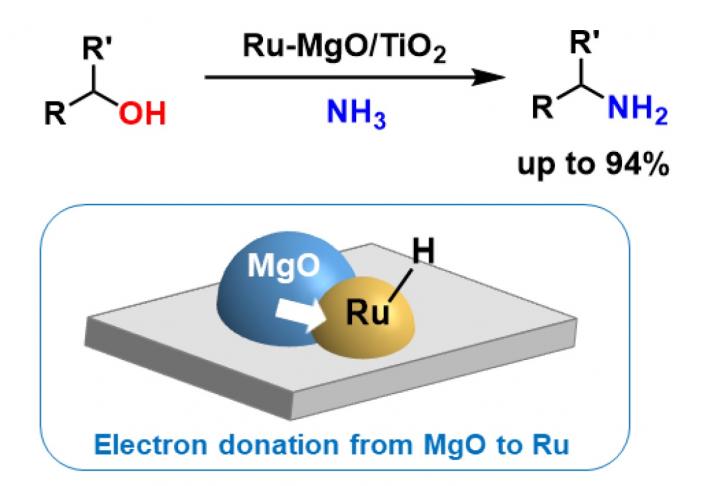
Researchers at Tokyo Institute of Technology (Tokyo Tech) have developed a high-performance reusable ruthenium-based catalyst for the production of primary amines. Their method represents a major advance for the development of efficient catalysts that enable selective conversion of alcohols into primary amines under mild reaction conditions.

Primary amines are extremely versatile building blocks that are used in the preparation of many kinds of dyes, detergents, pharmaceuticals and agricultural chemicals. So far, several methods have been developed to produce primary amines using catalysts containing ruthenium, cobalt and platinum, all of which require the addition of molecular hydrogen. Synthesis of primary amines by direct substitution of alcohols with ammonia has been a longstanding challenge.

Now, researchers at Tokyo Tech report a heterogeneous[1] ruthenium-based catalyst (Ru-MgO/TiO2) capable of driving direct amination[2] of alcohols to produce primary amines without having to introduce hydrogen gas. They showed that the catalyst works at low temperatures, of around 100°C. The ready availability of alcohols and low cost of ammonia make the system both cost-effective and environmentally friendly.

Compared with previous ruthenium-based systems, Ru-MgO/TiO2 achieved higher yields (up to 94%) of the desired primary amines. Reuse experiments showed that after base treatment, the catalyst could be reused three times without significant loss of activity.

Their study, published in Chemical Science, suggests that the MgO component of the catalyst plays an important role in enhancing reactivity through electron donation from MgO to Ru.

The researchers point out that the new catalytic system could be applied to a variety of alcohols, and could serve as a design guide for other new heterogeneous catalysts.

In addition, Ru-MgO/TiO2 could provide an efficient synthetic route for the production of 2,5-bis(aminomethyl)furan (BAMF), an attractive compound used as a hardener for epoxy resins, which are used in many types of coatings and adhesives. Using biomass-derived 2,5-bis(hydroxymethyl)furan (BHMF) as a substrate, the study showed the desired BAMF was obtained at 86% yield, outperforming previous systems.

###

Technical terms

[1] heterogeneous: Heterogeneous catalysis refers to catalysis whereby the phase of catalysts differs from that of the reactants or products.

[2] amination: The introduction of an amine group (a group containing a nitrogen atom with a lone pair of electrons) into an organic molecule.

Related Links

Green catalysts with Earth-abundant metals accelerate production of bio-based plastic

https://www.titech.ac.jp/english/news/2019/043317.html

Reusable ruthenium-based catalyst could be a game-changer for the biomass industry

https://www.titech.ac.jp/english/news/2017/039167.html

Hara & Kamata Laboratory

http://www.msl.titech.ac.jp/~hara/index-e.html

About Tokyo Institute of Technology

Tokyo Tech stands at the forefront of research and higher education as the leading university for science and technology in Japan. Tokyo Tech researchers excel in fields ranging from materials science to biology, computer science, and physics. Founded in 1881, Tokyo Tech hosts over 10,000 undergraduate and graduate students per year, who develop into scientific leaders and some of the most sought-after engineers in industry. Embodying the Japanese philosophy of “monotsukuri,” meaning “technical ingenuity and innovation,” the Tokyo Tech community strives to contribute to society through high-impact research.

https://www.titech.ac.jp/english/

Media Contact
Emiko Kawaguchi
[email protected]

Original Source

https://www.titech.ac.jp/english/news/2020/047976.html

Related Journal Article

http://dx.doi.org/10.1039/d0sc03858j

Tags: Chemistry/Physics/Materials Sciences
Share12Tweet8Share2ShareShareShare2

Related Posts

Salt adaptation linked to higher disease risk, Mizzou study finds

Salt adaptation linked to higher disease risk, Mizzou study finds

July 6, 2026
Intelligent Microgrid Management Promises Lower Household Energy Bills and Reduced Diesel Emissions — Chemistry

Intelligent Microgrid Management Promises Lower Household Energy Bills and Reduced Diesel Emissions

July 4, 2026

Graz University of Technology Deciphers the Structural Secrets of MOF Thin Films

July 2, 2026

Breaking Thermodynamic Limits: Wavelength-Driven Catalysis Advances Ammonia Synthesis

July 2, 2026
Please login to join discussion

POPULAR NEWS

  • Detection of EDCs in Breast Milk and Infant Urine Up to Six Months Highlights Early Exposure Risks

    77 shares
    Share 31 Tweet 19
  • New Drug Candidate Developed at McMaster Shows Potential for Treating Brain Cancer

    58 shares
    Share 23 Tweet 15
  • Saying Goodbye to PGY-6: Pediatric Fellowship Realities

    103 shares
    Share 41 Tweet 26
  • KTU Researchers Explore Ultrasound’s Role in Enhancing Blood Flow Beyond Diagnostics

    53 shares
    Share 21 Tweet 13

About

We bring you the latest biotechnology news from best research centers and universities around the world. Check our website.

Follow us

Recent News

Flame retardant BDE-209 targets molecularly linked to ulcerative colitis

Ultra-high frequency particle impacts mimic rockbursts to shatter hard rock

Kidney transplant outcomes in older adults studied by German researchers

Subscribe to Blog via Email

Enter your email address to subscribe to this blog and receive notifications of new posts by email.

Join 83 other subscribers
  • Contact Us

Bioengineer.org © Copyright 2023 All Rights Reserved.

Welcome Back!

Login to your account below

Forgotten Password?

Retrieve your password

Please enter your username or email address to reset your password.

Log In
No Result
View All Result
  • Homepages
    • Home Page 1
    • Home Page 2
  • News
  • National
  • Business
  • Health
  • Lifestyle
  • Science

Bioengineer.org © Copyright 2023 All Rights Reserved.