• HOME
  • NEWS
  • EXPLORE
    • CAREER
      • Companies
      • Jobs
    • EVENTS
    • iGEM
      • News
      • Team
    • PHOTOS
    • VIDEO
    • WIKI
  • BLOG
  • COMMUNITY
    • FACEBOOK
    • INSTAGRAM
    • TWITTER
Thursday, October 22, 2026
BIOENGINEER.ORG
No Result
View All Result
  • Login
  • HOME
  • NEWS
  • EXPLORE
    • CAREER
      • Companies
      • Jobs
        • Lecturer
        • PhD Studentship
        • Postdoc
        • Research Assistant
    • EVENTS
    • iGEM
      • News
      • Team
    • PHOTOS
    • VIDEO
    • WIKI
  • BLOG
  • COMMUNITY
    • FACEBOOK
    • INSTAGRAM
    • TWITTER
No Result
View All Result
Bioengineer.org
No Result
View All Result
Home NEWS Science News Biology

An atlas reveals the hidden “physical code” in the DNA sequence

by
October 22, 2026
in Biology
Reading Time: 2 mins read
0
An atlas reveals the hidden "physical code" in the DNA sequence

An atlas reveals the hidden "physical code" in the DNA sequence

Share on FacebookShare on TwitterShare on LinkedinShare on RedditShare on Telegram

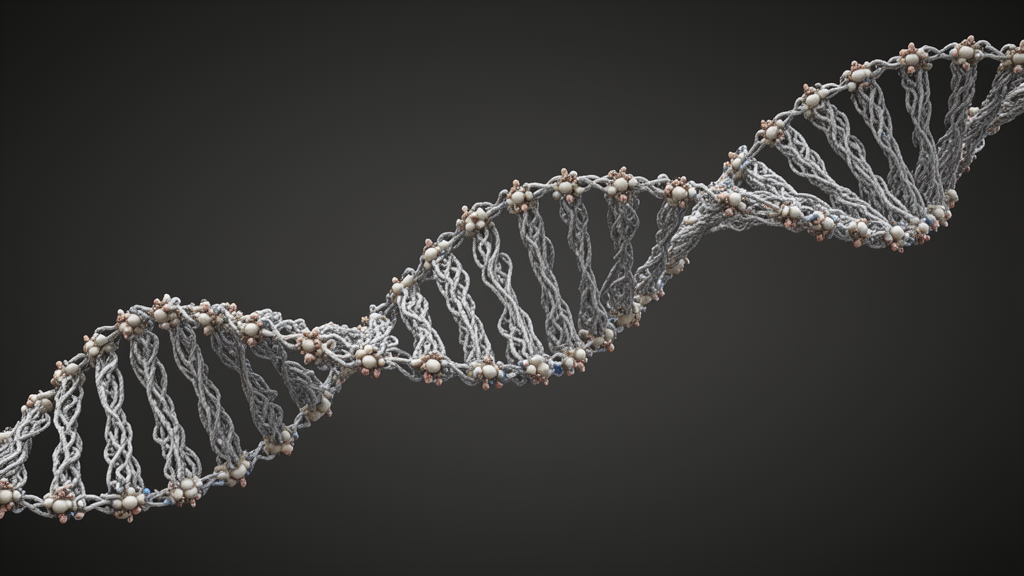
A new peer-reviewed atlas of DNA’s physical properties shows how the order of the four bases can shape how short DNA fragments bend, deform, open and move, with implications for how genes are regulated and how genomes evolve. The study, led by the Institute for Research in Biomedicine (IRB Barcelona) and published in Nature Communications, analyzed all 4,096 possible DNA hexamers, corresponding to 2,080 unique sequences, using molecular dynamics simulations. The researchers also examined non-protein-coding regions and observed a moderate trend in which frequently occurring sequences tended to retain their shape and movements when one base was substituted.

To construct the atlas, 14 groups from the Ascona B-DNA Consortium worked for three years on two replicas of 190 double-stranded DNA fragments, each 20 base pairs long. The simulations generated approximately 250 terabytes of atomic-resolution data. Researchers used the results to determine how sequence influences DNA structure and dynamics, group hexamers into physical families and record both common behavior and rare events such as transient openings and partial unwinding of the double helix.

The findings show that fragments with similar overall base composition can behave very differently depending on the arrangement of their bases, indicating that nucleotide order carries physical information beyond the protein-coding instructions contained in genes. For the evolutionary analysis, the team examined genomic regions that do not contain instructions for producing proteins. In these regions, the most frequently occurring sequences tended to resist small changes: replacing one letter produced little alteration in their shape and movements.

The reported association was moderate, and the study does not establish that physical stability alone caused these sequences to become frequent. Instead, the results are consistent with evolution having favored sequence patterns that preserve physical properties important to DNA function, while further evidence would be needed to establish that interpretation. The researchers say it can support the development of simplified computational models and artificial intelligence systems that represent DNA and chromatin at larger scales.

The study involved institutions from Spain, France, the United Kingdom, the United States, Germany, Poland, Switzerland, Uruguay and Lithuania, with computing resources supplied by the Barcelona Supercomputing Center and other international infrastructures. Because the atlas is based on simulations of short double-stranded DNA fragments under modeled conditions, it describes sequence-dependent physical behavior rather than the full range of DNA dynamics inside living cells. Its central result is a detailed reference map linking the order of DNA bases to molecular structure, movement and a limited evolutionary pattern in non-protein-coding regions.

Subject of Research: Computational characterization of sequence-dependent DNA physical properties and their relationship to genome evolution.

Article Title: An atlas reveals the hidden "physical code" in the DNA sequence

Article References: An atlas reveals the hidden "physical code" in the DNA sequence. Original publication (Bibliographic details unavailable.)

Image Credits: AI Generated

DOI: Not provided

Keywords: DNA hexamers, molecular dynamics, DNA structure, sequence-dependent dynamics, genome evolution, noncoding regions, double helix, atomic-resolution simulation, FAIR data, IRB Barcelona, atlas, reveals

News Source: Juliet Wilcox. (October 22, 2026). An atlas reveals the hidden “physical code” in the DNA sequence. Scienmag.


Tags: Atlasatomic-resolution simulationDNA hexamersDNA structuredouble helixFAIR datagenome evolutionIRB Barcelonamolecular dynamicsnoncoding regionsrevealssequence-dependent dynamics
Share12Tweet7Share2ShareShareShare1

Related Posts

Elapsed irrigation time improves lettuce water-stress classification in controlled reanalysis

Elapsed irrigation time improves lettuce water-stress classification in controlled reanalysis

October 22, 2026
Small breast cancer study finds no significant EBNA1 link to severity

Small breast cancer study finds no significant EBNA1 link to severity

October 22, 2026

Microsatellites reveal distinct structure among Serbia’s Pramenka sheep

October 22, 2026

Nutrient tuning raises ethanol concentration from sugarcane bagasse extract

October 22, 2026

POPULAR NEWS

  • Neurotechnology accelerator links commercialization gaps to concrete deliverables

    Neurotechnology accelerator links commercialization gaps to concrete deliverables

    29 shares
    Share 12 Tweet 7
  • Simulated manufacturing controller cuts emissions but misses allowance

    29 shares
    Share 12 Tweet 7
  • Elapsed irrigation time improves lettuce water-stress classification in controlled reanalysis

    29 shares
    Share 12 Tweet 7
  • Automated de-identification preserves relationships in child protection reports

    29 shares
    Share 12 Tweet 7

About

We bring you the latest biotechnology news from best research centers and universities around the world. Check our website.

Follow us

Recent News

Neurotechnology accelerator links commercialization gaps to concrete deliverables

Simulated manufacturing controller cuts emissions but misses allowance

Elapsed irrigation time improves lettuce water-stress classification in controlled reanalysis

Subscribe to Blog via Email

Enter your email address to subscribe to this blog and receive notifications of new posts by email.

Join 85 other subscribers
  • Contact Us

Bioengineer.org © Copyright 2023 All Rights Reserved.

Welcome Back!

Login to your account below

Forgotten Password?

Retrieve your password

Please enter your username or email address to reset your password.

Log In
No Result
View All Result
  • Homepages
    • Home Page 1
    • Home Page 2
  • News
  • National
  • Business
  • Health
  • Lifestyle
  • Science

Bioengineer.org © Copyright 2023 All Rights Reserved.