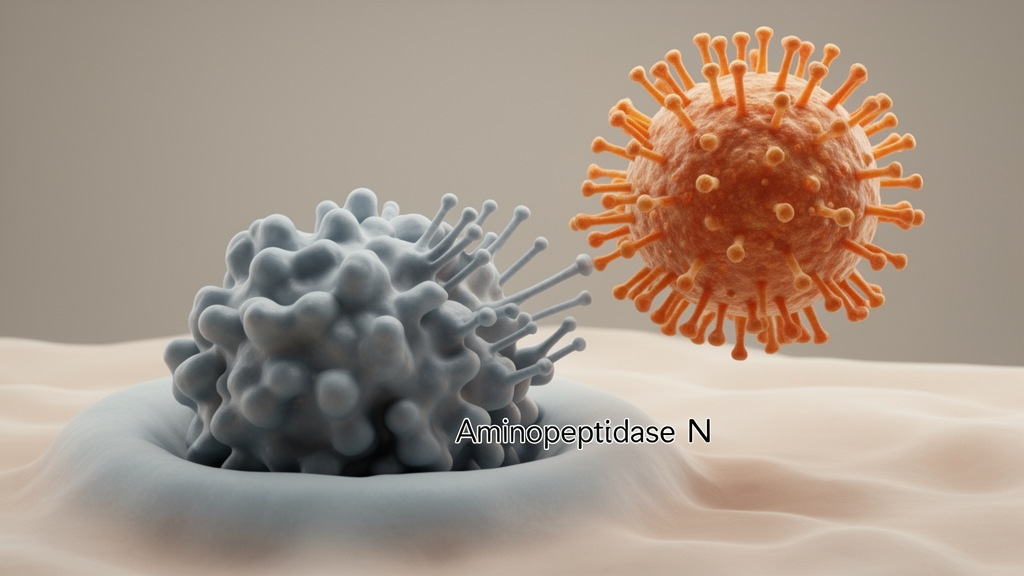
Coronaviruses circulating in European hedgehogs have long puzzled virologists because they are abundant, geographically widespread and closely related to the Middle East respiratory syndrome coronavirus, yet almost nothing has been known about how they actually get into cells. A new study published in Nature Microbiology has now closed that gap. A team led by Michael Letko of Washington State University and James Rini of the University of Toronto, together with collaborators across North America and Europe, shows that aminopeptidase N, a cell-surface enzyme known mainly as a receptor for alphacoronaviruses, serves as the functional entry receptor for the merbecoviruses that infect hedgehogs throughout Europe and Asia. The finding settles a question that has persisted since hedgehog coronaviruses were first identified in Germany in 2014 and provides a molecular framework for judging whether these viruses could ever threaten people.
Merbecoviruses form a subgenus of betacoronaviruses that includes MERS-CoV, the virus responsible for a deadly outbreak in the Arabian Peninsula in 2012. Since then, merbecoviruses have been detected in bats, pangolins, minks and hedgehogs. The hedgehog variants, which the researchers call ErinCoVs, have now been found in France, the United Kingdom, China, Italy, Poland, Russia and Portugal. Detection rates of viral genetic material in hedgehog populations are strikingly high, ranging from about ten percent of sampled animals in the United Kingdom to roughly sixty percent in Germany and Italy. Because hedgehogs thrive in dense urban environments, where food scraps and reduced predation boost their numbers, public health scientists have worried that these animals could act as a reservoir for viruses with zoonotic potential. Until now, however, the risk assessment has been largely speculative, because attempts to grow ErinCoVs in standard cell culture have failed and the host receptor used for cell entry was unknown.
Receptor binding is a critical species barrier for coronaviruses. Many animal species that are otherwise refractory to infection can be rendered susceptible simply by providing the appropriate host cell receptor, which means that identifying the receptor tells researchers a great deal about which hosts a virus can infect. Coronaviruses use their spike glycoprotein, specifically its receptor binding domain, to attach to a cell-surface protein before host proteases cleave the spike and trigger the conformational changes that drive membrane fusion. Only a handful of receptors are known for coronaviruses, and several viruses share the same ones. Human angiotensin-converting enzyme 2, or ACE2, is used by SARS-CoV, SARS-CoV-2 and the alphacoronavirus HCoV-NL63. Dipeptidyl peptidase IV, or DPP4, is the receptor for MERS-CoV and related viruses from bats, camelids and pangolins. Aminopeptidase N, or APN, is widely used by alphacoronaviruses, including HCoV-229E, but had never been shown to serve a betacoronavirus.
Previous work by the Letko group had divided merbecoviruses into four functional clades based on sequence features and receptor binding behavior. Clade 1 viruses, including MERS-CoV and HKU4, use DPP4 from diverse hosts. Clade 2 viruses, found in European and Asian bats, use ACE2 from their respective host species but show limited cross-species recognition. Clade 3 viruses, reported in African bats, can use ACE2 from a broad range of species, including humans. Clade 4 viruses, identified in both European and Asian hedgehogs, had no ascribed receptor at all. To fill that void, the team screened potential host receptors for their ability to mediate entry of clade 4 spike proteins using their MerbecoType platform, a pseudotype system based on replication-defective vesicular stomatitis virus particles bearing chimeric coronavirus spikes.
The results were unexpected. Several chimeric spikes carrying ErinCoV receptor binding domains mediated entry into cells expressing hedgehog APN, an outcome that surprised the researchers because APN had previously been considered a receptor for alphacoronaviruses but not for betacoronaviruses. The effect was species specific: the HCoV-229E spike could only infect cells expressing human APN, while the ErinCoV spikes could only infect cells expressing hedgehog APN. The team confirmed the phenotype in BHK cells, which exhibit little background signal in these assays, and retested additional human and hedgehog receptor candidates, observing ErinCoV entry only in cells expressing hedgehog APN. Adding trypsin during infection amplified the entry signal, but entry remained strictly receptor dependent. Notably, ErinCoV spikes did not enter cells expressing hedgehog DPP4 or hedgehog ACE2, ruling out the receptors used by other merbecovirus clades.
To validate the finding with a more physiologically relevant system, the researchers cloned the wild-type spike gene from ErinCoV-12-19, a virus identified in Italy, into a replication-competent vesicular stomatitis virus fluorescent reporter system. In agreement with the pseudotype results, Vero-81 cells and Huh-7.5 cells engineered to express hedgehog APN supported clear replication of the ErinCoV-12-19 pseudotyped virus. The team also tested whether the transmembrane protease serine 2, TMPRSS2, a well-known coronavirus spike activator, could enhance entry. Co-expression of human TMPRSS2 with hedgehog APN in human 293T cells produced a statistically significant increase in entry with both chimeric and wild-type ErinCoV-12-19 spikes, suggesting that TMPRSS2 can activate ErinCoV spikes in the absence of exogenous trypsin, although other serine proteases may also be involved during natural infection.
Because hedgehogs maintain a lower body temperature than humans or bats, averaging around thirty-five degrees Celsius, the researchers also examined whether production temperature affected pseudotype infectivity. Earlier studies had shown that coronaviruses adapt to the thermal environment of their host tissues: HCoV-229E, which infects the upper respiratory tract at roughly thirty-four degrees Celsius, yields more infectious pseudotypes when produced at that lower temperature, while SARS-CoV and MERS-CoV spikes perform better at thirty-seven degrees, mimicking the warmer lower respiratory tract. In agreement with this pattern, ErinCoV spike pseudotypes produced at lower temperatures were more infectious in hedgehog APN-expressing cells, although the difference was not statistically significant. The team observed temperature-dependent variation in spike processing, with lower-temperature production resulting in greater incorporation of S1/S2-cleaved spike protein, suggesting that the entry differences may reflect differentially processed spike or altered folding efficiency and thermal stability.
To probe cross-species receptor use, the team transfected BHK-21 cells with APN orthologues from thirty different mammalian species and challenged them with pseudotypes bearing wild-type and chimeric spikes from both European and Asian hedgehog viruses. The receptor specificity proved unexpectedly narrow. Beyond hedgehog APN, only APN from the Cape elephant shrew, the brown rat and the domestic cat supported viral entry. Asian hedgehog viruses, including HKU31-HeB and HKU31-HeN from China, did not appear compatible with rat APN, in contrast to the European strains. Human APN did not support entry at all, a result that carries significant implications for zoonotic risk.
To understand the molecular basis of receptor recognition, the researchers determined cryogenic electron microscopy structures of the ErinCoV-12-19 and ErinCoV-Ger12 receptor binding domains in complex with hedgehog APN, achieving global resolutions of about two angstroms. APN is a twofold symmetric dimer, and in both complexes one receptor binding domain engages each APN monomer through contacts exclusively with APN domain II, burying surface areas of roughly 575 to 601 square angstroms. Strikingly, the APN surface engaged by the ErinCoV spikes is distinct from those used by all previously characterized APN-dependent coronaviruses, including HCoV-229E, the canine-feline recombinant alphacoronavirus CCoV-HuPn-2018, porcine respiratory coronavirus and porcine deltacoronavirus. The binding interface is organized into three zones. Zone 1 involves apolar interactions between proline 522 and alanine 525 of the viral receptor binding domain and proline 418, histidine 419 and phenylalanine 415 of hedgehog APN, with phenylalanine 415 also forming a cation-pi interaction with arginine 521. Zone 2 centers on two tyrosines, 527 and 538, which insert between prolines 286 and 314 of APN and hydrogen bond to leucine 309. Zone 3 involves lysine 310 of APN making apolar contacts with threonine 536, glycine 529 and tyrosine 530 of the viral domain, along with a hydrogen bond to serine 531. In ErinCoV-Ger12, threonine 536 is replaced by asparagine, which hydrogen bonds to aspartate 306 of APN. The chitobiose core of the N-glycan at asparagine 362 of APN also stacks against the viral backbone, completing the zone 3 interactions.
Biolayer interferometry measurements showed that the ErinCoV-12-19 and ErinCoV-Ger12 receptor binding domains bind hedgehog APN with similar affinities, with dissociation constants of approximately nineteen and twenty-one micromolar respectively. These affinities are weaker than those reported for HCoV-229E binding human APN, which range from twenty-seven to four hundred thirty-four nanomolar, but porcine coronaviruses bind porcine APN with constants ranging from seventy nanomolar to forty-four micromolar, values that flank those found here, further evidence that a wide range of receptor affinities can support coronavirus entry through APN. Structure-guided mutagenesis confirmed the importance of the key interacting residues. Point mutations in the viral domain at arginine 521, tyrosine 527 and tyrosine 538 ablated entry, while mutating hedgehog APN phenylalanine 415 to alanine reduced viral entry. Mutating lysine 310 in zone 3 to serine did not disrupt ErinCoV entry, and although lysine 310 corresponds to an N-glycosylated asparagine in human APN, which may physically block binding, mutating that residue alone did not render human APN compatible. However, a triple mutation in human APN encompassing changes in both zone 2 and zone 3 allowed efficient use of the mutant receptor, and single mutations in canine and bovine APN in either zone 2 or zone 3 respectively facilitated entry. Taken together, the structural and mutagenesis data suggest that host receptor differences would probably prevent these viruses from spilling over into humans, although the possibility remains that ErinCoVs could adapt to a species in proximity with humans, such as cats, which have been shown to interact with hedgehogs in urban environments, and then spill over further. The enormous sequence diversity in the merbecovirus subgenus, coupled with the potential to recombine and exchange genetic elements, still presents a concern, and the researchers argue that broader antiviral interventions are urgently needed to prevent future pandemics.
Subject of Research: Aminopeptidase N is a receptor for hedgehog merbecoviruses
Article Title: Aminopeptidase N is a receptor for hedgehog merbecoviruses
Article References: Jin, M., Jefferson, V. A., Zhao, Z., Catanzaro, N. J., De Sabato, L., Keeler, E. L., Menasche, B. L., Hoffman, C., Yount, B. L., Castelli, A., Di Bartolo, I., Vaccari, G., Starr, T. N., Seifert, S. N., Castellanos, A. A., Han, B. A., Serebryannyy, L., Spaulding, A. B., Douek, D. C., … Letko, M. (2026). Aminopeptidase N is a receptor for hedgehog merbecoviruses. Nature Microbiology. https://doi.org/10.1038/s41564-026-02447-8
Image Credits: AI Generated
DOI: 10.1038/s41564-026-02447-8
Keywords: Aminopeptidase, receptor, hedgehog, merbecoviruses, scientific research, peer-reviewed research
News Source: Drew Townsend. (October 15, 2026). Aminopeptidase N is a receptor for hedgehog merbecoviruses. Scienmag.