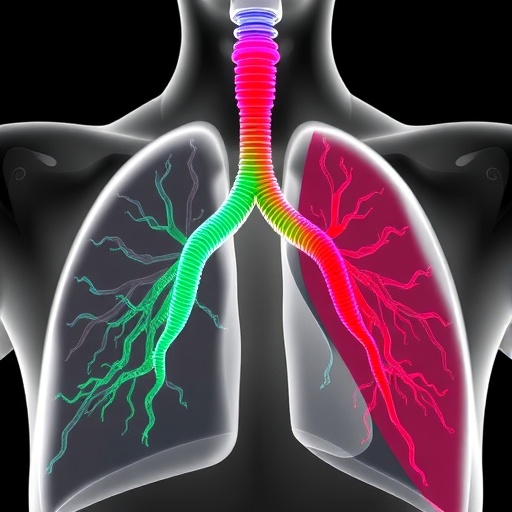
A drug that has been used for decades to control blood pressure and fluid balance may offer a new way to relieve respiratory distress linked to a rare genetic defect. In a study published in Nature Communications, Roh, Seo, Oh and colleagues report that amiloride can mitigate breathing problems caused by a deficiency of WFDC2 by blocking the epithelial sodium channel, or ENaC, a key regulator of salt and water movement across airway tissues.
The findings place WFDC2, best known for encoding the secretory protein HE4, in a potentially important pathway controlling respiratory physiology. Although the protein has been widely studied in reproductive biology and cancer research, its role in maintaining healthy airway function is less familiar. The new work suggests that when WFDC2 is absent or severely reduced, epithelial cells may handle sodium abnormally, disturbing the delicate fluid environment required for efficient gas exchange.
The airways are lined by a thin layer of liquid that allows cilia—microscopic, hair-like structures on epithelial cells—to sweep mucus and trapped particles toward the throat. This airway surface liquid must remain within a narrow range: too much fluid can impair clearance, while excessive absorption can leave mucus concentrated, sticky and difficult to remove. ENaC helps determine this balance by allowing sodium ions to enter epithelial cells. Water follows sodium through osmotic forces, meaning that increased ENaC activity can promote fluid absorption from the airway surface.
According to the study, WFDC2 deficiency is associated with respiratory distress, and the researchers identified excessive or dysregulated ENaC activity as a contributing mechanism. In this model, the loss of WFDC2 appears to shift epithelial ion transport in a direction that can reduce the fluid available on airway surfaces. That change may compromise mucus movement and airway patency, increasing the work required to breathe. The research therefore connects a genetic deficiency with a specific, drug-sensitive pathway rather than treating respiratory distress as an unexplained secondary symptom.
Amiloride is well suited to test this mechanism because it directly inhibits ENaC. The drug enters and blocks the channel from the extracellular side, reducing sodium uptake by epithelial cells. In the context of WFDC2 deficiency, this action may prevent excessive sodium absorption and help restore a more favorable hydration state at the airway surface. The proposed effect is not the same as opening the airways through smooth-muscle relaxation; instead, it targets the epithelial transport system that governs the airway lining’s salt and water content.
This distinction is important because respiratory disease can arise from several different biological failures. Some conditions primarily involve inflammation, infection or constriction of airway muscle, while others are driven by defective epithelial transport. By identifying ENaC as a downstream target of WFDC2 deficiency, the study points toward a mechanism-based intervention. Such an approach could be especially valuable for patients whose symptoms result from rare genetic changes and who may not respond adequately to conventional bronchodilators or anti-inflammatory medicines.
The work also highlights the broader importance of epithelial ion channels in lung health. Sodium, chloride and water transport are tightly coordinated across the airway lining, and even modest disturbances can alter mucus viscosity, ciliary beating and the ability to clear inhaled material. ENaC is therefore more than a molecular valve: it is part of a larger fluid-regulating network that helps maintain the physical conditions required for normal airway defense. The findings suggest that WFDC2 participates in this network, either directly or through signaling processes that influence channel activity.
Because amiloride is an established medicine, the results immediately raise the possibility of drug repurposing. Existing clinical experience could accelerate the path from laboratory discovery to further preclinical testing, since the compound’s pharmacology and safety considerations are already comparatively well characterized. However, that advantage does not mean that an established drug can be assumed to work safely or effectively in every respiratory context. Amiloride can affect kidney sodium handling and potassium levels, and the optimal route, dose and timing for treating airway disease would require careful investigation.
The study’s significance ultimately lies in linking a previously underappreciated genetic factor to a tractable physiological process. If the results are confirmed in additional models and eventually in patients, ENaC inhibition could become a targeted strategy for respiratory distress associated with WFDC2 deficiency. More broadly, the research illustrates how understanding the movement of ions across epithelial barriers can reveal unexpected therapeutic opportunities. A familiar diuretic may now be opening a new chapter in precision treatment for a rare, potentially serious disorder of airway function.
Subject of Research: The role of WFDC2 deficiency and epithelial sodium channel activity in respiratory distress, and the potential of amiloride as a treatment.
Article Title: Amiloride mitigates respiratory distress caused by WFDC2 deficiency via inhibiting the epithelial sodium channel.
Article References: Roh, J.W., Seo, S.K., Oh, J. et al. “Amiloride mitigates respiratory distress caused by WFDC2 deficiency via inhibiting the epithelial sodium channel.” Nature Communications (2026). https://doi.org/10.1038/s41467-026-76582-5
Image Credits: AI Generated
DOI: 10.1038/s41467-026-76582-5
Keywords: WFDC2 deficiency, amiloride, epithelial sodium channel, ENaC, respiratory distress, airway epithelium, ion transport, drug repurposing, respiratory disease, precision medicine