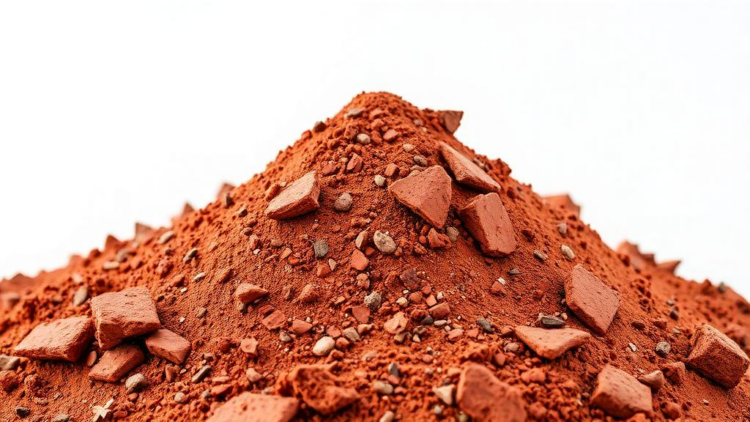
Every year, the global aluminum industry buries itself a little deeper in its own waste. For every ton of alumina extracted from bauxite ore through the Bayer process, roughly 0.8 to 1.8 tons of a caustic, rust-colored sludge known as red mud are left behind. Most of this material ends up in vast dry or wet stockpiles that consume land and threaten soil and water with their heavy metal content. Treating it can swallow up to 5 percent of the cost of producing alumina, yet worldwide, less than 10 percent of red mud is ever reused. Now, a team of Chinese researchers has reported a way to turn this liability into a core ingredient of one of the most promising low-carbon cements ever developed, using the waste not as a token additive but as a complete replacement for the calcined clay at the heart of the formulation.
The cement in question is limestone calcined clay cement, or LC3, a binder that has generated enormous excitement in the construction industry because it can swap out half or more of the carbon-intensive clinker in ordinary Portland cement while preserving mechanical performance. In its classic form, LC3 blends 50 percent clinker, 30 percent calcined clay, 15 percent limestone, and 5 percent gypsum. The magic lies in the pozzolanic chemistry: metakaolin in the heat-treated clay reacts with calcium hydroxide released by clinker hydration, while limestone fills the pore space and participates in the formation of carboaluminate phases. The result is a cement that can cut the industry’s carbon dioxide emissions by roughly 40 percent. But there is a catch. In many countries, clay resources suitable for calcination are protected by regulations, restricting large-scale extraction and threatening the scalability of the technology.
Red mud looks, on paper, like an ideal substitute. It is rich in alumina and silica, the same reactive oxides that make calcined clay valuable, and it arrives pre-alkaline, with a pH of 10.35, which could help activate other sluggish ingredients. The researchers, publishing in Case Studies in Construction Materials, obtained Bayer red mud from Shandong Xinfa Group and made a deliberate choice: they used it raw, with no energy-hungry heat treatment. Previous work had suggested that firing red mud at around 600 degrees Celsius improves its performance, but the gains were modest, with a strength activity index of 76.9 percent for heat-treated material versus 67.1 percent for untreated. Skipping the kiln entirely keeps the process simple and keeps the carbon savings intact.
What the raw material lacks in pozzolanic punch, it makes up for in physical finesse. Laser particle sizing revealed a median particle diameter of just 1.06 micrometers, far finer than the calcined clay it replaces, and a staggering specific surface area of 6,897 square meters per kilogram. Scanning electron microscopy showed rough, porous particles with sharp edges, micropores, and fine cracks, plus smaller grains clinging to larger ones in agglomerates that expose dangling bonds and unsaturated chemical sites. In a cement paste, such ultrafine particles pack into the gaps between coarser grains, act as nucleation sites where hydration products can anchor, and accelerate the early reactions of the cement’s calcium silicate phases.
The team formulated five mixes, all with a water-to-binder ratio of 0.5: a reference LC3 with 30 percent calcined clay, three red mud systems at 10, 20, and 30 percent replacement, a red mud plus fly ash composite, and a red mud plus calcium oxide blend. The results were striking. Every red mud formulation set faster than the reference, and all of them delivered higher compressive strength at three days, exceeding the control by 8 to 15 percent on average. At 28 days, the strengths converged to comparable values, meaning the waste-based binders matched conventional LC3 where it matters most for structural design. The best performers were the composite systems, BRM10-FA20 and BRM20-FA10, which paired red mud with fly ash, itself a coal-combustion waste rich in silica and alumina.
The reason for that synergy lies in a chemical handshake between the two wastes. Red mud’s alkalinity, driven by its 12.93 percent sodium oxide content, attacks the glassy silico-aluminate network of fly ash, depolymerizing it and releasing silicate and aluminate ions into the pore solution. Those ions then react with calcium from cement hydration to form additional C-(A)-S-H gel, the amorphous glue that gives concrete its strength, along with aluminum-bearing phases. X-ray diffraction confirmed that all the red mud systems produced the same essential hydration products as the reference cement: ettringite, portlandite, and calcite. Thermogravimetric analysis showed more pronounced mass loss in the low-temperature range for the red mud-fly ash blends, a signature of abundant gel formation that fills pores and densifies the matrix. Mercury intrusion porosimetry backed this up, revealing that the composite systems shifted from the reference’s bimodal pore distribution to a tighter, unimodal one with lower cumulative pore volume.
Not every additive helped. The blend containing 10 percent calcium oxide set dramatically fast, in just 90 minutes, and posted the strongest early strength, but its 28-day strength fell to 30.4 megapascals, below the reference. The researchers traced the failure to three mechanisms: the slaking of quicklime consumed mix water needed for later clinker hydration; a dense portlandite coating passivated the red mud particles, blocking dissolution of their aluminosilicates; and the surplus calcium hydroxide carbonated rapidly to calcium carbonate rather than feeding useful pozzolanic reactions. From this, they derived a practical design rule: the ratio of available calcium oxide to the sum of reactive silica and alumina should stay at or below 0.6. Exceed it, and the extra calcium becomes a liability rather than an asset.
Perhaps the most consequential finding concerns safety. Red mud carries heavy metals, including chromium, arsenic, and molybdenum, and any construction use must guarantee they stay locked in place. Using the toxicity characteristic leaching procedure on 28-day cured samples, the team found that every monitored element leached at concentrations orders of magnitude below both Chinese GB 5085.3-2007 limits and US EPA reference thresholds. In the highest red mud mix, leachable chromium measured just 0.0167 milligrams per liter against a 15 milligram per liter benchmark, and lead registered 0.00119 milligrams per liter against a limit of 5. The researchers attribute this immobilization to three mechanisms working in concert: physical encapsulation within dense C-(A)-S-H gel and interlocking ettringite needles, chemical adsorption and hydroxide precipitation in the highly alkaline pore fluid, and isomorphous substitution, in which metal ions such as chromium take the crystallographic places of aluminum in ettringite and AFm lattices.
The implications ripple outward in several directions at once. For the aluminum industry, the study points toward a disposal pathway that consumes red mud at meaningful volumes rather than the token percentages achieved when it merely replaces a few percent of cement. For the cement industry, it removes a raw material bottleneck, since red mud is abundant, geographically widespread near smelters, and requires no calcination energy. And for the climate, combining two industrial wastes in a binder that already halves clinker demand compounds the emissions savings. The authors are careful to note the limits of their work: the fly ash contribution has not yet been isolated with a dedicated control, the long-term stability of ettringite under elevated service temperatures remains to be verified, and the proposed chromium substitution mechanism still needs confirmation by spectroscopic speciation. But the core demonstration stands. A sludge that has accumulated for over a century as aluminum’s dirty secret can be ground, mixed, and poured into the very infrastructure that must now be built sustainably, hardening into a material that is simultaneously a building block and a vault for its own toxic cargo.
Subject of Research: Using Bayer red mud as a calcined clay substitute in limestone calcined clay cement
Article Title: Utilization of bayer red mud as a clay substitute in limestone-calcined clay cement (LC 3 )
Article References: Gu, H., Zhang, Z., Wang, R., Zhang, Z., Meng, Z., & Wang, J. (2026). Utilization of bayer red mud as a clay substitute in limestone-calcined clay cement (LC3). Case Studies in Construction Materials, 25, Article e06570. https://doi.org/10.1016/j.cscm.2026.e06570
Image Credits: AI Generated
DOI: 10.1016/j.cscm.2026.e06570
Keywords: Bayer red mud, limestone calcined clay cement, LC3, low-carbon cement, fly ash, pozzolanic reaction, heavy metal leaching, compressive strength, calcium oxide, industrial waste valorization, sustainable construction, hydration products
Cite Scienmag News
APA MLA Chicago
Denise Maddox. (September 30, 2026). Aluminum Waste Red Mud Could Replace Clay in Low-Carbon Cement. Scienmag. https://scienmag.com/aluminum-waste-red-mud-could-replace-clay-in-low-carbon-cement/
Denise Maddox. “Aluminum Waste Red Mud Could Replace Clay in Low-Carbon Cement.” Scienmag, 30 September 2026, https://scienmag.com/aluminum-waste-red-mud-could-replace-clay-in-low-carbon-cement/. Accessed 30 September 2026.
Denise Maddox. “Aluminum Waste Red Mud Could Replace Clay in Low-Carbon Cement.” Scienmag. September 30, 2026. https://scienmag.com/aluminum-waste-red-mud-could-replace-clay-in-low-carbon-cement/
Copy citation Download RIS
Tags: alumina production waste utilizationaluminum industry waste managementAluminum waste red mud reuseBayer red mudcalcium oxidecompressive strengtheco-friendly cement formulationsenvironmental impact of red mud disposalfly ashgreen building materialsheavy metal containment in construction wasteheavy metal leachinghydration productsindustrial waste valorizationinnovative cement manufacturing processesLC3LC3 limestone calcined clay cementlimestone calcined clay cementlow-carbon cementlow-carbon cement alternativespozzolanic reactionred mud as sustainable construction materialred mud replacing clay in cement productionsustainable construction