• HOME
  • NEWS
  • EXPLORE
    • CAREER
      • Companies
      • Jobs
    • EVENTS
    • iGEM
      • News
      • Team
    • PHOTOS
    • VIDEO
    • WIKI
  • BLOG
  • COMMUNITY
    • FACEBOOK
    • INSTAGRAM
    • TWITTER
Sunday, April 19, 2026
BIOENGINEER.ORG
No Result
View All Result
  • Login
  • HOME
  • NEWS
  • EXPLORE
    • CAREER
      • Companies
      • Jobs
        • Lecturer
        • PhD Studentship
        • Postdoc
        • Research Assistant
    • EVENTS
    • iGEM
      • News
      • Team
    • PHOTOS
    • VIDEO
    • WIKI
  • BLOG
  • COMMUNITY
    • FACEBOOK
    • INSTAGRAM
    • TWITTER
  • HOME
  • NEWS
  • EXPLORE
    • CAREER
      • Companies
      • Jobs
        • Lecturer
        • PhD Studentship
        • Postdoc
        • Research Assistant
    • EVENTS
    • iGEM
      • News
      • Team
    • PHOTOS
    • VIDEO
    • WIKI
  • BLOG
  • COMMUNITY
    • FACEBOOK
    • INSTAGRAM
    • TWITTER
No Result
View All Result
Bioengineer.org
No Result
View All Result
Home NEWS Science News Health

Alterations in gut microbiota and metabolites associated with altitude-induced cardiac hypertrophy in rats during hypobaric hypoxia challenge

Bioengineer by Bioengineer
April 20, 2022
in Health
Reading Time: 2 mins read
0
Characteristic longitudinal alterations of the gut microbial community during the 28-day hypobaric hypoxia challenge.
Share on FacebookShare on TwitterShare on LinkedinShare on RedditShare on Telegram

This study is led by Dr. Ruifu Yang (State Key Laboratory of Pathogen and Biosecurity, Beijing Institute of Microbiology and Epidemiology) and Dr. Zhenjiang Zech Xu (State Key Laboratory of Food Science and Technology, Nanchang University).
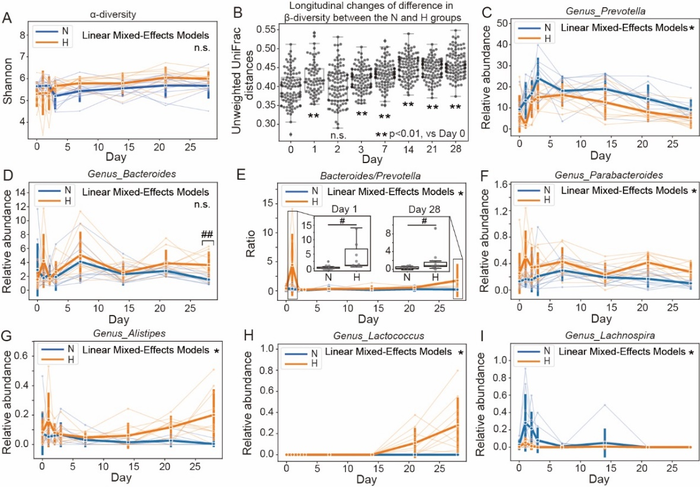
Characteristic longitudinal alterations of the gut microbial community during the 28-day hypobaric hypoxia challenge.

Credit: ©Science China Press

This study is led by Dr. Ruifu Yang (State Key Laboratory of Pathogen and Biosecurity, Beijing Institute of Microbiology and Epidemiology) and Dr. Zhenjiang Zech Xu (State Key Laboratory of Food Science and Technology, Nanchang University).

Accumulating evidence has shown that there are great differences in the structure and diversity of intestinal microorganisms in mammals or humans living at different altitudes. However, it is still unknown whether such changes play a role in the development and progression of chronic altitude-related diseases, especially in high-altitude heart disease.

Therefore, the researchers first developed a rat model of high-altitude heart disease by exposing the rats in a hypobaric chamber, simulating the altitude of 5000 meters for 28 days. Then, they used 16S rDNA amplicon sequencing combined with targeted metabonomics to monitor the dynamics of intestinal microbes and their metabolites during this process. They identified that the hypobaric hypoxia-induced pathological cardiac hypertrophy in rats was accompanied by a large compositional shift in the gut microbiota, which was characterized by increased abundances of the Parabacteroides, Alistipes, and Lactococcus genera and a larger Bacteroides to Prevotella ratio (Figure 1).

Trans-omics analyses showed that the gut microbiome was significantly correlated with the metabolic abnormalities of short-chain fatty acids and bile acids in feces, suggesting an interaction network remodeling of the microbiome-metabolome after the hypobaric hypoxia challenge. Interestingly, the transplantation of fecal microbiota (FMT) ameliorated the pathological cardiac hypertrophy and fibrosis in hypoxic rats (Figure 2), which was due to an inhibition of the Bacteroides and Alistipes genera abundances after FMT treatment (Figure 3).

In addition, they also demonstrated that administrations of probiotics, prebiotics, and synbiotics could significantly alleviate high-altitude heart disease in the same model (https://doi.org/10.1128/spectrum.01053-21).

Taken together, this study provides an insight into the longitudinal changes in intestinal microecology during the hypobaric hypoxia challenge, suggesting a promising strategy to prevent or treat high-altitude heart disease through regulating the gut microbiota.

See the article:

Alterations in gut microbiota and metabolites associated with altitude-induced cardiac hypertrophy in rats during hypobaric hypoxia challenge

https://link.springer.com/article/10.1007/s11427-021-2056-1


Journal

Science China Life Sciences

DOI

10.1007/s11427-021-2056-1

Share12Tweet8Share2ShareShareShare2

Related Posts

Exercise, IADL, Social Interaction Ease Depression in Elderly

April 19, 2026

Financial Strain of Non-Communicable Diseases in Indian Elderly

April 19, 2026

Comorbidities Shape Hip Fracture Surgery Outcomes

April 19, 2026

Wastewater Detects Drug-Resistant Candidozyma auris Emergence

April 18, 2026

POPULAR NEWS

  • Scientists Investigate Possible Connection Between COVID-19 and Increased Lung Cancer Risk

    62 shares
    Share 25 Tweet 16
  • NSF funds machine-learning research at UNO and UNL to study energy requirements of walking in older adults

    101 shares
    Share 40 Tweet 25
  • Boosting Breast Cancer Risk Prediction with Genetics

    47 shares
    Share 19 Tweet 12
  • Self-Oscillating Electroactive Nanocomposites Boost Heat Pumps

    41 shares
    Share 16 Tweet 10

About

We bring you the latest biotechnology news from best research centers and universities around the world. Check our website.

Follow us

Recent News

Exercise, IADL, Social Interaction Ease Depression in Elderly

Financial Strain of Non-Communicable Diseases in Indian Elderly

Elevated Fetal Catecholamine Metabolites Signal Growth Restriction

Subscribe to Blog via Email

Enter your email address to subscribe to this blog and receive notifications of new posts by email.

Join 79 other subscribers
  • Contact Us

Bioengineer.org © Copyright 2023 All Rights Reserved.

Welcome Back!

Login to your account below

Forgotten Password?

Retrieve your password

Please enter your username or email address to reset your password.

Log In
No Result
View All Result
  • Homepages
    • Home Page 1
    • Home Page 2
  • News
  • National
  • Business
  • Health
  • Lifestyle
  • Science

Bioengineer.org © Copyright 2023 All Rights Reserved.