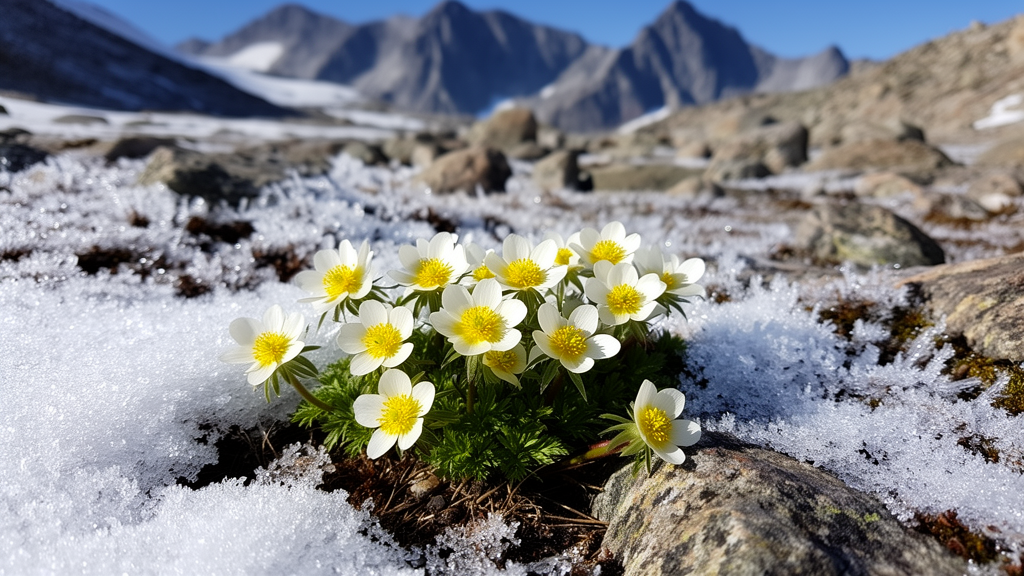
In high-elevation mountain environments, related plant lineages that reproduce sexually or clonally through asexual seed formation often partition landscapes along distinct geographic and altitudinal gradients. A newly published common-garden study on the alpine buttercup species Ranunculus kuepferi demonstrates that sexual diploid plants perform equally well or even surpass asexual tetraploid plants in reproductive fitness across a one-thousand-meter elevation gradient in the Austrian Alps. This finding directly challenges long-standing assumptions regarding geographical parthenogenesis, a pattern wherein asexual polyploid organisms occupy broader, colder, or higher distribution ranges than their diploid ancestors. Over three consecutive years, researchers tracked adult individuals transplanted across four mountain elevations from the subalpine belt up to the subnival margin near glacier moraines. Despite apomictic tetraploids demonstrating specific physiological adaptations to frost, including greater leaf freezing resistance and denser storage tissues, diploid sexual plants consistently produced equivalent or higher proportions of viable seeds, shedding new light on how ecological and reproductive trade-offs shape plant distributions across postglacial landscapes.
The study addressed the enduring ecological puzzle of geographical parthenogenesis, first described in animals and subsequently observed across numerous plant taxa. In Ranunculus kuepferi, diploid sexual populations remain predominantly restricted to unglaciated refugial zones in the southwestern European Alps between 1300 and 2500 meters above sea level, where plants require insect pollinators and cross-fertilization due to self-incompatibility. By contrast, tetraploid apomicts, which reproduce uniparentally by forming seeds without fertilization while maintaining self-compatibility, have colonized nearly the entire Alpine Arc from 1700 to 2800 meters, as well as parts of the Northern Apennines and Corsica. Prior correlative surveys and bioclimatic models suggested that tetraploids conquered these harsher, formerly glaciated territories because polyploidy provided enhanced developmental plasticity and shifted their ecological tolerance toward cooler temperatures. However, because nature confounds altitudinal climate with differences in soil chemistry, local competition, and maternal provenance, determining whether tetraploids possess an inherent physiological superiority at high altitudes required experimental separation in standardized alpine conditions.
To rigorously evaluate the direct influence of mountain temperature and growing season length, researchers established an elevation transect in the Stubai Alps of North Tyrol, Austria, spanning from 1770 meters to 2830 meters above sea level. This region was selected because wild Ranunculus kuepferi does not naturally occur there, eliminating the confounding possibility of spontaneous pollen exchange between native and experimental plots. Experimental plots were deployed across four discrete altitudinal stations: a subalpine grassland at 1770 meters, a lower alpine pasture at 2290 meters, an upper alpine moraine ridge at 2600 meters, and a subnival rocky plateau situated adjacent to the Stubai glacier at 2830 meters. To eliminate confounding soil chemistry and eliminate underground competition from surrounding vegetation, adult plants collected from diverse wild populations in the Western and Eastern Alps were planted individually into plastic grid baskets filled with standardized, lime-free alpine soil. Root zones were isolated using mesh partitions, and wire cages protected the plots from grazing livestock and birds.
Microenvironmental loggers deployed at the soil surface revealed that plant-level canopy temperatures did not decrease along a simple linear adiabatic lapse rate during the active growing season. Instead, variation in winter snowmelt timing governed the microclimate experienced between thaw and seed maturation. Because early snowmelt at the subalpine site coincided with early spring cold snaps while late-thawing alpine plots were buffered until warmer summer months, daily mean canopy temperatures remained comparable between 1770 meters and 2600 meters. Canopy temperatures dropped sharply only at the subnival 2830-meter site, where nocturnal readings regularly plunged near the freezing threshold. Furthermore, comparison with baseline measurements from natural populations showed that natural diploids in the southwestern Alps experienced significantly warmer summer conditions where temperatures rarely fell below 5 degrees Celsius, whereas natural tetraploids in the eastern Kaun Valley lived under severe thermal conditions closely matching the subnival experimental plots.
Vegetative monitoring across three full growing seasons revealed that neither ploidy level exhibited uniform superiority across the altitudinal gradient, but rather displayed significant cytotype-by-elevation interactions. Survival rates among the originally transplanted individuals fluctuated across sites, largely driven by localized environmental factors rather than metabolic limitations; for example, heavy localized mortality among tetraploids at 2600 meters resulted from subnivean snow vole predation rather than freezing stress. Both cytotypes formed new lateral vegetative ramets at comparable rates, with up to 56 percent of diploids and 37 percent of tetraploids establishing daughter crowns. However, leaf production per individual diverged significantly at higher elevations, where sexual diploids produced substantially more leaves than tetraploids. Below ground, tetraploids consistently allocated more biomass toward storage, developing thickened, bulb-like rhizomes that increased from an average dry weight of 24 milligrams at the lowest plot to 53 milligrams at the subnival margin, whereas diploid rhizome weight peaked at 22 milligrams at 2600 meters and showed minimal variation across elevations.
Architectural and cellular examination of leaf tissues further illuminated distinct morphological strategies between the two cytotypes across the transect. Fully expanded leaves of both diploids and tetraploids decreased in total lamina area and dry weight as elevation increased. Diploids maintained a constant specific leaf area across all four mountain plots, indicating that their leaf thickness and internal mass per unit surface area did not change with altitude. Conversely, tetraploids exhibited significantly reduced specific leaf area at the highest and lowest elevations, reflecting plastic leaf thickening and denser mesophyll development in response to harsh local climates. Microscopic examination of the lower leaf epidermis showed persistent cytological differences: diploid leaves possessed smaller epidermal cells, resulting in 1.4-fold to 1.8-fold higher cell densities per square millimeter, alongside higher stomatal frequencies and smaller guard cells. Tetraploids possessed significantly larger, fewer stomata, but compensated for reduced stomatal density by enlarging stoma dimensions as elevation increased, underscoring divergent anatomical pathways for atmospheric gas exchange.
Controlled freezing tests on mature detached leaves at the end of flowering confirmed that tetraploid apomicts possessed superior physiological frost resistance. Leaf tissues subjected to precise cooling protocols between minus 3 and minus 12 degrees Celsius inside computerized test chambers were evaluated using both visual tissue necrosis scoring and chlorophyll fluorescence measurements. The ratio of variable to maximum fluorescence, dark-adapted Fv/Fm, served as an objective metric of photosystem II damage to calculate the lethal temperature causing 50 percent tissue injury, designated LT50. Freezing tolerance improved with altitude in both lineages, with visible damage appearing at minus 5 degrees Celsius across all plots, while complete necrosis occurred below minus 9 degrees Celsius at lower sites and extended beyond minus 12 degrees Celsius for high-elevation foliage. Crucially, statistical bootstrapping confirmed that tetraploids maintained significantly lower LT50 thresholds than diploids at every transect station, establishing that tetraploid foliage possesses an inherent physiological capacity to withstand severe subzero frost events during metabolic activity.
In marked contrast to their lower freezing tolerance, sexual diploids exhibited equal or superior reproductive performance across the entire mountain transect, defying the hypothesis that adverse high-altitude weather suppresses insect-pollinated sexual outcrossing. While flowering frequency showed alternating annual rhythms in both cytotypes due to individual biennial bud patterns, the proportion of flowering diploid individuals increased progressively with altitude in the second and third seasons, whereas tetraploid flowering remained stagnant. Aggregate fruit set was equally robust between cytotypes, with 50 to 80 percent of flowers maturing fruits. Even at the subnival station where tetraploid fruit-to-flower ratios declined, diploid plants successfully matured carpels into fruitlets. This sustained diploid fruit production occurred without supplemental pollination, indicating that pollinator availability in high-alpine environments was not limiting for outcrossing sexual plants.
Detailed analyses of floral anatomy and diaspore maturation revealed contrasting reproductive allocation strategies. Tetraploid flowers produced roughly twice as many uniovular carpels as diploid blossoms, developing up to 100 carpels per flower compared to 3 to 30 carpels in diploids, with carpel counts in tetraploids increasing further at higher elevations. However, developmental disturbances during ovule formation caused substantial seed abortion in tetraploid fruits, whereas diploids converted a much higher fraction of ovules into filled achenes. Consequently, diploid flowers matured as many or significantly more viable seeds per fruit than tetraploids at the upper stations. Nevertheless, tetraploid achenes were significantly heavier than diploid fruitlets across most sites, reflecting their higher endosperm ploidy of 10x or 12x compared to the 3x endosperm of sexual diploids. In multi-year germination trials, diploid seeds germinated rapidly, reaching 71 to 77 percent emergence within the first year at lower sites and 48 percent at 2830 meters, whereas tetraploid seeds exhibited pronounced physiological dormancy, germinating at only 6 to 27 percent in year one before emerging more substantially in the second season.
These comprehensive findings demonstrate that the wider geographic and elevational distribution of apomictic polyploids cannot be attributed to a universal fitness superiority across all life stages. Instead, the persistent postglacial success of tetraploid Ranunculus kuepferi reflects an ecological trade-off between vegetative cold durability and flexible reproductive output. Tetraploid apomicts combine uniparental reproductive assurance with enhanced leaf freezing resistance, increased rhizome storage reserves, heavier diaspores, and persistent soil seed banking, allowing them to endure erratic alpine climates and colonize deglaciated terrain. Concurrently, sexual diploids retain exceptional reproductive efficiency, producing abundant germinable seeds despite the energetic costs of outcrossing, though their lighter achenes, thinner rhizomes, and reduced frost tolerance may limit their ability to establish in nutrient-poor, acid soils at higher elevations. Ultimately, resolving the drivers of geographical parthenogenesis requires weighing these multi-trait life-history compromises against historical migration corridors and reproductive modes.
Subject of Research: Comparative ecological and reproductive fitness of sexual diploid and apomictic tetraploid Ranunculus kuepferi across an Alpine elevation transect
Article Title: Growth, leaf freezing resistance and reproductive fitness differ between sexual diploid and apomictic tetraploid Ranunculus kuepferi plants along a climatic elevation transect and at natural growing sites
Article References: Ladinig, U., Bertel, C., Hörandl, E., & Wagner, J. (2025). Growth, leaf freezing resistance and reproductive fitness differ between sexual diploid and apomictic tetraploid Ranunculus kuepferi plants along a climatic elevation transect and at natural growing sites. Alpine Botany, 135(2), 239-260. https://doi.org/10.1007/s00035-025-00337-z
Image Credits: AI Generated
DOI: 10.1007/s00035-025-00337-z
Keywords: Ranunculus kuepferi, Geographical Parthenogenesis, Polyploidy, Apomixis, Alpine Botany, Elevation Transect, Freezing Resistance, Common Garden Experiment, Leaf Mass per Area, Specific Leaf Area, Seed Dormancy, Achene Mass, Diploids, Tetraploids, Stubai Alps, Cold Acclimation, Plant Reproduction
News Source: Drew Townsend. (November 25, 2026). Alpine Buttercup Cytotypes Show Divergent Cold Adaptations Across Mountain Elevations. Scienmag.