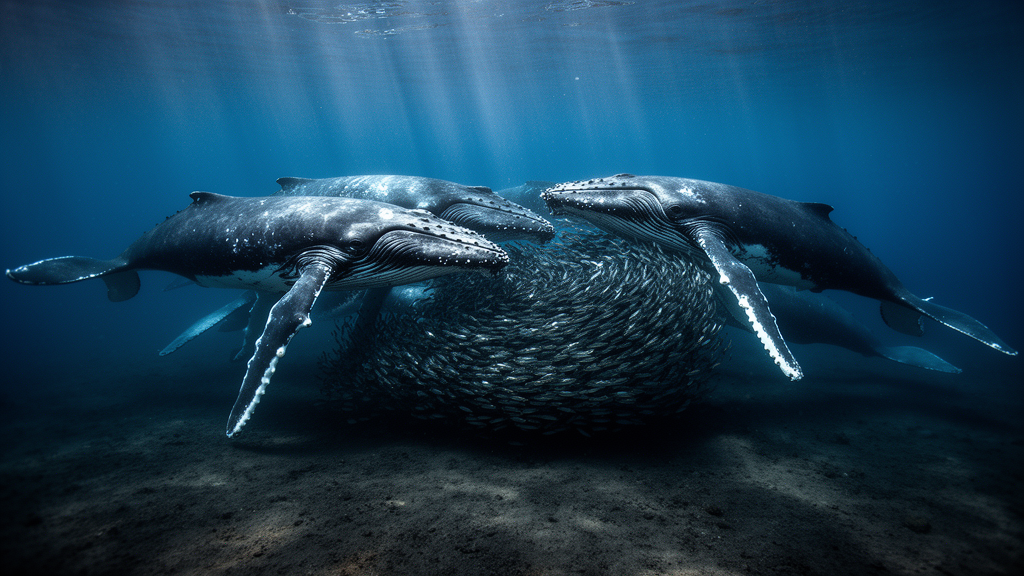
Biologists deploying multi-sensor video recording suction tags onto free-swimming humpback whales in the southern Gulf of Maine have documented the first empirical evidence of coordinated, collaborative benthic hunting in the species. Across fifty-five feeding bouts encompassing one hundred and ten foraging events, researchers observed humpback whales descending directly to the sandy ocean floor to herd, trap, and engulf northern sand lance through structured multi-individual maneuvers. Rather than foraging as independent solitary predators or uncoordinated aggregations, the tagged individuals joined with between one and three conspecific co-hunters in seventy-nine percent of all analyzed benthic events. The animals executed synchronized approaches toward each other, forming tight head-to-head configurations that converged until their rostrums were separated by merely a few meters. These synchronized underwater maneuvers actively directed fleeing schools of small, evasive fish toward the open mouths of partner whales, meeting the rigorous behavioral criteria established for animal collaboration.
Cooperative hunting across the animal kingdom occupies a broad behavioral continuum ranging from basic similarity to complex collaborative partnerships. Previous behavioral frameworks distinguish four ascending levels of group predation: similarity, where multiple predators simultaneously pursue shared prey without spatial or temporal adjustments; synchrony, where hunters match the timing of their actions; coordination, where predators align their movements in both space and time from varying trajectories; and collaboration, the most cognitively sophisticated form, where individuals perform differentiated, complementary roles directed toward a shared objective. In predatory carnivores and marine mammals, true collaboration requires that individuals modulate their physical speed, headings, and capture timing in response to the specific actions of their partners rather than relying solely on the evasive reactions of the prey. Demonstrating collaborative predation in wild cetaceans requires fine-scale tracking of individual orientations, positions, and strike timing beneath the surface.
To capture these elusive underwater dynamics, the research team attached advanced CATS-CAM sensor suites equipped with forward-facing video cameras, triaxial accelerometers, magnetometers, and gyroscopes to humpback whales off the coast of Massachusetts during daylight hours in June 2018. The instrument packages recorded high-definition visual imagery across a ninety-five-degree horizontal by fifty-four-degree vertical field of view, while auxiliary instruments logged continuous spatial orientation parameters including animal pitch, roll, depth, and compass heading decimated to ten-hertz sampling rates. Because optical recording was constrained by ambient underwater illumination, visual analyses were restricted to daylight dives occurring at depths of less than forty meters where the seafloor substrate and target schools of northern sand lance were distinctly visible. Feeding events were formally identified in the video logs whenever at least one whale within the visual record opened its mouth along the bottom in the direct presence of sand lance prey.
Analysis of the kinematic data revealed that solitary benthic feeding was comparatively uncommon among the study animals, occurring in only twenty-one percent of the recorded feeding events. In the remaining seventy-nine percent of events, the tagged whales operated alongside one, two, or three co-hunters. Pair-hunting configurations consisting of the tagged animal and a single companion accounted for forty-six percent of all observed events, representing fifty-one discrete occurrences across five tagged individuals. Groups consisting of three whales, comprised of the tagged subject and two partners, appeared in twenty-seven percent of the events, totaling thirty distinct occurrences across multiple tag deployments. The largest observed groups involved four whales, where the tagged subject fed alongside three associates, representing five percent of events across two separate tag records. Across all multi-whale encounters, group members consistently arrived at the seabed at the same time and synchronized their terminal feeding strikes.
To evaluate whether the spatial arrangements of participating whales represented deliberate structural geometry rather than accidental groupings, the scientists established a standardized clock-face reference framework centered on the tagged animal’s attack heading at twelve o’clock. Under theoretical models of completely random spatial distribution, each available clock segment would be expected to hold an associate approximately eight percent of the time. The empirical observations strongly contradicted randomness, showing pronounced structural clustering. Across eighty-seven group events, the one o’clock position was occupied most frequently, appearing in fifty-nine percent of events across sixty-five occurrences. The eleven o’clock position served as the second most frequent station, recorded in thirty-five percent of events across thirty-nine instances. Direct twelve o’clock approaches occurred in twelve percent of cases, while the three o’clock and two o’clock positions appeared in five percent and two percent of observations, respectively.
When humpbacks engaged in pair hunting, companion whales occupied positions exclusively on the tagged animal’s forward flanks, choosing the one o’clock station in 60.8 percent of fifty-one events and the eleven o’clock station in the remaining 39.2 percent. In three-whale hunting events, the co-hunters formed convergent angular vectors, with the two most prevalent configurations consisting of simultaneous occupancy of eleven o’clock and one o’clock, which occurred in forty percent of thirty events, and twelve o’clock paired with one o’clock, which occurred in 36.7 percent of events. In four-whale hunting groups, two distinct structural formations emerged, consisting either of whales situated at eleven o’clock, twelve o’clock, and one o’clock simultaneously, or individuals positioned at eleven o’clock, one o’clock, and three o’clock. The forward-facing geometry ensured that descending whales systematically framed the escaping fish schools from opposing angles as they converged along the seabed.
Individual identification of companion whales demonstrated remarkable fidelity to specific spatial stations across sequential dives. Researchers confirmed the unique identities of all attending group members in sixty-seven percent of multi-whale events, encompassing fifty-eight distinct instances primarily observed across two extensively tagged subjects designated Wonderland and Bombay. In feeding events where all group associates were positively identified from distinctive anatomical scuffing, scars, and barnacle configurations, individuals assumed the exact same clock position in 93.1 percent of fifty-four events. For instance, across twenty-eight evaluated events involving the four-year-old female Wonderland, an identified companion whale known as Animal A occupied the one o’clock position in twenty-seven instances, departing from this station to adopt the eleven o’clock position only once. Similarly, across seventeen events recorded on the fifteen-year-old female Bombay, an associate designated Animal B maintained the eleven o’clock station in ninety-four percent of events.
This persistent positioning was maintained despite the fact that the focal tagged whales altered their geographical compass heading during every single attack run. Tag telemetry confirmed that each subsequent dive and benthic approach initiated along a new directional heading, yet associated co-hunters actively repositioned their bodies relative to the focal whale’s trajectory to re-establish the standardized clock geometry. This continuous spatial adjustment demonstrates that group members were actively cueing upon the body orientation and heading of their fellow hunters rather than passively reacting to environmental landmarks or localized patches of prey. By constantly reorienting to match their partners’ changing vectors, the whales maintained an interlocking cordon that prevented sand lance from executing lateral evasive escapes along the bottom substrate.
The timing of mouth expansion further substantiated coordinated synchronization among hunting partners during bottom strikes. In forty-three benthic events where gape timing could be measured between the tagged whale and at least one associate, the mean gape offset was 3.7 seconds with a standard deviation of 5.3 seconds, with offsets ranging from zero to thirty-one seconds. In several instances, whales opened their lower jaws in complete unison within meters of each other. Within the Wonderland dataset, where all group members exhibited visible gape in twenty-one events, the mean gape offset was 3.1 seconds with a standard deviation of 2.9 seconds. Specific individuals exhibited consistent behavioral sequence roles during strikes: in Wonderland’s group, associate Animal A opened its mouth first in twenty-four out of twenty-seven events, whereas associate Animal B was consistently the last whale to open its mouth across all five events in which its feeding was recorded.
The emergence of collaborative hunting in humpback whales presents an intriguing evolutionary scenario because their social organization lacks the stable, kin-based social units typically associated with collaborative carnivores such as lions, wolves, or killer whales. In the southern Gulf of Maine, humpback populations exhibit a fluid fission-fusion social structure characterized by short-term, unstable associations between unrelated individuals. The authors propose that the intense selective pressure driving this cognitive and behavioral plasticity stems directly from the evasive anti-predator adaptations of their primary prey, the northern sand lance. Sand lance measure between eight and forty-six centimeters as adults and possess a distinct survival strategy of burrowing into sandy bottom sediments and schooling tightly along the benthic substrate. When startled by an approaching predator, sand lance flush explosively, flee several meters across the bottom, and rapidly dive back into the sediment.
A single humpback whale attempting to capture schooling sand lance along the seafloor faces high energetic expenditure with minimal return, as fleeing fish easily evade a solitary scoop by darting sideways or re-burrowing into the seabed. By converging simultaneously in a star-shaped formation with mouths opening in near unison, collaborating humpbacks effectively trap the fleeing fish in the narrowing corridor between their converging rostrums, blocking primary escape routes and substantially elevating capture success. While such complex coordination was evident in well-lit waters where acoustic signals were absent, previous studies demonstrated that humpbacks foraging benthically under dark or turbid conditions rely on specialized double-pulse acoustic calls to maintain coordination, underscoring the flexible behavioral repertoire of these large marine predators.
Despite its foraging efficiency, benthic collaborative hunting carries severe conservation implications by placing humpback whales in direct physical contact with bottom-set commercial fishing gear, including trap pots and gill nets anchored across the seabed. Whales maneuvering with their rostra along the ocean bottom face an elevated hazard of lethal entanglement, an issue that has contributed to an ongoing Unusual Mortality Event designated for humpback whales along the United States Atlantic coast. While surface group foraging behaviors such as bubble-net feeding have been widely documented, the confirmation of structured, cognitively demanding collaborative hunting on the seafloor highlights the sophisticated behavioral plasticity of humpbacks and reinforces the urgent operational need to mitigate hazardous benthic fishing gear throughout critical coastal foraging habitats.
Subject of Research: Collaborative benthic foraging behavior in Gulf of Maine humpback whales
Article Title: Meet me in the middle: potential collaborative benthic hunting in humpback whales (Megaptera novaeangliae)
Article References: Wiley, D. N., Cade, D. E., Friedlaender, A. S., Goldbogen, J., Kendall-Bar, J., Parks, S. E., Thompson, M. A., Weinrich, M., & Silva, T. L. (2026). Meet me in the middle: potential collaborative benthic hunting in humpback whales (Megaptera novaeangliae). Behavioral Ecology and Sociobiology, 80(7), Article 95. https://doi.org/10.1007/s00265-026-03770-0
Image Credits: AI Generated
DOI: 10.1007/s00265-026-03770-0
Keywords: humpback whales, Megaptera novaeangliae, collaborative hunting, benthic foraging, Ammodytes dubius, northern sand lance, Gulf of Maine, CATS-CAM tags, animal cognition, cooperative feeding, gape synchronization, clock position method, fission-fusion society, marine predator ecology, gear entanglement risk, Stellwagen Bank
News Source: Drew Townsend. (November 25, 2026). Humpback Whales Coordinate Seafloor Attacks in Complex Collaborative Hunting Teams. Scienmag.