Across the globe, more than 39 million people are living with the Human Immunodeficiency Virus (HIV), the virus that causes AIDS, including more than 1.3 million new HIV diagnoses last year. The majority of those afflicted — approximately 76% — have access to antiviral therapy that allows them to live with HIV as a chronic disease.
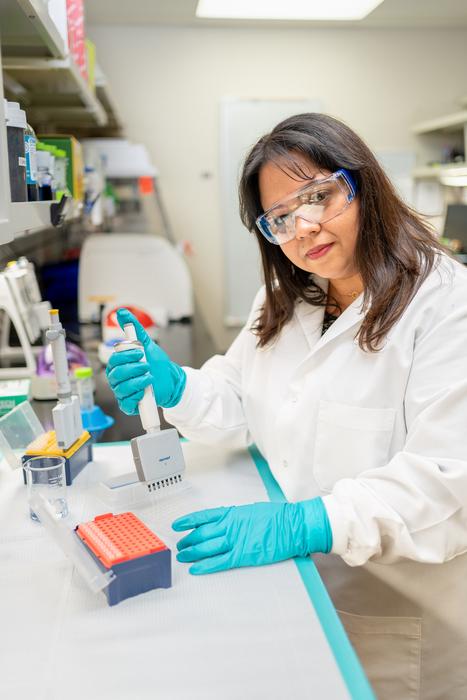
Credit: TTUHSC
Across the globe, more than 39 million people are living with the Human Immunodeficiency Virus (HIV), the virus that causes AIDS, including more than 1.3 million new HIV diagnoses last year. The majority of those afflicted — approximately 76% — have access to antiviral therapy that allows them to live with HIV as a chronic disease.
Sharilyn Almodóvar, Ph.D., from the Department of Immunology and Molecular Microbiology at the Texas Tech University Health Sciences Center (TTUHSC) School of Medicine and the TTUHSC Graduate School of Biomedical Sciences, said that even with the widespread availability of therapy, people living with HIV are facing challenges.
“The good news is that treated patients do not die of AIDS and that HIV is being treated as a chronic disease,” Almodóvar said. “Unfortunately, we still do not have a cure, and the longer people live with HIV, the more susceptible they become to comorbidities that affect their quality of life and may even cause premature death.”
Almodóvar said those comorbidities include neurological and metabolic disorders, liver and kidney diseases, cancers and cardiovascular diseases. They also include pulmonary hypertension, which is currently the focus of her lab’s research. Pulmonary hypertension is a condition in the lungs caused by severe narrowing of the arteries. It increases the pressure in these arteries and affects the right side of the heart, which is not anatomically equipped to handle such high pressures. If the condition progresses without diagnosis or treatment, the result is often death due to right heart failure.
To better understand the role HIV plays in pulmonary hypertension, the National Heart, Lung and Blood Institute at the National Institutes of Health recently awarded Almodóvar a four-year, $2.67 million grant (Role of HIV gp120 and Nef in Transcriptome Dysregulation and Pulmonary Vascular Remodeling) to study how the HIV virus damages the normal interactions between different cell types in the lung arteries that lead to the condition.
“The blood vessels in the lungs are severely affected in the presence of HIV, and this leads to serious illnesses in the lungs and heart,” Almodóvar explained. “In this study, we will conduct experiments to understand how HIV molecules change the way that lung molecules interact so that we can propose novel therapies to prevent lung diseases in people with HIV.”
For this project, Almodóvar will work with a multidisciplinary team that includes co-investigators Igor Ponomarev, Ph.D., and Ebtesam Islam, M.D., Ph.D., from the TTUHSC School of Medicine and the TTUHSC Graduate School of Biomedical Sciences; Michael Melkus, Ph.D., and Jacob Nichols, M.D., from the TTUHSC School of Medicine; Duke Appiah, Ph.D., MPH, from the TTUHSC Julia Jones Matthews School of Population and Public Health and the TTUHSC Graduate School of Biomedical Sciences; and Jeremy Goettel, Ph.D., from Vanderbilt University.
Pulmonary hypertension is relatively rare in the general population but Almodóvar said it is over-represented in people with HIV.
“Years ago, we had the opportunity to study the virus in non-human primates and in patients diagnosed with pulmonary hypertension associated with HIV, and we discovered specific mutations in the virus,” Almodóvar recalled. “With this new study, we will examine how these mutations in the virus damage the normal interactions between different cell types in the lung arteries.”
Almodóvar said one of the study’s novel aspects will be the use of a mouse model with a humanized immune system. These mice allow researchers to study the complex roles of infection, immunodeficiency and pulmonary vascular biology in a system that mimics the physiology of non-human primates.
During this study, the Almodóvar Lab will monitor the infected mice for several weeks to track viral loads (the number of viruses present in the circulation), CD4 cell counts (an indicator of the immune system’s overall health) and inflammatory markers in plasma. Almodóvar said this would not be possible without the support of Scott Trasti, DVM, and the veterinary staff in the TTUHSC Laboratory Animal Resource Center.
“At the end of each experiment, which takes months to complete, we perform right heart catheterizations on these mice to measure their pulmonary arterial pressures and examine their hearts for evidence of heart disease,” Almodóvar said.
The research for this project will occur at the interface of infectious diseases and pulmonary medicine. This provides opportunities for training the next generation of scientists and physician-scientists who are interested in researching this field and are learning how to operate under high biosafety research standards.
“We do not know how HIV causes or contributes to these severe pulmonary vascular diseases,” Almodóvar said. “With these funded studies, we will increase the understanding of how HIV changes the way that the cells in the lung interact with this virus so that we can propose novel therapies to prevent lung diseases in people with HIV.”
###