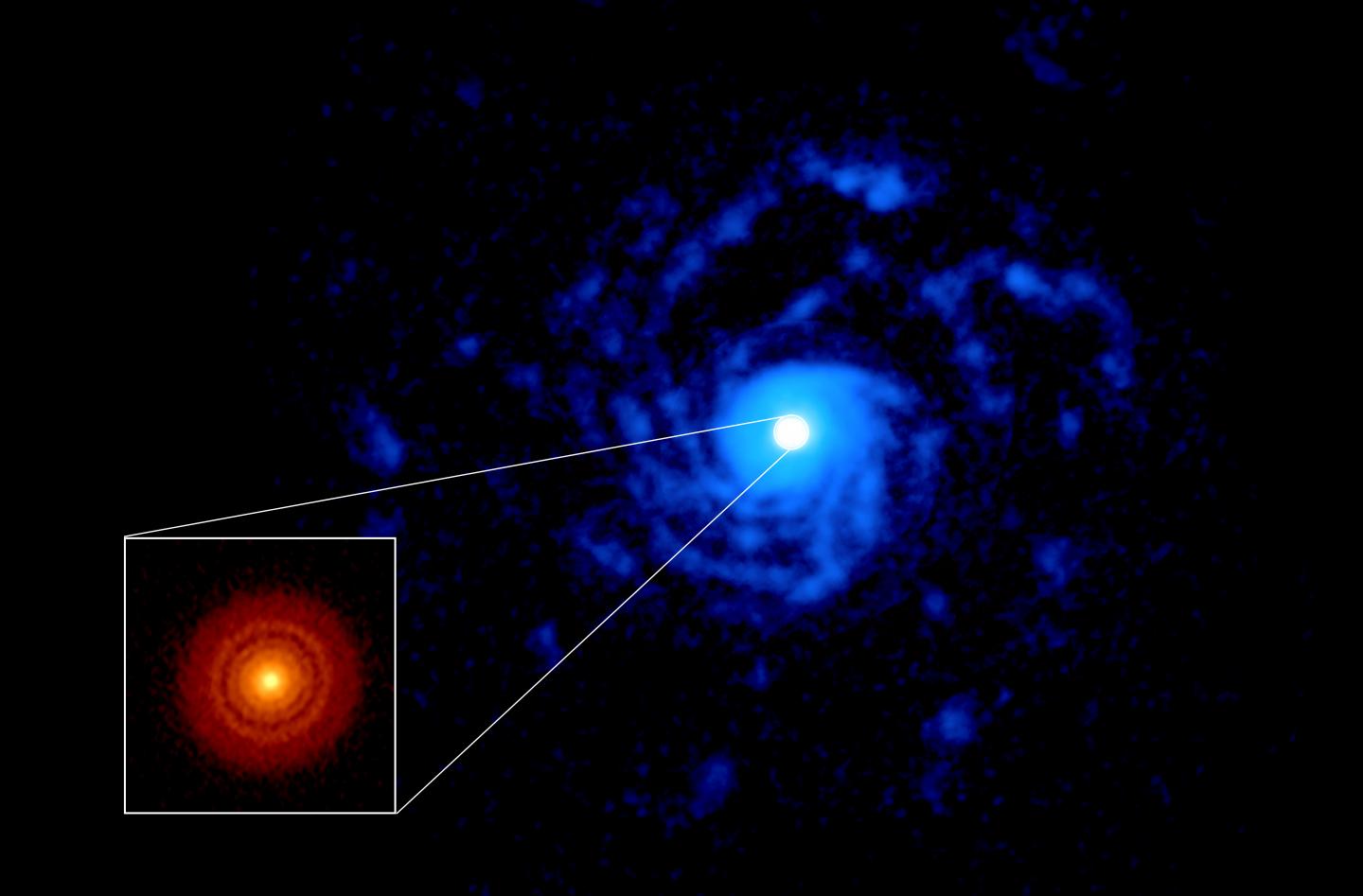
Credit: ALMA (ESO/NAOJ/NRAO), J. Huang and S. Andrews; NRAO/AUI/NSF, S. Dagnello
Planet-forming environments can be much more complex and chaotic than previously expected. This is evidenced by a new image of the star RU Lup, made with the Atacama Large Millimeter/submillimeter Array (ALMA).
All planets, including the ones in our Solar System, are born in disks of gas and dust around stars, so-called protoplanetary disks. Thanks to ALMA we have stunning high-resolution images of many of these planet factories, showing dusty disks with multiple rings and gaps that hint at the presence of emerging planets. The most famous examples of these are HL Tau and TW Hydrae.
But disks are not necessarily as neatly arranged as these initial dust observations suggest. A new ALMA image of RU Lup, a young variable star in the Lupus constellation, revealed a giant set of spiral arms made of gas, extending far beyond its more well-known dust disk. This spiral structure – resembling a ‘mini-galaxy’ – extends to nearly 1000 astronomical units (au) from the star, much farther away than the compact dust disk that extends to about 60 au.
Previous observations of RU Lup with ALMA, which were part of the Disk Substructures at High Angular Resolution Project (DSHARP, https:/
Protoplanetary disks contain much more gas than dust. While dust is needed to accumulate the cores of planets, gas creates their atmospheres.
In recent years, high resolution observations of dust structures have revolutionized our understanding of planet formation. However, this new image of the gas indicates that the current view of planet formation is still too simplistic and that it might be much more chaotic than previously inferred from the well-known images of neatly concentric ringed disks
“The fact that we observed this spiral structure in the gas after a longer observation suggests that we have likely not seen the full diversity and complexity of planet-forming environments. We may have missed much of the gas structures in other disks,” added Huang.
Huang and her team suggest several scenarios that could possibly explain why the spiral arms appeared around RU Lup. Maybe the disk is collapsing under its own gravity, because it is so massive. Or maybe RU Lup is interacting with another star. Another possibility is that the disk is interacting with its environment, accreting interstellar material along the spiral arms.
“None of these scenarios completely explain what we have observed,” said team-member Sean Andrews of CfA. “There might be unknown processes happening during planet formation that we have not yet accounted for in our models. We will only learn what they are if we find other disks out there that look like RU Lup.”
###
This research is presented in a paper titled “Large-scale CO spiral arms and complex kinematics associated with the T Tauri star RU Lup”, by J. Huang et al., in the Astrophysical Journal. DOI: 10.3847/1538-4357/aba1e1
The team is composed of Jane Huang, Sean M. Andrews, Karin I. Öberg and David J. Wilner (Center for Astrophysics | Harvard & Smithsonian), Megan Ansdell (NASA HQ), Myriam Benisty (Universidad de Chile/IPAG France), John M. Carpenter (Joint ALMA Observatory Chile), Andrea Isella (Rice University), Laura M. Pérez (Universidad de Chile), Luca Ricci (California State University Northridge), Jonathan P. Williams (University of Hawaii), and Zhaohuan Zhu (University of Nevada).
The National Radio Astronomy Observatory is a facility of the National Science Foundation, operated under cooperative agreement by Associated Universities, Inc.
The Atacama Large Millimeter/submillimeter Array (ALMA), an international astronomy facility, is a partnership of the European Organisation for Astronomical Research in the Southern Hemisphere (ESO), the U.S. National Science Foundation (NSF) and the National Institutes of Natural Sciences (NINS) of Japan in cooperation with the Republic of Chile. ALMA is funded by ESO on behalf of its Member States, by NSF in cooperation with the National Research Council of Canada (NRC) and the Ministry of Science and Technology (MOST) and by NINS in cooperation with the Academia Sinica (AS) in Taiwan and the Korea Astronomy and Space Science Institute (KASI).
ALMA construction and operations are led by ESO on behalf of its Member States; by the National Radio Astronomy Observatory (NRAO), managed by Associated Universities, Inc. (AUI), on behalf of North America; and by the National Astronomical Observatory of Japan (NAOJ) on behalf of East Asia. The Joint ALMA Observatory (JAO) provides the unified leadership and management of the construction, commissioning and operation of ALMA.
Media Contact
Iris Nijman
[email protected]
Original Source
https:/
Related Journal Article
http://dx.