• HOME
  • NEWS
  • EXPLORE
    • CAREER
      • Companies
      • Jobs
    • EVENTS
    • iGEM
      • News
      • Team
    • PHOTOS
    • VIDEO
    • WIKI
  • BLOG
  • COMMUNITY
    • FACEBOOK
    • INSTAGRAM
    • TWITTER
Saturday, June 27, 2026
BIOENGINEER.ORG
No Result
View All Result
  • Login
  • HOME
  • NEWS
  • EXPLORE
    • CAREER
      • Companies
      • Jobs
        • Lecturer
        • PhD Studentship
        • Postdoc
        • Research Assistant
    • EVENTS
    • iGEM
      • News
      • Team
    • PHOTOS
    • VIDEO
    • WIKI
  • BLOG
  • COMMUNITY
    • FACEBOOK
    • INSTAGRAM
    • TWITTER
  • HOME
  • NEWS
  • EXPLORE
    • CAREER
      • Companies
      • Jobs
        • Lecturer
        • PhD Studentship
        • Postdoc
        • Research Assistant
    • EVENTS
    • iGEM
      • News
      • Team
    • PHOTOS
    • VIDEO
    • WIKI
  • BLOG
  • COMMUNITY
    • FACEBOOK
    • INSTAGRAM
    • TWITTER
No Result
View All Result
Bioengineer.org
No Result
View All Result
Home NEWS Science News

Algal residue — an alternative carbon resource for pharmaceuticals and polyesters

Bioengineer by Bioengineer
April 12, 2017
in Science News
Reading Time: 2 mins read
0
Share on FacebookShare on TwitterShare on LinkedinShare on RedditShare on Telegram
IMAGE

Credit: Tokyo Institute of Technology

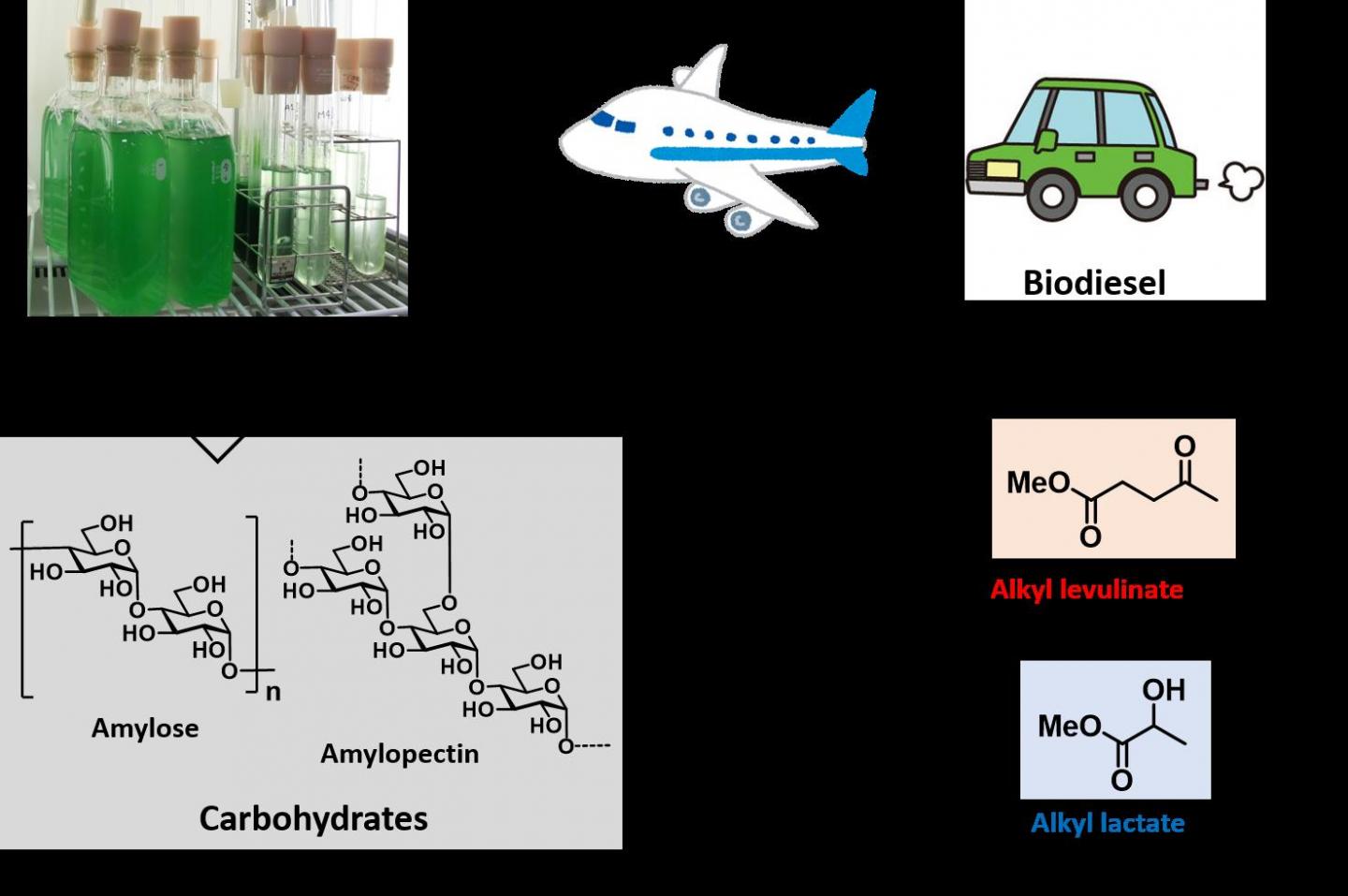
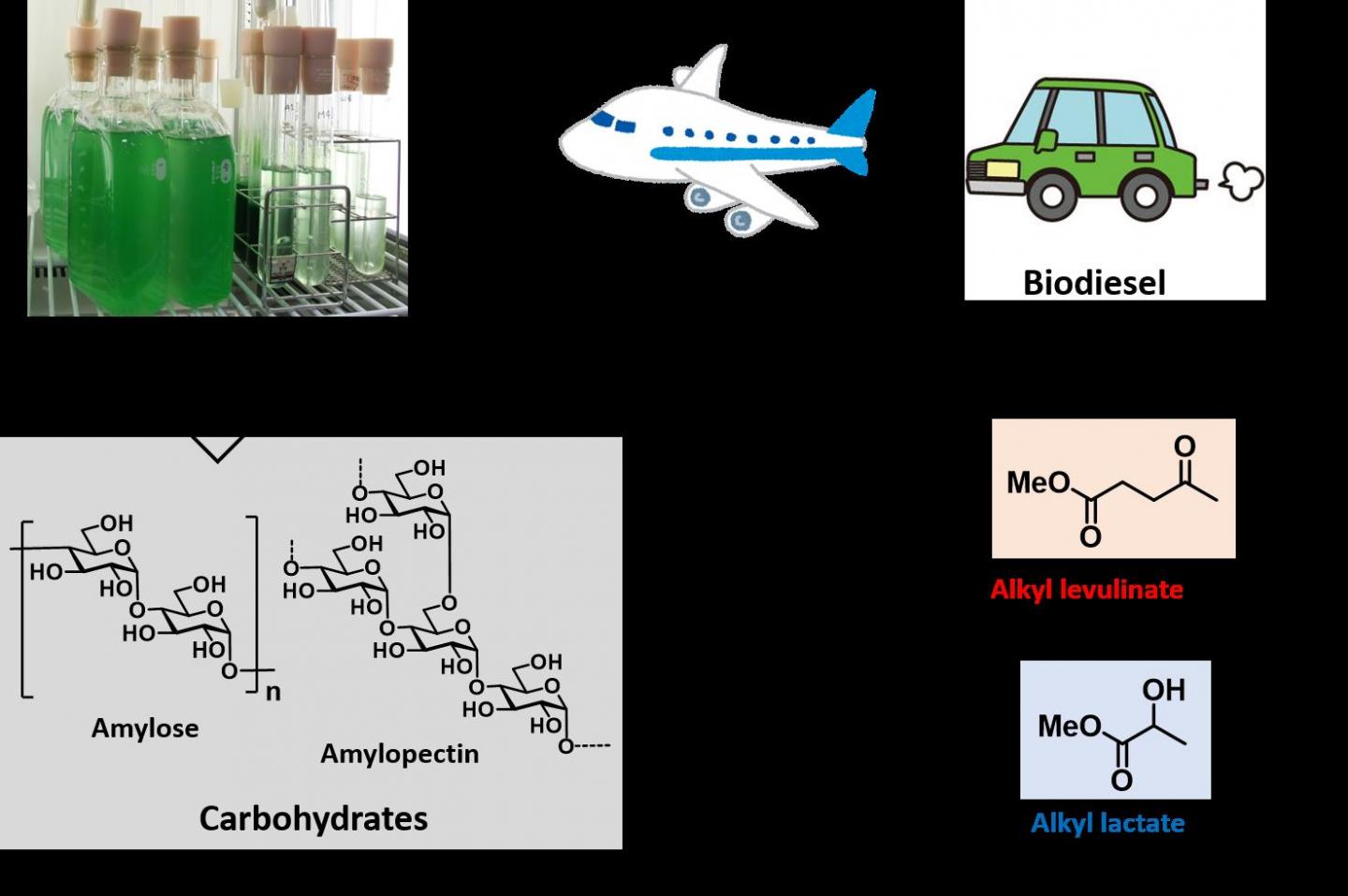
Microalgae have received much attention in biomass production due to many strains having a high biomass productivity per unit time and per unit area. Algae produce high levels of oil as well as carbohydrates, occurring mainly in the form of starch. They can survive in unfavorable, nutrient deficient conditions, and can be propagated industrially without using farmland. Oil derived from algae has recently been adopted for use in jet fuels and biodiesel. Previously overlooked, however, was the starch remaining in algal cells after oil extraction. Tokyo Tech researcher Sho Yamaguchi and colleagues found that this starch can be converted into alkyl lactate and alkyl levulinate, important chemicals in the production of pharmaceuticals, additives, and polyesters.

Two molecules of lactic acid can be dehydrated to lactone lactide and subsequently polymerized to either atactic or syndiotactic polylactide, which are biodegradable polyesters. Levulinic acid, on the other hand, is used as a precursor for pharmaceuticals and additives like plasticizers, as well as a starting material for a wide number of compounds. The researchers found that using homogeneous Sn(OTf)2 led to an increase in the yield of alkyl levulinate, while using SnBr4 allowed for the selective production of alkyl lactate. Their results show that algae can be utilized not only as a biofuel source, but also as a carbon resource for chemicals that are applied in a wide range of industries. This could lead to algae biomass becoming a new alternative carbon resource to fossil fuels.

Yamaguchi and colleagues examined various homogeneous catalysts to optimize the selective production of methyl levulinate and methyl lactate. They state, however, that further development of heterogeneous catalysts is needed before the process can be put to practical use. Additionally, they recognize the importance in understanding the underlying mechanisms of starch production in algae, as doing so could lead to further advances in algal biomass production.

###

Author Information

Sho Yamaguchi*1, Yuuki Kawada2, Hidetaka Yuge2, Kan Tanaka3,4, Sousuke Imamura3,4, Development of New Carbon Resources: Production of Important Chemicals from Algal Residue, Scientific Reports, 2017, DOI:10.1038/s41598-017-00979-y

Media Contact

Emiko Kawaguchi
[email protected]
81-357-342-975

http://www.titech.ac.jp/english/index.html

############

Story Source: Materials provided by Scienmag

Share12Tweet8Share2ShareShareShare2

Related Posts

Tracking Lanthanide-Labeled Microplastics in Plants

June 25, 2026

POSTECH Researchers Slash Cost of Reconstituted Cell-Free Systems by 95%

June 25, 2026

AI and Physics Collaborate to Design Advanced Hydrogen Storage Materials

June 25, 2026

Natural Hallucinogens: Evolution’s Ecological Tools, Not Mere Chemical Byproducts

June 25, 2026
Please login to join discussion

POPULAR NEWS

  • Saying Goodbye to PGY-6: Pediatric Fellowship Realities

    103 shares
    Share 41 Tweet 26
  • Multi-Hospital Study Reveals Long Covid Burden Is Twice as High as Current Estimates

    92 shares
    Share 36 Tweet 23
  • Detection of EDCs in Breast Milk and Infant Urine Up to Six Months Highlights Early Exposure Risks

    77 shares
    Share 31 Tweet 19
  • New Drug Candidate Developed at McMaster Shows Potential for Treating Brain Cancer

    58 shares
    Share 23 Tweet 15

About

We bring you the latest biotechnology news from best research centers and universities around the world. Check our website.

Follow us

Recent News

Tracking Lanthanide-Labeled Microplastics in Plants

POSTECH Researchers Slash Cost of Reconstituted Cell-Free Systems by 95%

AI and Physics Collaborate to Design Advanced Hydrogen Storage Materials

Subscribe to Blog via Email

Success! An email was just sent to confirm your subscription. Please find the email now and click 'Confirm' to start subscribing.

Join 82 other subscribers
  • Contact Us

Bioengineer.org © Copyright 2023 All Rights Reserved.

Welcome Back!

Login to your account below

Forgotten Password?

Retrieve your password

Please enter your username or email address to reset your password.

Log In
No Result
View All Result
  • Homepages
    • Home Page 1
    • Home Page 2
  • News
  • National
  • Business
  • Health
  • Lifestyle
  • Science

Bioengineer.org © Copyright 2023 All Rights Reserved.