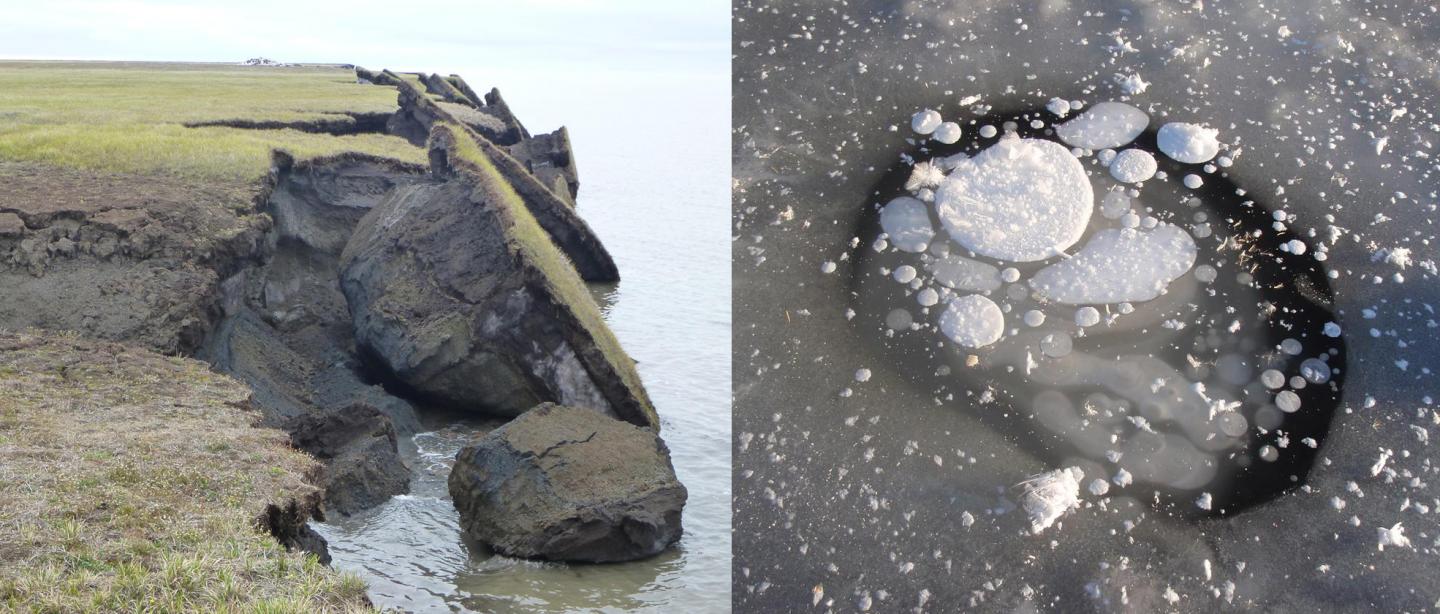
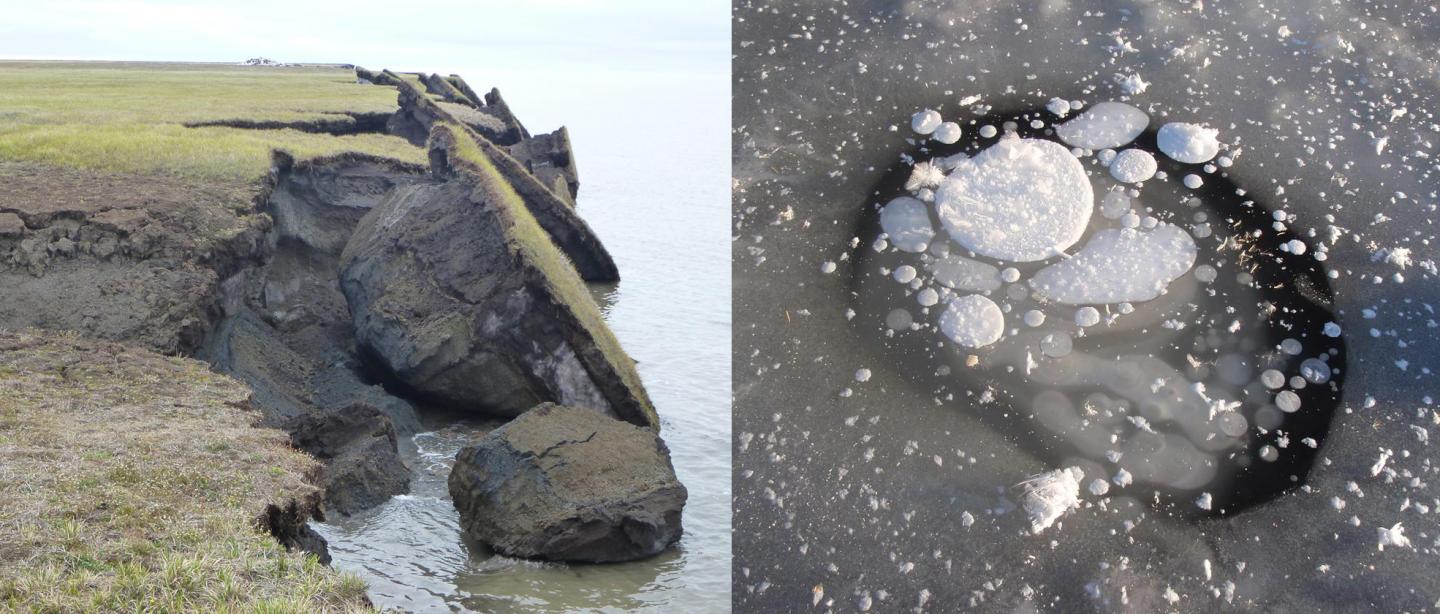
Credit: Miriam Jones and USGS
Alaska's land mass is equal to the size of one-fifth of the continental United States, yet stores about half of the country's terrestrial – both upland and wetland – carbon stores and fluxes. The carbon is not only stored in vegetation and soil, but also in vital freshwater ecosystems even though lakes and ponds, rivers, streams, and springs only cover a small amount of landmass in Alaska.
Alarmingly, recent studies show that Alaska is warming more than twice as fast as the rest of the country. The fate of the large state's plentiful carbon, and how carbon management policy is structured there, has implications on national, and even international, scales.
A collection of articles in the Ecological Society of America's journal Ecological Applications provides a synthesis of the Alaska terrestrial and aquatic carbon cycle. "Taken as a whole, the set of papers in the invited feature provide a comprehensive view of a critical region, and one that could be a model for other regions within the U.S. and globally," USGS researcher David McGuire writes in the feature's introduction.
The warming climate in northern ecosystems such as Alaska's can release carbon dioxide (CO2) and other gases into the atmosphere through many pathways, including but not limited to the thawing of methane-laden permafrost and increased carbon emissions from more frequent wildfires.
However, other aspects of the carbon cycle could counter the increased carbon release. Warmer, longer growing seasons and more available nutrients may result in more green growth to take up more atmospheric CO2, providing a sink. The types of forests that grow at high latitudes could shift from more flammable conifer forest to less flammable deciduous forest, meaning fewer wildfires.
Together, the papers provide new syntheses of Alaskan carbon stores and fluxes, fire dynamics, vegetation change, forest management, permafrost soil thaw, and many other facets of historical (1950-2009) and projected (2010-2100) carbon balance in these sensitive ecosystems.
These papers stem from efforts by the U.S. Geological Survey, U.S. Forest Service, and university scientists to assess past and future carbon fluxes as mandated by the Energy Independence and Security Act of 2007. The original report, a first-of-its-kind assessment published in 2016, revealed the vulnerability of carbon stored in high latitude ecosystems and how soil carbon losses in Alaska are amplified by wildfires with the warming Arctic climate.
McGuire explains ways in which future assessments can be even more comprehensive, such as modeling the future methane emissions from lakes and including the effects that fire disturbances have on insects and abrupt thawing. In addition, he recommends that future assessments extend to 2300 given that many effects of permafrost thaw and elevated atmospheric CO2 have not yet fully manifested, and those assessments should include societal impacts of climate change in Alaska.
As demonstrated by the 2016 report, and further emphasized by these new publications, it is absolutely vital to pursue a field-based understanding of the carbon cycle of the Earth in various settings in order to better understand both the natural and the human-influenced mechanisms of climate change.
###
Journal Articles:
A. David McGuire, et al. (2018) Introduction for invited feature "Alaska Carbon Cycle." Ecological Applications. DOI: 10.1002/eap.1808
A. David McGuire, et al. (2018) Assessing historical and projected carbon balance of Alaska: A synthesis of results and policy/management implications. Ecological Applications. DOI: 10.1002/eap.1768
Hélène Genet, et al. (2017) The role of driving factors in historical and projected carbon dynamics of upland ecosystems in Alaska. Ecological Applications. DOI: 10.1002/eap.1641
Zhou Lyu, et al. (2018) The role of environmental driving factors in historical and projected carbon dynamics of wetland ecosystems in Alaska. Ecological Applications. DOI: 10.1002/eap.1755
Neal J. Pastick, et al. (2017) Historical and projected trends in landscape drivers affecting carbon dynamics in Alaska. Ecological Applications. DOI: 10.1002/eap.1538
Sarah M. Stackpoole, et al. (2017) Inland waters and their role in the carbon cycle of Alaska. Ecological Applications. DOI: 10.1002/eap.1552
Author contact:
A.David McGuire [email protected]
The Ecological Society of America (ESA), founded in 1915, is the world's largest community of professional ecologists and a trusted source of ecological knowledge, committed to advancing the understanding of life on Earth. The 9,000 member Society publishes five journals and a membership bulletin and broadly shares ecological information through policy, media outreach, and education initiatives. The Society's Annual Meeting attracts 4,000 attendees and features the most recent advances in the science of ecology. Visit the ESA website at http://www.esa.org.
Media Contact
Zoe Gentes
[email protected]
202-833-8773
@ESA_org
http://www.esa.org
Original Source
https://www.esa.org/esa/alaskan-carbon-assessment-has-implications-for-national-climate-policy/