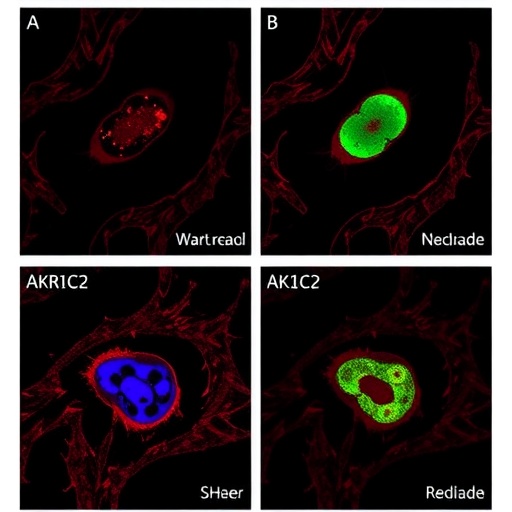
Cervical cancer has long been understood as a disease in which malignant cells gradually acquire the ability to escape the primary tumor, invade surrounding tissue and travel through the lymphatic system. A new study published in Cell Death Discovery identifies a previously underappreciated driver of that process: the enzyme aldo-keto reductase family 1 member C2, or AKR1C2. According to research led by He, Li, Zu and colleagues, AKR1C2 can promote lymph node metastasis not only through its conventional biochemical activity, but also through an unexpected function inside the cell nucleus. The finding expands the biological role of a protein traditionally associated with steroid metabolism and suggests that its subcellular location may be as important as its enzymatic identity.
AKR1C2 belongs to the aldo-keto reductase superfamily, a group of enzymes that catalyze the reduction of aldehydes and ketones. These reactions influence the metabolism of steroid hormones, prostaglandins and other signaling molecules. Because such compounds can affect cell growth, inflammation and survival, changes in AKR1C2 activity have been linked to several forms of cancer. In its better-known role, AKR1C2 operates as a metabolic regulator, altering the chemical environment around a tumor cell. The new cervical cancer study points to a second layer of biology: AKR1C2 can enter the nucleus, where it appears to influence gene-regulatory programs directly or indirectly.
The distinction matters because metastasis is not simply a faster version of tumor growth. To reach a lymph node, a cancer cell must loosen its attachments to neighboring cells, remodel its cytoskeleton, move through the surrounding extracellular matrix, enter lymphatic vessels and survive transport before establishing a new population. Each stage depends on coordinated changes in gene expression. Proteins that control these changes are often transcription factors, chromatin regulators or signaling proteins. AKR1C2 is not usually placed in that category. Its reported nuclear activity therefore provides a striking example of how a metabolic enzyme can acquire a non-canonical role in cancer progression.
The investigators examined the relationship between AKR1C2 and aggressive behavior in cervical cancer models, focusing particularly on invasion and lymphatic dissemination. Their findings associate higher AKR1C2 activity or abundance with characteristics linked to metastatic disease. Experimental manipulation of the protein showed that increasing AKR1C2 enhanced cancer-cell behaviors required for spread, while reducing it weakened those behaviors. These types of gain- and loss-of-function experiments are important because they move beyond a simple correlation observed in tumor samples. They test whether AKR1C2 is merely a marker of aggressive cancer or whether it actively contributes to the phenotype.
A central observation was the presence of AKR1C2 in the nucleus. Enzymes are often described according to the reactions they perform, but their effects can change dramatically when they appear in a different cellular compartment. In the cytoplasm, AKR1C2 may influence hormone or lipid-derived metabolites. In the nucleus, it can participate in protein complexes or gene-control machinery, potentially changing the expression of genes involved in cell adhesion, motility, extracellular-matrix remodeling and survival. The study’s title emphasizes this “non-canonical nuclear function,” indicating that the protein’s metastasis-promoting activity cannot be explained solely by its traditional metabolic role.
This nuclear behavior offers a possible explanation for how cervical cancer cells switch into a more invasive state. Tumor cells undergoing metastatic progression frequently alter epithelial–mesenchymal plasticity, a reversible process in which cells reduce stable epithelial characteristics and gain greater motility and tissue-penetrating capacity. They may also increase production of matrix-degrading enzymes, modify interactions with stromal cells and become more resistant to stressful conditions. By influencing transcriptional programs from within the nucleus, AKR1C2 could help coordinate several of these changes at once. Rather than acting as a single isolated trigger, it may function as a molecular amplifier that reinforces the cellular state required for lymph node colonization.
The study is also significant because lymph node involvement is a critical clinical turning point in cervical cancer. Once malignant cells reach regional lymph nodes, the risk of further dissemination increases and treatment decisions become more complex. Current clinical assessment relies heavily on imaging, pathology and surgical evaluation, but these approaches do not fully reveal the molecular machinery that enables a tumor to spread. A protein such as AKR1C2 could eventually become useful as a prognostic biomarker if its level, localization or activity consistently correlates with nodal metastasis in larger patient cohorts. However, an experimental association is not yet a validated clinical test, and the value of AKR1C2 for patient stratification will require independent confirmation.
The findings may also have therapeutic implications, although they do not immediately justify the use of an AKR1C2-targeting drug. Blocking the enzyme’s catalytic activity might not be sufficient if the metastatic effect depends on its nuclear interactions rather than on the metabolites it produces. Future strategies could need to prevent AKR1C2 from entering the nucleus, disrupt its interaction with nuclear partners or selectively inhibit the gene-regulatory program it activates. Such approaches would have to be carefully designed because AKR1C2 participates in normal physiology, including the handling of steroid-related molecules and potentially other reactive carbonyl compounds. The challenge will be to suppress its tumor-promoting function without causing unacceptable effects in healthy tissues.
The work also reinforces a broader principle in cancer biology: metabolic enzymes are increasingly recognized as multifunctional proteins. Their catalytic reactions remain important, but they can also act as signaling components, scaffolds or regulators of gene expression. This phenomenon reflects the adaptability of cancer cells, which repurpose ordinary cellular machinery to survive, invade and colonize new environments. In cervical cancer, the nuclear activity of AKR1C2 may represent one such adaptation, linking metabolic regulation to the transcriptional control of metastasis. The discovery does not reduce lymph node spread to a single protein, but it identifies a potentially actionable node within the complex network that governs tumor dissemination.
For now, the study provides a mechanistic framework rather than a finished clinical solution. The next steps will include determining precisely which nuclear proteins interact with AKR1C2, identifying the genes and chromatin regions affected by that interaction, and testing whether the mechanism operates across different cervical cancer subtypes and treatment backgrounds. Researchers will also need to establish whether nuclear AKR1C2 predicts lymph node metastasis more accurately than total AKR1C2 expression and whether its inhibition can prevent spread in clinically relevant models. If those questions are answered, an enzyme once viewed mainly through the lens of steroid metabolism could emerge as a molecular indicator—and perhaps a therapeutic vulnerability—of cervical cancer’s most dangerous transition: the journey from a localized tumor to disease established in the lymphatic system.
Subject of Research: AKR1C2 and its role in lymph node metastasis in cervical cancer
Article Title: AKR1C2 promotes lymph node metastasis in cervical cancer via a non-canonical nuclear function
Article References: He, F., Li, Y., Zu, S. et al. AKR1C2 promotes lymph node metastasis in cervical cancer via a non-canonical nuclear function. Cell Death Discovery (2026). https://doi.org/10.1038/s41420-026-03287-5
Image Credits: AI Generated
DOI: https://doi.org/10.1038/s41420-026-03287-5
Keywords: AKR1C2, cervical cancer, lymph node metastasis, nuclear function, cancer biology, tumor invasion, steroid metabolism, molecular oncology
Tags: AKR1C2 enzyme functioncervical cancer metastasisenzyme regulation of cancer cell invasionlymph node metastasis mechanismsmolecular drivers of cervical cancer spreadnoncanonical nuclear activity in cancernovel targets for cervical cancer therapynuclear functions of metabolic enzymesrole of aldo-keto reductase family in tumor progressionsignaling pathways in cervical lymphatic disseminationsteroid metabolism enzymes in cancersubcellular localization of AKR1C2