• HOME
  • NEWS
  • EXPLORE
    • CAREER
      • Companies
      • Jobs
    • EVENTS
    • iGEM
      • News
      • Team
    • PHOTOS
    • VIDEO
    • WIKI
  • BLOG
  • COMMUNITY
    • FACEBOOK
    • INSTAGRAM
    • TWITTER
Sunday, April 19, 2026
BIOENGINEER.ORG
No Result
View All Result
  • Login
  • HOME
  • NEWS
  • EXPLORE
    • CAREER
      • Companies
      • Jobs
        • Lecturer
        • PhD Studentship
        • Postdoc
        • Research Assistant
    • EVENTS
    • iGEM
      • News
      • Team
    • PHOTOS
    • VIDEO
    • WIKI
  • BLOG
  • COMMUNITY
    • FACEBOOK
    • INSTAGRAM
    • TWITTER
  • HOME
  • NEWS
  • EXPLORE
    • CAREER
      • Companies
      • Jobs
        • Lecturer
        • PhD Studentship
        • Postdoc
        • Research Assistant
    • EVENTS
    • iGEM
      • News
      • Team
    • PHOTOS
    • VIDEO
    • WIKI
  • BLOG
  • COMMUNITY
    • FACEBOOK
    • INSTAGRAM
    • TWITTER
No Result
View All Result
Bioengineer.org
No Result
View All Result
Home NEWS Science News Chemistry

Air pollution speeds snowmelt

Bioengineer by Bioengineer
June 27, 2023
in Chemistry
Reading Time: 2 mins read
0
Changes in Himalayan positive radiative forcing
Share on FacebookShare on TwitterShare on LinkedinShare on RedditShare on Telegram

Diminished anthropogenic pollutant emissions during 2020 Covid-19 lockdowns reduced snowmelt in the Himalayas, according to a study. Liqiang Zhang and colleagues used multiple satellite data from the Moderate Resolution Imaging Spectroradiometer (MODIS) and Ozone Monitoring Instrument (OMI), as well as a coupled atmosphere-chemistry-snow model (GEOS-Chem-SNICAR) to explore how the sudden, dramatic reduction in particulate pollution in the region affected snow and ice melt. Snow and ice on the Tibetan plateau act as a water source for over 20% of the global population. However, ice and snow in the Himalayas have been melting at an accelerating rate in recent decades. While much of this melting is attributable to climate change, air pollution also plays a role, because dark particles of dust and soot that fall on frozen surfaces absorb solar energy and melt the nearby snow and ice. The COVID-19 pandemic created a natural experiment because the Indian national lockdown from 25 March 2020 to 31 May 2020 reduced economic and transportation activities. The authors estimate that the reduced anthropogenic pollutant emissions during the Indian lockdown was responsible for 71.6% of the reduction in radiative forcing on snow in April 2020 compared to the same period in 2019. This reduction in radiative forcing may have prevented 27 Mt in ice and snow melt. The results emphasize the power of reducing anthropogenic pollutant emissions when combating snow and ice melt, according to the authors.
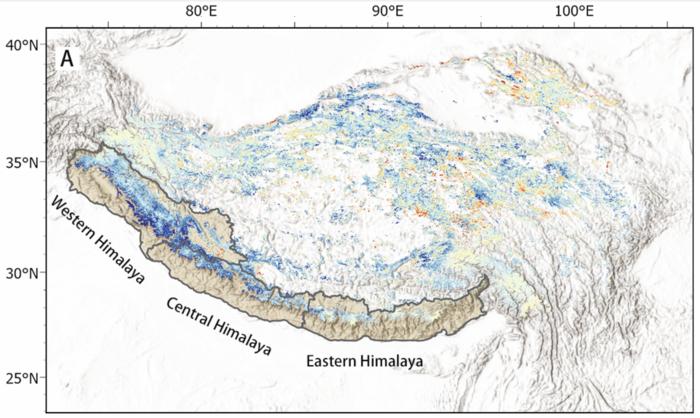
Changes in Himalayan positive radiative forcing

Credit: Hou et al

Diminished anthropogenic pollutant emissions during 2020 Covid-19 lockdowns reduced snowmelt in the Himalayas, according to a study. Liqiang Zhang and colleagues used multiple satellite data from the Moderate Resolution Imaging Spectroradiometer (MODIS) and Ozone Monitoring Instrument (OMI), as well as a coupled atmosphere-chemistry-snow model (GEOS-Chem-SNICAR) to explore how the sudden, dramatic reduction in particulate pollution in the region affected snow and ice melt. Snow and ice on the Tibetan plateau act as a water source for over 20% of the global population. However, ice and snow in the Himalayas have been melting at an accelerating rate in recent decades. While much of this melting is attributable to climate change, air pollution also plays a role, because dark particles of dust and soot that fall on frozen surfaces absorb solar energy and melt the nearby snow and ice. The COVID-19 pandemic created a natural experiment because the Indian national lockdown from 25 March 2020 to 31 May 2020 reduced economic and transportation activities. The authors estimate that the reduced anthropogenic pollutant emissions during the Indian lockdown was responsible for 71.6% of the reduction in radiative forcing on snow in April 2020 compared to the same period in 2019. This reduction in radiative forcing may have prevented 27 Mt in ice and snow melt. The results emphasize the power of reducing anthropogenic pollutant emissions when combating snow and ice melt, according to the authors.


Journal

PNAS Nexus

DOI

10.1093/pnasnexus/pgad172

Article Title

The COVID-19 lockdown: A unique perspective into heterogeneous impacts of transboundary pollution on snow and ice darkening across the Himalayas

Article Publication Date

27-Jun-2023
Share12Tweet8Share2ShareShareShare2

Related Posts

Transforming Microalgae into Premium Fuels: Biochar Catalyst Enables Cleaner Aromatic Synthesis

Transforming Microalgae into Premium Fuels: Biochar Catalyst Enables Cleaner Aromatic Synthesis

April 17, 2026
New Study Unveils Pathway to Harness Majorana States for Quantum Computing

New Study Unveils Pathway to Harness Majorana States for Quantum Computing

April 17, 2026

Concordia Study Explores Using Mining Waste to Store Carbon Emissions

April 17, 2026

Breaking Boundaries: Soft Materials Pave the Way for Transparent, Broadband Ultrasound

April 17, 2026

POPULAR NEWS

  • Scientists Investigate Possible Connection Between COVID-19 and Increased Lung Cancer Risk

    62 shares
    Share 25 Tweet 16
  • NSF funds machine-learning research at UNO and UNL to study energy requirements of walking in older adults

    101 shares
    Share 40 Tweet 25
  • Boosting Breast Cancer Risk Prediction with Genetics

    47 shares
    Share 19 Tweet 12
  • Self-Oscillating Electroactive Nanocomposites Boost Heat Pumps

    41 shares
    Share 16 Tweet 10

About

We bring you the latest biotechnology news from best research centers and universities around the world. Check our website.

Follow us

Recent News

NYU Langone Health Neurologists Unveil Latest Clinical Findings and Research at AAN 2026

Exercise, IADL, Social Interaction Ease Depression in Elderly

Financial Strain of Non-Communicable Diseases in Indian Elderly

Subscribe to Blog via Email

Enter your email address to subscribe to this blog and receive notifications of new posts by email.

Join 79 other subscribers
  • Contact Us

Bioengineer.org © Copyright 2023 All Rights Reserved.

Welcome Back!

Login to your account below

Forgotten Password?

Retrieve your password

Please enter your username or email address to reset your password.

Log In
No Result
View All Result
  • Homepages
    • Home Page 1
    • Home Page 2
  • News
  • National
  • Business
  • Health
  • Lifestyle
  • Science

Bioengineer.org © Copyright 2023 All Rights Reserved.