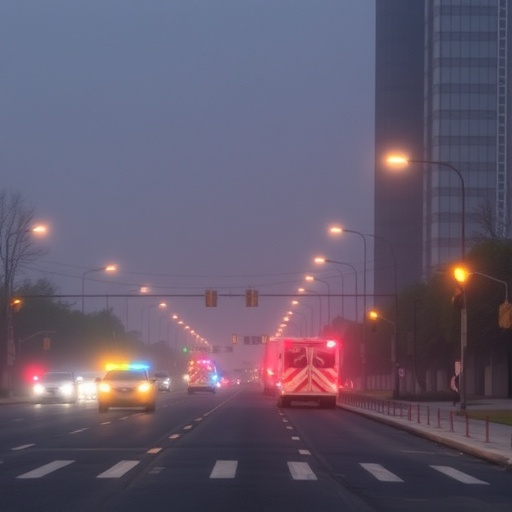
Scientific communities have long scrutinized the health ramifications of ambient air pollution, predominantly emphasizing chronic diseases such as asthma, cardiovascular conditions, and general respiratory decline. However, a pioneering investigation conducted in Guangzhou, China, sheds new light on the acute, short-term impacts of air pollution, particularly how transient exposure episodes correlate with obstetrical emergencies. The study, led by researchers Xie, Fan, Lin, and collaborators, intricately examines the linkage between ambient air pollution and emergency ambulance dispatches attributed to precipitous labor—a phenomenon characterized by labor progressing at an unusually rapid pace, potentially risking maternal and neonatal health.
This groundbreaking time-series analysis meticulously tracks the temporal relationship between air pollutant concentrations and the frequency of ambulance calls for precipitous labor over multiple years. Utilizing comprehensive environmental monitoring data and emergency medical services records, the authors ingeniously integrated these datasets to uncover compelling associations that previous epidemiological studies had not fully explored. The urban landscape of Guangzhou, marked by intense industrial activity, vehicular emissions, and fluctuating meteorological conditions, provided an optimal setting to study these acute exposure outcomes.
The research leverages advanced statistical models, including distributed lag non-linear models (DLNM), to dissect the delayed and nonlinear effects of pollutants such as PM2.5, PM10, nitrogen dioxide (NO2), sulfur dioxide (SO2), and ozone (O3) on precipitous labor incidents. Through this robust analytical framework, the study transcends mere correlation, approaching causative inference by adjusting for confounders like temperature, humidity, day of the week, and seasonal variation. This methodological rigor enhances the credibility of their findings and demonstrates the intricate temporal dynamics between pollutant exposure and rapid labor onset.
The researchers found that exposure to fine particulate matter (PM2.5) and nitrogen dioxide, even over short durations spanning hours to a few days, significantly elevated the risk of precipitous labor. This suggests that acute inflammatory responses stimulated by these pollutants might trigger uterine contractions or exacerbate underlying vulnerabilities in pregnant women. These pollutants are known to penetrate deep into the pulmonary alveoli and enter systemic circulation, instigating oxidative stress and systemic inflammation, mechanisms plausibly linked to sudden labor onset.
Notably, the study reveals a pronounced lag effect within 24 to 48 hours following pollutant exposure, indicating that the body’s inflammatory cascade following inhalation does not instantaneously precipitate labor but rather unfolds over a critical short-term window. This temporal insight holds profound implications for public health interventions, advocating for timely air quality warnings and enhanced prenatal care, especially on days with heightened pollution levels.
The findings also unveil a differential impact among pollutants. While fine particulate matter and nitrogen dioxide exhibit strong associations, ozone and sulfur dioxide showed comparatively weaker or nonsignificant effects in the context of precipitous labor. This distinction could relate to their varying capacities to induce systemic inflammation or their distinct atmospheric behavior and sources. Understanding which pollutants pose the highest risk allows policymakers to prioritize emission reduction strategies more effectively.
Moreover, the study underscores the disproportionate vulnerability of pregnant women to environmental insults, an often-overlooked demographic in air pollution-related health discourse. It challenges healthcare professionals and urban planners to recognize gestational vulnerability as a critical factor when devising environmental and clinical risk mitigation protocols. Emergency medical services can also benefit from predictive analytics derived from such research, optimizing resource allocation during high-risk pollution episodes.
From a mechanistic perspective, previous biomedical research indicates that pro-inflammatory cytokines and oxidative stress markers surge following air pollutant exposure, potentially instigating uterine irritability and cervical changes that expedite labor progression. These biological underpinnings lend biological plausibility to the epidemiological trends observed. However, direct mechanistic studies linking specific pollutants to uterine physiology in vivo remain scant, illuminating a fertile avenue for future interdisciplinary investigation.
The Guangzhou time-series study further amplifies the global relevance of air pollution as a maternal health hazard, especially in rapidly urbanizing and industrializing regions where pollutant concentrations often spike episodically. The study’s implications resonate beyond China, urging international health bodies to integrate air quality surveillance within prenatal risk assessments and emergency obstetric preparedness plans.
In addition to healthcare implications, the findings invoke socio-economic considerations. Precipitous labor can lead to higher incidences of adverse birth outcomes such as postpartum hemorrhage, perineal trauma, and neonatal distress, which impose substantial burdens on families and healthcare systems. Recognizing environmental triggers thus not only protects individual health but also mitigates broader societal costs.
The study also prompts reevaluation of urban environmental policies, advocating for sustained reductions in traffic emissions and industrial pollutants. Future urban planning paradigms could embed maternal health metrics as core criteria, facilitating the development of greener transport systems and industrial practices. Such integration could catalyze multifaceted health benefits extending across vulnerable populations.
Crucially, the research design embodies innovative application of time-series and environmental epidemiology methods, setting a precedent for analogous investigations into other acute obstetrical events potentially influenced by environmental factors. By elucidating temporal exposure-response relationships at fine resolution, this approach transcends traditional cross-sectional frameworks, enabling dynamic public health monitoring and real-time intervention strategies.
Critically, the authors acknowledge limitations inherent to observational data, including potential residual confounding and exposure misclassification. For instance, ambient pollution levels may not perfectly capture personal exposure due to individual mobility or indoor air quality variations. Nonetheless, the large dataset and sophisticated modeling partially mitigate these constraints, strengthening causal inference.
In summary, the study by Xie et al. constitutes a seminal contribution to environmental health literature, illuminating how short-term exposure to specific ambient air pollutants can precipitate emergent obstetric emergencies in the form of precipitous labor. The research amalgamates epidemiological rigor, innovative statistical modeling, and clinically pertinent outcomes to generate actionable insights. It implores multidisciplinary collaboration to address the intertwined challenges of urban pollution and maternal health resilience.
This emergent understanding demands urgent attention from healthcare providers, environmental regulators, and urban developers worldwide. Implementing air quality improvement measures and incorporating anticipatory clinical practices could markedly enhance perinatal outcomes and emergency response efficacy. As urban air quality fluctuates globally, this study serves as a clarion call to reconsider air pollution not merely as a chronic hazard but as an acute trigger of critical obstetric events, redefining the landscape of maternal-fetal healthcare in the 21st century.
Subject of Research: The association between short-term exposure to ambient air pollution and emergency ambulance dispatches for precipitous labor in Guangzhou, China.
Article Title: Short-term exposure to ambient air pollution and emergency ambulance dispatches for precipitous labor: a time-series study in Guangzhou, China.
Article References:
Xie, H., Fan, S., Lin, T. et al. Short-term exposure to ambient air pollution and emergency ambulance dispatches for precipitous labor: a time-series study in Guangzhou, China. Sci Rep (2026). https://doi.org/10.1038/s41598-026-43343-9
Image Credits: AI Generated
Tags: acute respiratory impact on pregnancyair pollutant concentrations and labor onsetair pollution and emergency laborambient air pollution effects on pregnancydistributed lag non-linear models in health studiesemergency ambulance dispatches for laborGuangzhou air pollution health studyobstetrical emergencies and pollutionPM2.5 impact on maternal healthprecipitous labor and air qualityshort-term air pollution exposure risksurban air pollution and labor outcomes