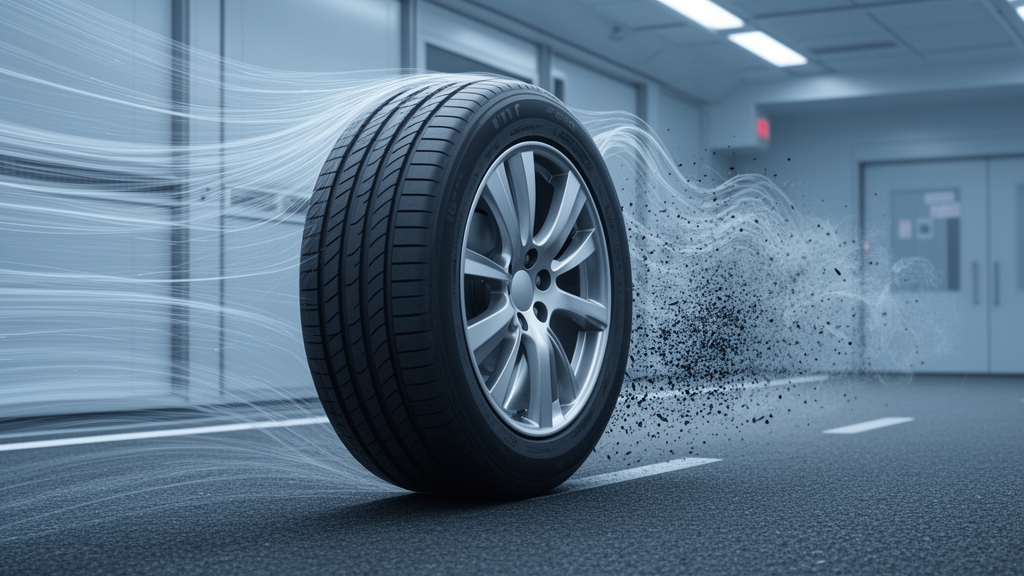
Every time a car rolls down a highway, its tyres shed microscopic fragments of rubber into the environment. These tyre wear particles, now recognized as one of the largest sources of microplastic pollution, litter roadsides, wash into rivers, and drift through the air we breathe. Yet one of the most basic questions about this pollution has remained surprisingly unanswered: once a tyre particle settles on a surface, how much wind does it actually take to lift it back into the air? A team of researchers at the University of Bayreuth has now provided the first rigorous answer, and their findings upend some long-standing assumptions about how plastic particles move through the atmosphere.
In a study published in the journal Aerosol Research, Bashir Olasunkanmi Ayinde and colleagues combined a classic boundary-layer wind tunnel with a cutting-edge deep learning system to watch, frame by frame, exactly when individual tyre wear particles tear loose from a glass surface. The particles they tested were pristine tyre wear fragments generated on a laboratory test stand from car tyres supplied by Continental Reifen Deutschland GmbH, meaning they had never been mixed with road dust or aged by weathering. This deliberately idealized setup allowed the team to isolate the fundamental physics of detachment without the confounding complexity of real-world road environments.
The technical challenge was considerable. Tyre wear particles are not neat spheres; scanning electron microscope images reveal jagged, irregular fragments with sharp edges and wildly varying aspect ratios. Traditional image processing methods, which rely on fluorescence thresholds or binary segmentation, struggle with such shapes and demand laborious manual preprocessing prone to operator bias. The Bayreuth team instead trained a YoloV8nano instance segmentation model, a convolutional neural network architecture released by Ultralytics in 2023, to detect each particle as a separate object and delineate its pixel-level boundary. The model detected more than 90 percent of particles across image frames, and after systematic testing of input resolutions from 416 to 1280 pixels, the researchers settled on the highest resolution, which maximized precision and recall at an acceptable computational cost.
Equally important was getting the particles onto the test surface in the first place. The team compared three seeding methods: cap tipping, sieving, and a custom-built low-cost pressurized apparatus that fires a roughly 20-millisecond pulse of compressed air through a dual-orifice assembly, ejecting particles into an airtight chamber where they settle gravitationally onto glass slides. The pressurized method proved the clear winner, producing a uniform near-monolayer deposit concentrated in the 80 to 180 micrometre range with minimal agglomeration. The tipping method, by contrast, yielded clumpy, heterogeneous distributions that degraded segmentation quality, with most particles scoring Dice similarity coefficients of 0.2 or below, while pressurized seeding pushed large particles consistently above 0.8.
With the experimental stage set, the researchers subjected the particle-laden slides to ten stepwise increases in airflow inside a 730-centimetre open-circuit wind tunnel. Friction velocity, the key variable characterizing the wind stress at the surface, was carefully calibrated using both logarithmic wind profile fitting and independent eddy covariance measurements, which agreed within about 4 percent. A high-resolution camera captured images every 10 seconds over an 18 by 12 millimetre field of view, and a tracking script assigned consistent identifiers to particles across frames, declaring a particle detached only when it moved beyond a 1.8-millimetre matching threshold. Eight replicate experiments were run to ensure statistical robustness.
The headline result: tyre wear particles require a bulk threshold friction velocity of approximately 0.26 metres per second to begin detaching, but that threshold is far from uniform across the population. Particles in the smaller size class, 80 to 150 micrometres, detached at a mean threshold of 0.33 metres per second, while larger particles of 150 to 300 micrometres needed roughly 25 percent more wind stress. Shape mattered just as much. Rounded particles with circularity between 0.8 and 1.0 lifted off at 0.33 metres per second, whereas highly irregular particles with circularity between 0.3 and 0.6 resisted until 0.40 metres per second. Across the full analysed range, the most easily mobilized and most stubborn particles differed by a factor of about 1.3 in their detachment thresholds.
The explanation lies in contact geometry. Irregular tyre fragments tend to lie flatter against the substrate, creating larger effective contact areas and multiple points of adhesion. In the force balance framework the researchers used, irregular particles gain a longer adhesion lever arm while simultaneously presenting a shorter drag lever arm to the airflow, meaning the aerodynamic moment must grow substantially before the particle yields. Even protruding edges that extend into faster-moving regions of the boundary layer, which should enhance aerodynamic forcing, proved secondary to the strengthened adhesion. Wind, in effect, preferentially strips away the finer and rounder particles first, leaving coarser, more angular fragments stubbornly anchored in place.
The comparison with spherical particles is perhaps the most striking finding. Drawing on threshold data for smooth polyethylene microspheres measured in the identical wind tunnel in a previous study, the team tested the widely used semi-empirical threshold model of Shao and Lu, originally formulated for spherical sand grains. The model reproduced the microsphere behaviour with standard parameters, but it systematically underestimated the tyre particle thresholds. Even pushing the cohesion parameter to the upper limit of the range accepted for natural dust and sand failed to close the gap. Allowing both the cohesion term and the aerodynamic scaling parameter to vary freely recovered the observed trend, but only with an aerodynamic efficiency parameter substantially larger than values typically used for mineral particles, a reflection of the morphological irregularity and multiple substrate contact points of tyre fragments.
Density, notably, was not the culprit. The tyre wear particles are about 1300 kilograms per cubic metre, compared with roughly 1025 for the polyethylene microspheres, but within the studied size range of 106 to 125 micrometres this difference would shift predicted thresholds by less than 10 percent, whereas the measured difference reached a factor of two. Morphology, not mass, dominates the aerodynamics of these particles. The researchers also note that the particle Reynolds and Stokes numbers in their experiments indicate inertial effects become relevant for the larger fragments, meaning particles do not respond instantaneously to turbulent gusts and require sustained forcing to overcome adhesion and gravity.
The authors are careful to frame their work as a deliberately idealized first step rather than a field-ready parameterization. Real roads add vehicle-induced vibrations, wake turbulence, surface roughness, environmental ageing, and road dust, all of which likely modify detachment behaviour. Still, the implications are significant. Resuspension models used to predict how microplastics travel through urban air currently rest on spherical-particle assumptions that tyre wear particles violate. By demonstrating that size and shape jointly control preferential mobilization, and by showing that deep learning can quantify these dynamics with high accuracy at modest computational cost, the Bayreuth team has laid a mechanistic foundation for the next generation of microplastic transport models, and for future experiments on the rougher, messier surfaces where tyre particles actually live.
Subject of Research: Aerodynamic detachment and transport of tyre wear microplastic particles under controlled wind tunnel conditions
Article Title: From seeding to detachment: leveraging deep learning to quantify the transport of tyre wear microplastics in a wind tunnel
Article References: Ayinde, B. O., Babel, W., Olesch, J., Wagner, D., Agarwal, S., Laforsch, C., Brehm, J., Nölscher, A., & Thomas, C. K. (2026). From seeding to detachment: leveraging deep learning to quantify the transport of tyre wear microplastics in a wind tunnel. Aerosol Research, 4(2), 345-372. https://doi.org/10.5194/ar-4-345-2026
Image Credits: AI Generated
Keywords: tyre wear particles, microplastics, wind tunnel, deep learning, aerosol research, particle detachment, threshold friction velocity, resuspension, particle morphology, air pollution, image segmentation, environmental transport
News Source: Russell Cooper. (October 9, 2026). AI Wind Tunnel Study Reveals Why Tyre Microplastics Refuse to Blow Away. Scienmag.