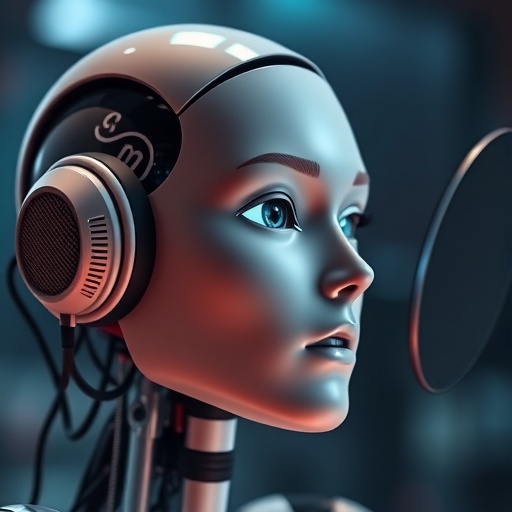
In the rapidly evolving landscape of synthetic speech technologies, a groundbreaking study has uncovered an astonishing advantage of voice cloning: these artificially created voices are more intelligible in noisy environments than their human counterparts. As synthetic voices become ubiquitous—from digital assistants like Siri and Alexa to automated customer service lines—the advent of voice cloning technology marks a transformative shift. Unlike conventional synthetic voices that demand extensive voice actor recordings, voice clones can recreate a unique vocal fingerprint from mere seconds of recorded speech, unlocking unprecedented applications and diversity in voice interfaces.
Recently published in The Journal of the Acoustical Society of America, a comprehensive investigation led by acoustic researchers Patti Adank from University College London and Han Wang from the University of Roehampton delved into the perceptual intelligibility of voice clones compared to original human speech under challenging auditory conditions. While it seemed intuitive that artificial voice reproductions could obscure meaning, the empirical evidence defied expectations. Listeners consistently found voice clones easier to decipher amidst background noise, revealing a novel “voice cloning intelligibility benefit” that could revolutionize auditory communication technologies.
Traditional synthetic voices rely heavily on hours of studio-recorded data to generate speech that sounds natural, which severely restricts the number of unique voices that can be produced. Voice cloning flips this paradigm by requiring only about ten seconds of audio input to generate a remarkably accurate vocal signature. This drastic reduction in data sampling opens doors for more personalized, context-aware text-to-speech systems, potentially enhancing accessibility tools, language learning apps, and voice interfaces for those with hearing impairments.
Intrigued by the cognitive implications of machine-generated speech, Adank and Wang set out to quantify how easily people could understand voice clones, especially in acoustically noisy environments. Contrary to their hypothesis that unfamiliar synthetic voices would prove harder to comprehend, early tests showed up to a 20% increase in intelligibility for voice clones. This surprising discovery sparked extensive efforts to identify the acoustic factors underpinning this phenomenon.
To validate their findings, the researchers conducted a battery of rigorous experiments with diverse populations, including elderly listeners with hearing difficulties, American English speakers to control for dialect effects, and individuals using cochlear implant simulations to approximate hearing impairment. In every demographic and auditory condition, voice cloning exhibited a sustained intelligibility advantage, underscoring its robustness and broad potential impact.
Delving into more than a hundred acoustic features, from spectral clarity to temporal modulation patterns, Adank and Wang searched for definitive characteristics that might explain why cloned voices penetrate noisy auditory scenes more effectively than natural human speech. While subtle differences in voice timbre, articulation precision, and frequency content were noted, a clear mechanistic explanation remains elusive, compelling the researchers to collaborate with digital signal processing and text-to-speech synthesis experts.
One promising avenue involves dissecting the digital signal processing algorithms that generate voice clones, examining how they emphasize certain acoustic cues and streamline speech features to maximize clarity. Synthesizers often apply noise reduction, amplitude normalization, and harmonic enhancement techniques that could inherently boost the perceptual salience of phonetic elements, thereby aiding intelligibility when competing with ambient noise.
This counterintuitive result—that synthetic replicas exceed original voices in comprehension—is poised to transform how we design voice-based technologies. Future interfaces might leverage voice cloning not only for its aesthetic customization but also for its functional superiority in challenging acoustic conditions, such as bustling public spaces, call centers, or assistive listening devices.
Moreover, this discovery invites reconsideration of traditional assumptions about naturalness and intelligibility in speech synthesis. The voice cloning intelligibility benefit reveals that authenticity in vocal reproduction may not be the ultimate goal; instead, optimizing clarity and comprehension could take precedence, particularly for applications necessitating reliable communication under adverse listening environments.
As research unfolds, these insights could inspire novel speech enhancement algorithms that merge the natural fluency of human speech with the clarity advantages of synthetic voices. The integration of advanced AI techniques with psychoacoustic models promises to elevate human-computer interaction, enabling more effective and inclusive auditory experiences.
The investigation led by Adank and Wang is more than a scientific curiosity; it represents a milestone in the quest to harness artificial intelligence to bridge the gap between human communication and machine understanding. Their study provides a compelling glimpse into a future where voice cloning technology not only mimics but also surpasses human auditory performance in specific contexts.
In light of these findings, developers, audiologists, and cognitive scientists are encouraged to explore the intersection of voice cloning and auditory perception further. Enhanced intelligibility afforded by digital voice clones may pave the way for new speech therapy tools, improved accessibility aids for the hard-of-hearing, and more natural yet functionally superior virtual assistants.
Ultimately, this research underscores the profound impact that advancing synthetic voice technologies can have on everyday communication. The voice cloning intelligibility advantage challenges preconceived boundaries and opens exciting avenues for innovation across fields as diverse as linguistics, signal processing, and human-computer interaction.
The full article, “Voice clones are easier to understand in noise than their human originals: the voice cloning intelligibility benefit,” by Patti Adank and Han Wang, appears in The Journal of the Acoustical Society of America, April 21, 2026 (DOI: 10.1121/10.0043094). It promises to spur continued exploration into the acoustic and cognitive dimensions of synthetic speech clarity.
Subject of Research: People
Article Title: Voice clones are easier to understand in noise than their human originals: the voice cloning intelligibility benefit
News Publication Date: 21 April 2026
Web References: https://doi.org/10.1121/10.0043094
Image Credits: AIP
Keywords
Voice, Acoustics, Technology, Auditory perception, Synthetic speech, Voice cloning, Hearing impairment, Digital signal processing, Text-to-speech systems, Speech intelligibility, Psychoacoustics, Human-computer interaction
Tags: acoustic research on synthetic speechAI voices versus human voicesauditory communication innovationautomated customer service voice techdigital assistants voice clarityperceptual intelligibility of synthetic voicesspeech technology advancementssynthetic speech intelligibilityvocal fingerprint recreationvoice cloning applicationsvoice cloning in noisy environmentsvoice cloning technology