


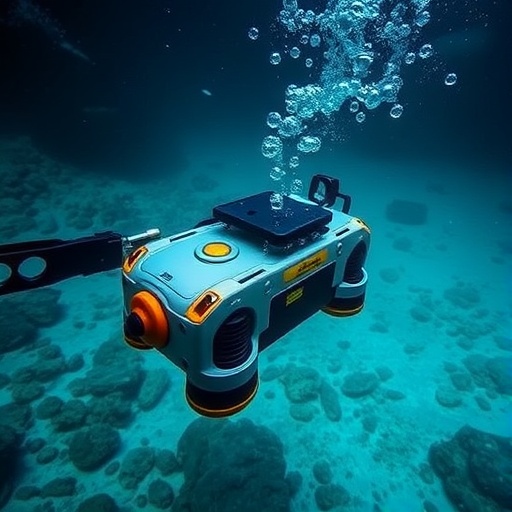
University of Minnesota Twin Cities researchers have unveiled a first-of-its-kind AI system for underwater companion robots that can assess a diver’s health in real time without physical sensors. The approach, reported in The International Journal of Robotics Research, estimates a diver’s Human Respiration Rate (HRR) by visually interpreting exhaled bubbles observed by a camera-equipped robot.
Scuba diving, especially in harsh environments, can quickly turn dangerous when physiological stress escalates. Excessive workload, exhaustion, or respiratory distress may develop faster than a diver can reliably self-report. Until now, underwater respiration monitoring has relied heavily on contact-based or wearable methods that struggle behind thick wetsuits and drysuits, while underwater wireless communication constrains data quality and bandwidth.
The new method treats breathing as a perception problem: bubbles provide a natural, non-contact signal that a robot can interpret. By detecting bubble patterns in video and mapping them to breaths per minute, the system converts routine underwater activity into an actionable respiratory metric.
A key technical challenge is training reliable perception under real-world conditions such as limited visibility, varying temperatures, and inconsistent bubble appearance. The team addressed this by building a dataset from multiple aquatic settings, including Lake Superior near Duluth, Square Lake near Stillwater, and an open-water test in the Caribbean Sea off Barbados.
To create ground truth, researchers developed a “fuzzy labeling” pipeline. They manually categorized thousands of frames while leveraging synchronized audio cues tied to regulator exhalations, teaching the model what a breath looks like even when visual cues are imperfect.
In field trials, the robot communicates dive-relevant status using a system dubbed HREyes. Breathing is categorized as below-normal (<14 breaths/min), normal (14–20 breaths/min), or above-normal (>20 breaths/min), enabling a safety partner to flag potential trouble early.
The researchers used an extensive set of audio and visual recordings to ensure the model generalized across environments with different clarity and acoustic conditions. This robustness is essential for any deployment where a robot must operate autonomously without recalibration.
Looking ahead, the team plans to fuse respiration-rate estimates with analysis of diver movement, aiming to generate a more comprehensive “wellness profile.” Such a profile could improve monitoring across groups of divers within a robot’s field of view.
Beyond safety, the work demonstrates a new category of underwater human-robot collaboration where the robot serves as a second set of eyes for physiological awareness. With non-contact sensing and AI-driven interpretation, the system offers a practical path toward more reliable assistance in deep-water exploration.
Subject of Research: Underwater robotic respiration monitoring for diver safety
Article Title: Robotic estimation of single scuba diver respiration rate for safety in underwater human-robot collaboration
News Publication Date: 27-Jul-2026
Web References: https://journals.sagepub.com/doi/10.1177/02783649251411466
References: 10.1177/0278364925141146
Image Credits: Photo provided by Junaed Sattar
Keywords: underwater robotics, artificial intelligence, human respiration rate, autonomous underwater vehicles, scuba safety, robotic vision, human-robot collaboration
Tags: AI-driven bubble pattern recognition in aquatic environmentsAI-powered underwater robot health assessmentaquatic environment dataset for underwater AI perceptionautonomous underwater respiratory monitoring systemcontactless diver vital sign measurementexhaled bubble pattern analysis for respirationnon-contact underwater respiration sensorsreal-time diver stress detection using visual cuestechnical challenges in underwater perception under variable conditionsunderwater AI diver health monitoringunderwater robotic systems for diver safetyunderwater vision-based physiological monitoring


