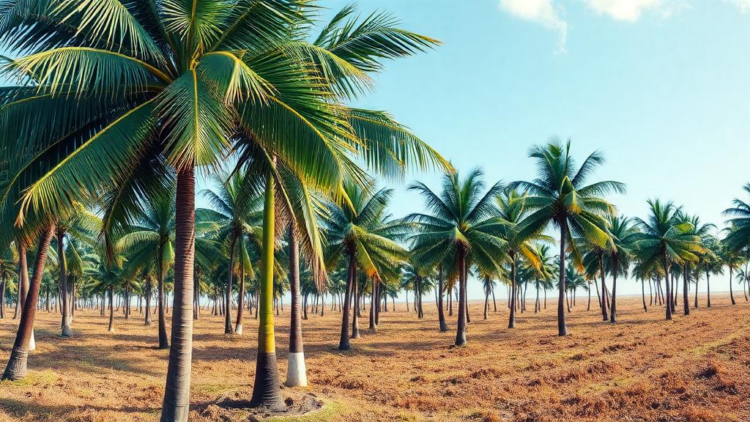
Oil palm plantations feed one of the world’s largest commodity markets, yet the trees that produce the vegetable oil in half the products on supermarket shelves are surprisingly hard to diagnose. Diseases such as basal stem rot, fungal leaf spots, and nutrient deficiencies in nitrogen, phosphorus, and potassium can devastate yields long before symptoms become obvious to the human eye. A new study published in Smart Agricultural Technology proposes an unusual solution: take the cheap, ubiquitous RGB camera that every smartphone and drone already carries, and computationally transform its three-channel images into rich, 31-band hyperspectral data cubes that reveal the hidden biochemistry of a leaf.
The central challenge the researchers confronted is one of the oldest problems in imaging science. A standard RGB photograph compresses the entire visible spectrum into just three broad bands, discarding the subtle reflectance signatures that betray chlorophyll loss, water stress, or the earliest stages of infection. Hyperspectral sensors capture this information across dozens of narrow wavelength bands, but they are expensive, bulky, and impractical to deploy across thousands of hectares of tropical plantation. Simply training a network to map RGB values directly to full spectra, however, is mathematically ill-posed: a three-dimensional RGB vector cannot uniquely determine a high-dimensional spectral signature, so many different plausible spectra correspond to the same photograph, producing unstable and physically inconsistent reconstructions.
The team’s answer was to stop treating spectral reconstruction as a single regression problem and instead decompose it into a sequence of physically meaningful stages. First, a coarse spectral cube is generated from the RGB input as an initial spectral prior, constraining the enormous space of possible solutions. In parallel, a multi-scale feature cube is extracted using a Multi-scale Atrous Convolutional Residual Network, capturing textures, edges, and structural patterns that provide contextual evidence when similar colors could mean different things. The visible spectrum, spanning 400 to 700 nanometers, is reconstructed first because it is most directly constrained by the RGB observation. The near-infrared bands, from 700 to 950 nanometers, which carry critical information about internal leaf structure and water status, are then estimated using the refined visible representation together with the spatial features. Finally, the visible and near-infrared sub-cubes are concatenated into a complete 3D hyperspectral cube with 31 spectral bands.
But richer data alone was not enough. Like most real-world agricultural datasets, the oil palm leaf collection used in the study, drawn from a public repository of 7,312 images across five health classes, was severely imbalanced. Potassium deficiency accounted for 4,076 samples while brown spot disease had only 475, a majority-to-minority ratio of roughly 8.6 to 1. Conventional fixes like random oversampling or simple geometric augmentation fail here because they cannot capture the complex distribution of high-dimensional spectral data. The researchers therefore built an imbalance-aware 3D Generative Adversarial Network that operates directly on volumetric spectral cubes. Its generator is conditioned on minority-class labels, so synthetic samples are produced preferentially for the rare conditions, while a class-weighted adversarial objective penalizes errors on underrepresented classes more heavily. Signed Distance Function representations add structural regularization, encouraging smooth spatial-spectral transitions and guarding against the twin failure modes of GAN training: overfitting and mode collapse.
The quality of the synthetic samples was assessed quantitatively using two complementary metrics. Spectral Angle Mapper values, which measure the angular similarity between real and generated spectral signatures, averaged just 2.609 degrees across the five classes, ranging from 2.409 degrees for healthy leaves to 2.813 degrees for brown spot. Fréchet Inception Distance scores, which quantify how closely the distribution of synthetic samples matches the real data, averaged 5.080, with healthy leaves again scoring best at 4.088. These consistently low values indicate that the generated cubes preserved the class-specific spectral characteristics rather than drifting into unrealistic territory, and visualization of the learned feature space showed compact, well-separated clusters emerging by the later training epochs.
The balanced, spectrally enriched cubes then feed into the final stage of the pipeline: a 3D Convolutional Neural Network. Unlike conventional 2D networks that process only spatial information, 3D convolutions slide across height, width, and wavelength simultaneously, allowing the model to learn joint spatial-spectral features. The architecture uses three successive convolutional blocks with 3 by 3 by 3 kernels, increasing from 32 to 64 to 128 filters, each followed by max-pooling. The first block captures local intensity variations and short-range spectral relationships, the second assembles these into texture patterns and spatial-spectral interactions, and the third produces abstract, class-discriminative representations that a fully connected layer maps to the five output classes: brown spot, white scale, healthy, nitrogen deficiency, and potassium deficiency.
The results were evaluated against six benchmark models, including Mask R-CNN, a DenseNet-based classifier, a Firefly Algorithm-optimized support vector machine, the CoDet pipeline, the BEiT vision transformer, and the lightweight DLMC-Net. The proposed framework achieved the lowest root mean square error in every class, recording 0.112 for healthy leaves, 0.128 for brown spot, 0.124 for white scale, 0.121 for nitrogen deficiency, and 0.116 for potassium deficiency. Coefficients of determination followed the same pattern, reaching 0.930 for healthy and potassium-deficient leaves, while ratios of performance to deviation peaked at 2.946 for the healthy class, well above the best competitor’s 2.444. An ablation study confirmed that no single component was sufficient on its own: reconstruction, generative balancing, and volumetric classification each contributed, and only their integration delivered the lowest errors and most stable convergence across all leaf conditions.
Statistical testing reinforced the picture. Paired t-tests across the five health classes found that the proposed method’s improvements in accuracy, precision, recall, and F1-score were significant against every benchmark at the 0.05 level, with 95 percent confidence intervals for the mean differences remaining entirely above zero. The margins were largest against Mask R-CNN and DnCNN and narrowest against the strongest competitors, BEiT and DLMC-Net, but even those smaller gaps remained statistically significant. The authors are careful to note an important caveat, however: the benchmarks were originally designed for RGB imagery, so the comparison primarily demonstrates that reconstructed spectral information adds discriminative value over conventional color-based approaches, rather than proving superiority over models fed directly acquired hyperspectral data from real sensors.
That distinction points to the framework’s main limitations. Because the hyperspectral cube is estimated rather than measured, its fidelity is ultimately bounded by the information contained in three RGB channels, and reconstruction errors may propagate into classification. Variations in illumination, camera characteristics, cultivar, geography, and disease presentation could all shift the distribution the model was trained on, and the study did not include dedicated robustness experiments with sensor noise, occlusion, or field lighting changes. The computational cost is also nontrivial, combining spectral reconstruction, adversarial training, and 3D convolutions, which the authors acknowledge may require model compression and lightweight variants before deployment on drones or edge devices becomes practical.
Even with those caveats, the work represents a compelling step toward democratizing spectral agriculture. If a hyperspectral-grade diagnosis can be extracted from an ordinary photograph, the barrier to monitoring vast plantations drops from the cost of specialized optics to the cost of computation. The researchers outline a roadmap that includes validating the reconstruction against directly acquired hyperspectral measurements under matched conditions, extending the dataset to more diseases and environments, exploring diffusion models for even higher-quality synthetic augmentation, and developing edge-optimized versions for real-time UAV and IoT monitoring. For an industry in which early detection of a single disease can save millions of dollars in lost yield, teaching cheap cameras to see what only expensive sensors could see before may prove one of the more consequential ideas in precision farming.
Subject of Research: RGB-driven hyperspectral reconstruction with imbalance-aware 3D GAN and 3D CNN for oil palm health assessment
Article Title: A novel RGB-driven 3D spectral representation learning framework with imbalance-aware 3D GAN and 3D CNN for oil palm health assessment
Article References: Hartono, Zuhanda, M. K., Syah, R., Ongko, E., Kuswardani, R. A., & Suswati (2026). A novel RGB-driven 3D spectral representation learning framework with imbalance-aware 3D GAN and 3D CNN for oil palm health assessment. Smart Agricultural Technology, 15, Article 102590. https://doi.org/10.1016/j.atech.2026.102590
Image Credits: AI Generated
DOI: 10.1016/j.atech.2026.102590
Keywords: oil palm, hyperspectral imaging, spectral reconstruction, 3D GAN, 3D CNN, class imbalance, plant disease detection, precision agriculture, deep learning, RGB imagery, nutrient deficiency, smart farming
Cite Scienmag News
APA MLA Chicago
Alan Morgan. (October 3, 2026). AI Turns Ordinary RGB Photos Into Hyperspectral Cubes to Diagnose Sick Oil Palms. Scienmag. https://scienmag.com/ai-turns-ordinary-rgb-photos-into-hyperspectral-cubes-to-diagnose-sick-oil-palms/
Alan Morgan. “AI Turns Ordinary RGB Photos Into Hyperspectral Cubes to Diagnose Sick Oil Palms.” Scienmag, 3 October 2026, https://scienmag.com/ai-turns-ordinary-rgb-photos-into-hyperspectral-cubes-to-diagnose-sick-oil-palms/. Accessed 3 October 2026.
Alan Morgan. “AI Turns Ordinary RGB Photos Into Hyperspectral Cubes to Diagnose Sick Oil Palms.” Scienmag. October 3, 2026. https://scienmag.com/ai-turns-ordinary-rgb-photos-into-hyperspectral-cubes-to-diagnose-sick-oil-palms/
Copy citation Download RIS
Tags: 3D CNN3D GANaffordable plant health assessment toolsAI-based plant disease diagnosisclass imbalancecost-effective hyperspectral imaging solutionsdeep learningdetecting nutrient deficiencies in cropsdrone-based crop monitoringearly detection of plant diseaseshyperspectral imaginghyperspectral imaging in agricultureimaging science for agricultural applicationsmachine learning in precision agriculturenutrient deficiencyoil palmplant disease detectionprecision agricultureremote sensing for oil palm healthRGB imageryRGB to hyperspectral data conversionSmart farmingspectral analysis of leaf biochemistryspectral reconstruction